A world record from the Revillagigedos
The all-tackle world record is 37 lb 9 oz (17.05 kg), caught by Tom Pfleger at Isla Clarión, Revillagigedo Islands, Mexico, on November 21, 1991. It has stood for more than 30 years.
Source ↗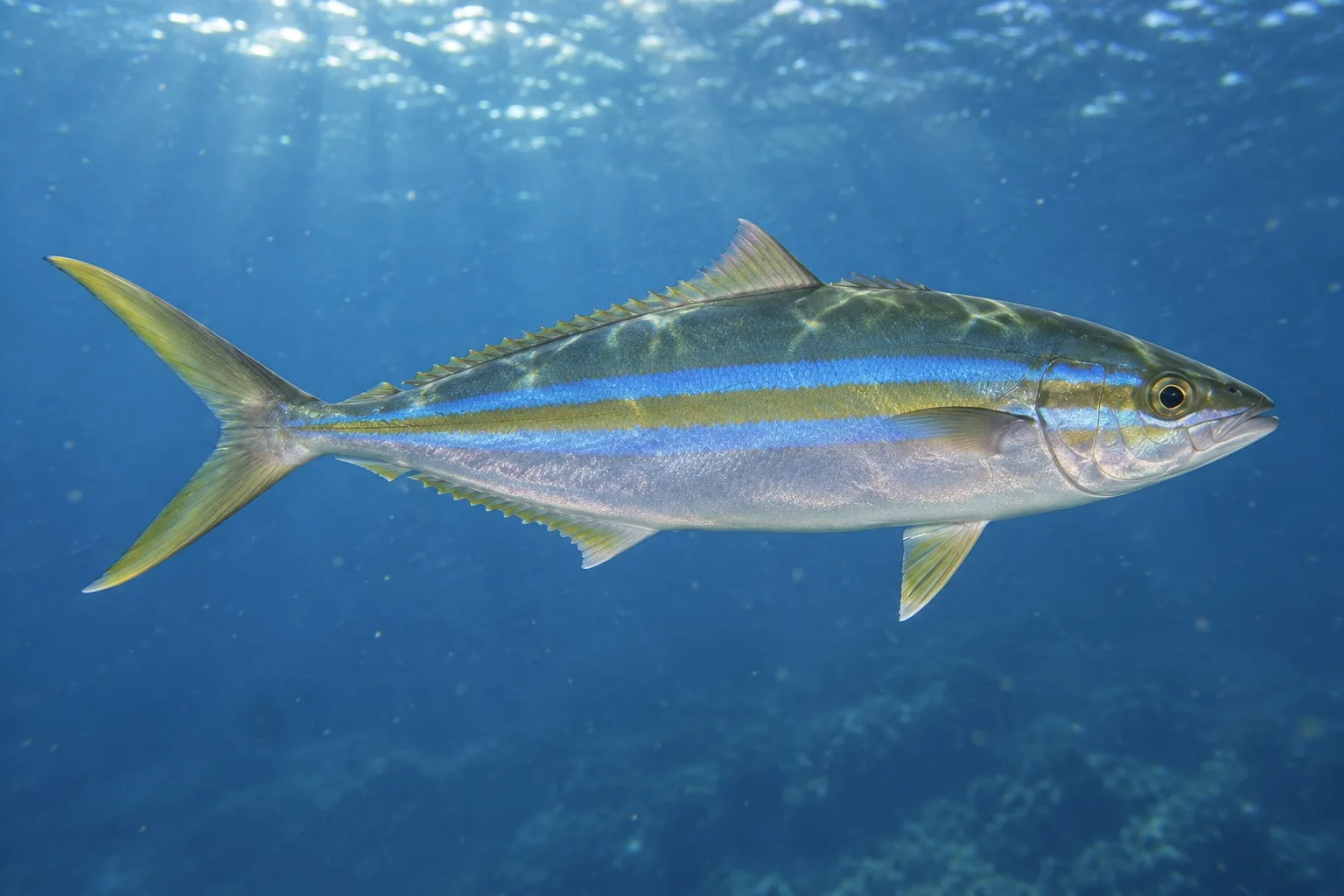
Anglers call it rainbow yellowtail or even Hawaiian salmon, but it’s a jack, the only species in its genus. It wears blue and yellow stripes, carries two tiny detached finlets, and its all-tackle world record comes from Mexico’s Revillagigedo Islands.
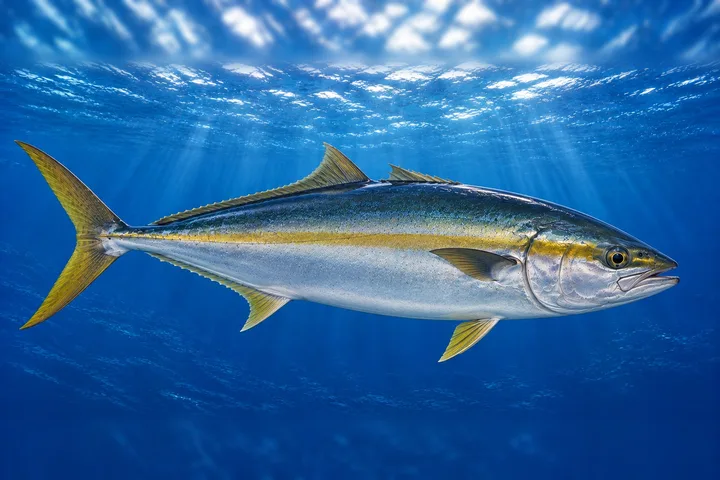
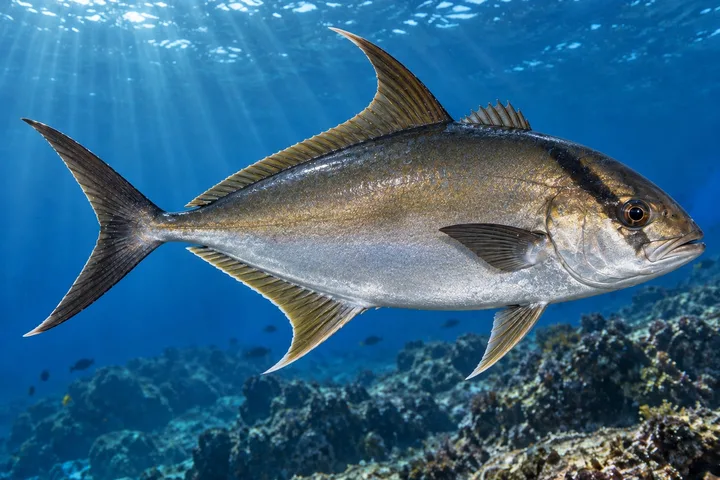
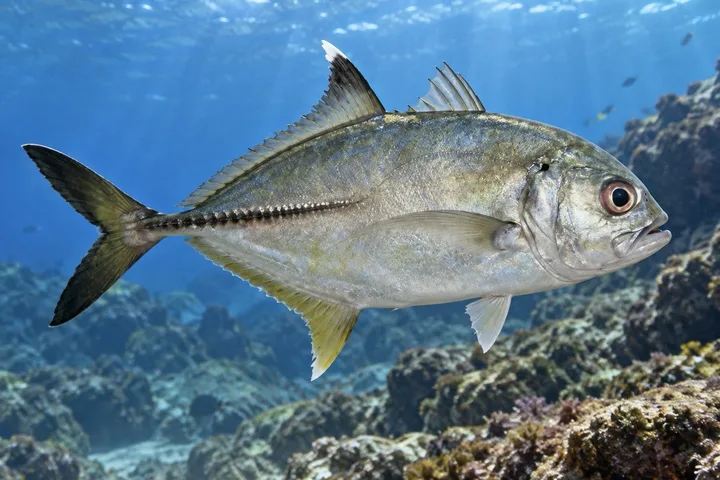
Long, slender, torpedo-shaped body with a pointed snout and a small mouth that ends well before the eye. Dark olive-green to blue above and white below, with two narrow light blue stripes along each side and a broader olive or yellow stripe between them; the fins are olive or yellowish. Behind the second dorsal fin and behind the anal fin sits a detached finlet of two rays. The tail is deeply forked on a slender, notched base, and there are no hard scutes along the lateral line.
The rainbow runner lives in tropical and subtropical seas around the world: from Massachusetts to Brazil, off West Africa, throughout the Indo-Pacific, and rarely in the Mediterranean off Genoa. In the eastern Pacific it ranges from the mouth of the Gulf of California to Ecuador, including the Galápagos and other oceanic islands. It’s an open-water fish, found near the surface over reefs or far offshore around floating logs and debris, from the surface to 150 m but usually 2 to 10 m deep, and it can form large schools.
It feeds mainly on the larger crustaceans of the zooplankton, plus small fish and squid. Its eggs float in the open sea. It commonly reaches 80 to 90 cm, matures at about 65 cm and grows to 180 cm; the oldest reported fish was 6 years old. The heaviest on record weighed 17.05 kg.
The all-tackle world record is 37 lb 9 oz (17.05 kg), caught by Tom Pfleger at Isla Clarión, Revillagigedo Islands, Mexico, on November 21, 1991. It has stood for more than 30 years.
Source ↗Despite names like rainbow yellowtail and Hawaiian salmon, it belongs to the jack family, Carangidae, and is the only species in its genus, Elagatis.
Source ↗In the western Indian Ocean, scientists tagged 24 rainbow runners at drifting fish aggregating devices. One stayed with the same floating object for almost 85 days, and survival models put the average stay at about 94 days.
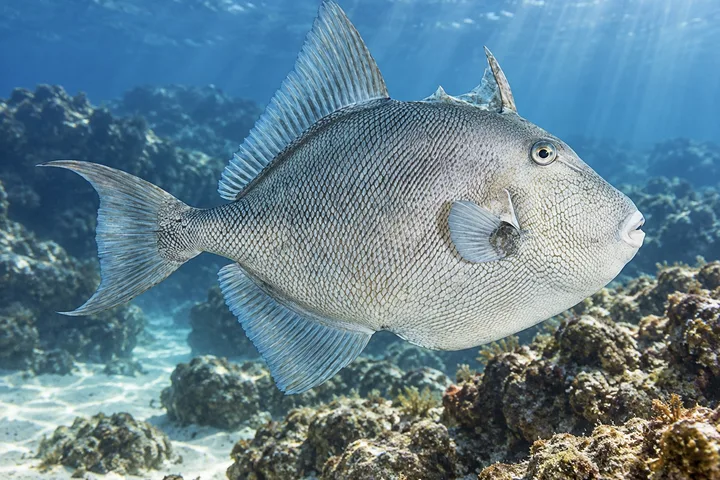
Source ↗Tagged rainbow runners made short daytime excursions of under two hours away from their floating object and returned, more often than oceanic triggerfish did. Ambient light seemed to switch the behavior on and off.
Source ↗For a fish that reaches 180 cm, its diet is surprising: mainly the larger crustaceans of the zooplankton, plus small fish.
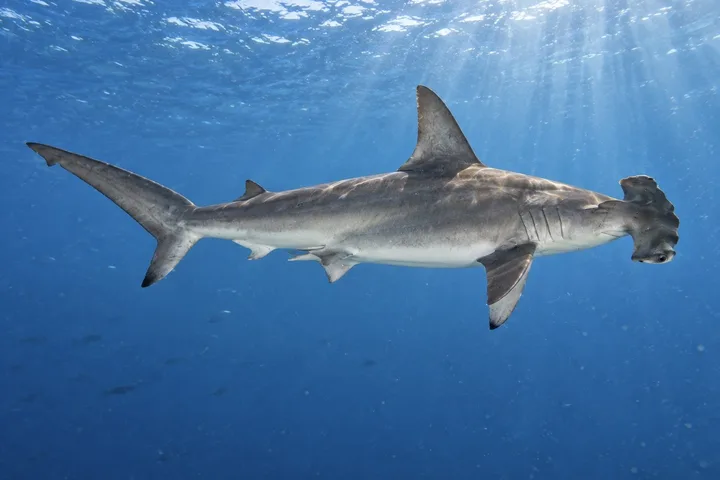
Source ↗Young rainbow runners have been seen swimming with large sharks, alongside pilotfish. They also gather around floating rafts and debris.
Source ↗Local reports from Gordo Banks Pangas in San José del Cabo, published since 2010, mention rainbow runners mostly from September to December, with the best weekly counts in October and November and almost none from April to July. The fleet notes they gather on the high spots and prefer warm water. They come from the same banks and rock piles that hold the yellowfin tuna, such as the Gordo Banks, the Iman Bank and the structure north of Punta Gorda, mixed with amberjack, snapper and grouper.
Most are caught on yo-yo jigs or on strips, chunks and live bait drifted over the structure. The same reports say most local fish run under 5 lb, with some up to 15 lb; in October 2025 a 25-pounder took a slow-trolled live bulito. Offshore, rainbow runners are also among the fish that gather under drifting objects with dorado and tuna.
A good food fish, sold fresh, salted, dried and frozen, and used for sashimi. The San José del Cabo fleet calls it good eating (local report). FishBase lists reports of ciguatera.
| Daily limit (NOM-017-PESC-1994) | Up to 5 per angler per day, within the 10-fish total |
|---|---|
| IUCN Red List | Least Concern (2012) |
| IGFA all-tackle record | 37 lb 9 oz (17.05 kg), Isla Clarión, Revillagigedo, 1991 |
| Yellowtail and almaco jack | Different species, each counted separately under the same 5-fish rule |
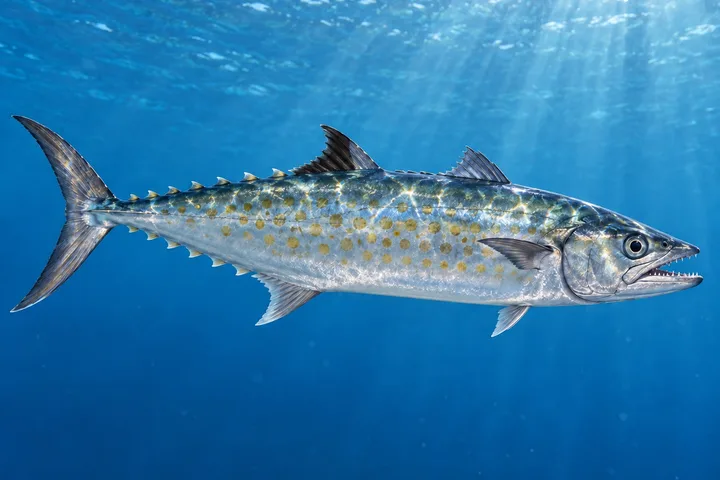
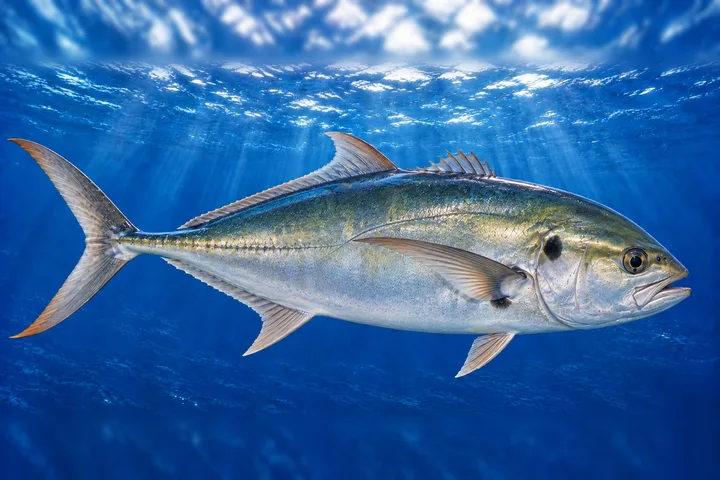
Yellowtail (jurel, Seriola dorsalis) has a bigger mouth that ends under the front edge of the pupil, a single bronze-to-yellow stripe, yellow fins and no detached finlets. Almaco jack (Seriola rivoliana) is deep and arched, with long sickle-shaped dorsal and anal lobes and a dark bar from nape to eye. The rainbow runner has a small mouth that ends well before the eye, light blue stripes on either side of the yellow one, and a two-ray finlet behind the dorsal and anal fins.
How to tell yellowtail, almaco jack and Cabo’s jacks apart ›
Neither. It’s a jack, the only species in the genus Elagatis. Yellowtail are jacks too, but of another genus, and have no detached finlets.
The IGFA all-tackle record is 37 lb 9 oz (17.05 kg), caught at Isla Clarión in Mexico’s Revillagigedo Islands in 1991.
Local reports from the San José del Cabo fleet mention them most from September to December, peaking in October and November.

Top illustration: Top Anglers. Photos: iNaturalist contributors, credited on each photo.
Sportfishers with the range to reach the offshore banks. From $799 with license included.