The Cabo Pulmo tornado
At Cabo Pulmo, bigeye trevally gather by the thousands to mate and reproduce, forming the swirling schools photographed by marine scientist Octavio Aburto.
Source ↗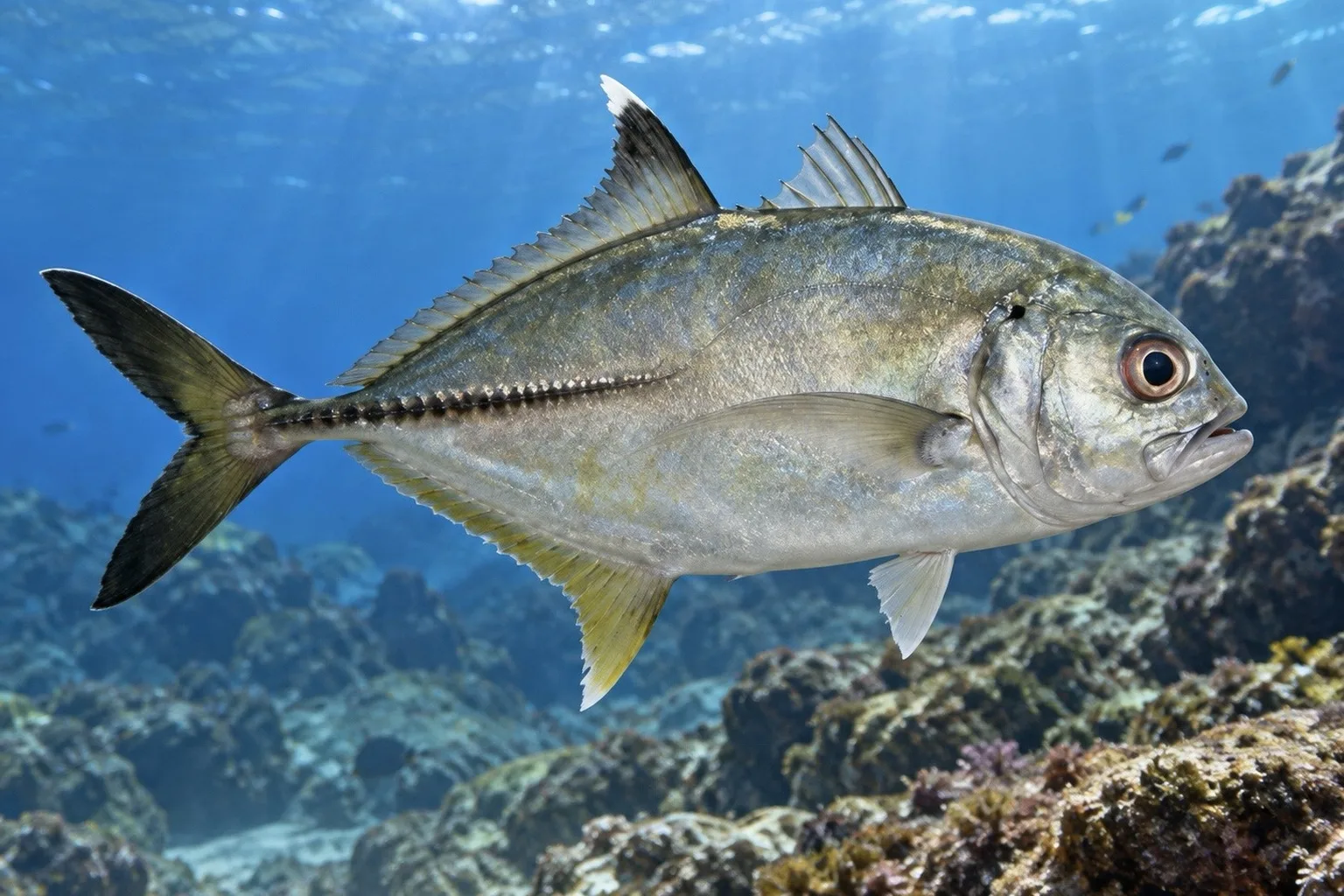
A big-eyed night hunter that spends its days milling in tight schools along the reef. At Cabo Pulmo, thousands gather in a spinning wall of silver that divers call the fish tornado.
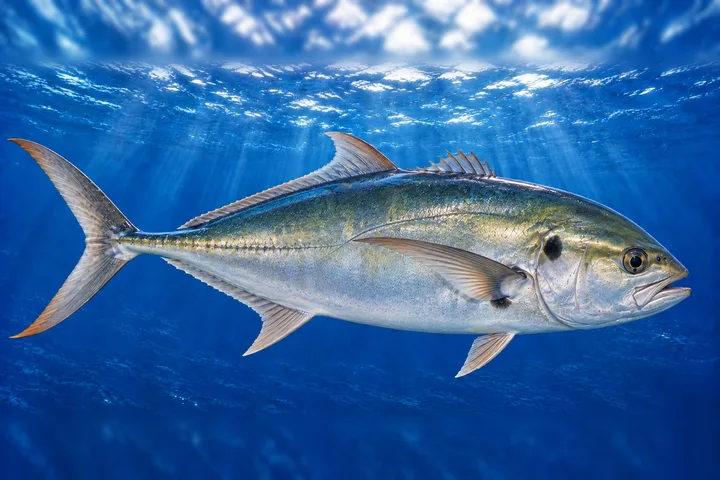
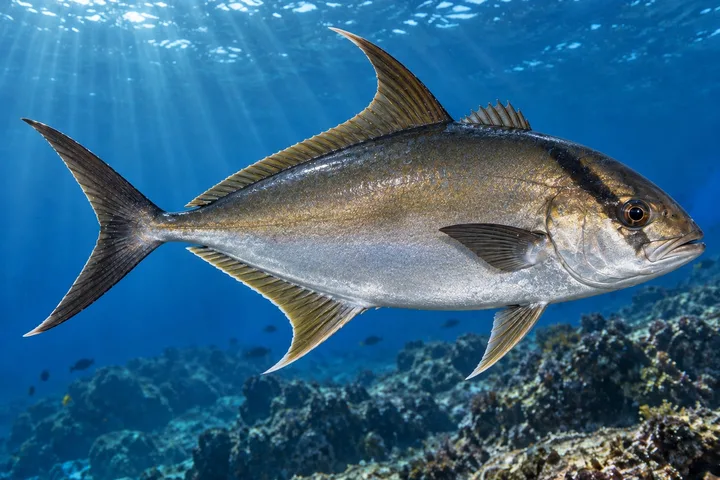
Elongate, compressed silver body, iridescent blue-green on the back. A very large eye with a well-developed fatty eyelid, a dark dorsal-fin lobe with a white tip, a small blackish spot at the top of the gill opening and a row of 27 to 36 strong, usually dark scutes near the tail. The breast is fully scaled. Juveniles are golden yellow with 4 to 7 dark vertical bars.
The bigeye trevally lives across the tropical Indian and Pacific Oceans, from the Red Sea and East Africa to the Americas. In the eastern Pacific it ranges from southwestern Baja California to Ecuador and the Galápagos, including the lower Gulf of California. It’s found on reefs and over soft bottoms, from the surface to about 146 m.
Adults form schools during the day and hunt alone at night, eating mainly fish, squid and crustaceans. Juveniles grow up in estuaries and sometimes enter rivers. It matures at around 42 cm, can live 11 years and has been recorded up to 120 cm and 18 kg.
At Cabo Pulmo, bigeye trevally gather by the thousands to mate and reproduce, forming the swirling schools photographed by marine scientist Octavio Aburto.
Source ↗Cabo Pulmo has been a protected marine park since 1995; about a third is a strict no-take zone, and the community keeps almost all of it free of fishing. Between 1999 and 2009 its fish biomass rose 463%, and its top predators increased about elevenfold.
Source ↗Bigeye trevally school during the day but split up to feed alone after dark. Those oversized eyes are built for hunting in low light.
Source ↗Sexfasciatus means “six-banded” in Latin, after the dark bars on the juveniles. Adults lose them and turn silver.
Source ↗Juveniles grow up in estuaries and occasionally swim up into rivers before moving out to the reefs.
Source ↗It’s one of the Indo-Pacific fish that crossed the whole ocean: the same species lives from East Africa to the Americas, from southern California to northern Peru.
Source ↗Bigeye trevally hold along rocky reefs, points and drop-offs, where schools mill in place during the day. They’re caught as a bonus on inshore trips alongside other jacks and reef fish.
Cast poppers, stickbaits or jigs at the edge of the school, or drift live bait. They hunt hardest in low light, so early mornings tend to be best. Like every jack, it pulls hard and dives for structure, so keep the drag firm. Sport fishing is not allowed inside Cabo Pulmo National Park.
Edible and sold fresh, dried, salted or frozen in its range. FishBase lists reports of ciguatera poisoning for this species.
| Daily limit (NOM-017-PESC-1994) | Up to 5 per angler per day, within the 10-fish total |
|---|---|
| IUCN Red List | Least Concern (2018) |
| IGFA all-tackle record | 31 lb 8 oz (14.3 kg), Poivre Island, Seychelles, 1997 |
| IGFA all-tackle length record | 84 cm, Isla Coiba, Panama, 2011 |
| Cabo Pulmo National Park | Sport fishing not allowed |
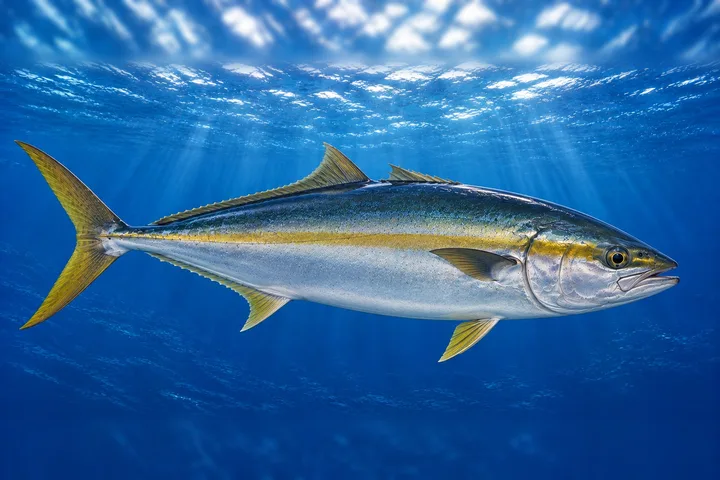
The jack crevalle (toro, Caranx caninus) is deeper-bodied, with a dark blotch on the lower pectoral fin, yellowish tail and anal fins, and a breast that’s mostly scaleless. The bigeye has no pectoral spot, a fully scaled breast and a much larger eye. The almaco jack (Seriola rivoliana) has a dark band running from the eye toward the dorsal fin.
How to tell yellowtail, almaco jack and Cabo’s jacks apart ›
A school of thousands of bigeye trevally swirling together to mate and reproduce. It’s seen by divers inside Cabo Pulmo National Park.
Look at the pectoral fin and the eye. The jack crevalle has a dark spot on the lower pectoral fin; the bigeye doesn’t, and its eye is noticeably larger.
It’s eaten and sold across its range, but FishBase lists reports of ciguatera for this species.

Top illustration: Top Anglers. Photos: iNaturalist contributors, credited on each photo.
Pangas and small boats that work the beaches, points and rocky reefs. From $453 with license included.