Described from Cabo San Lucas
Theodore Gill named the species in 1863 from specimens collected at Cape San Lucas. The lectotype is kept at the Smithsonian (USNM 6393).
Source ↗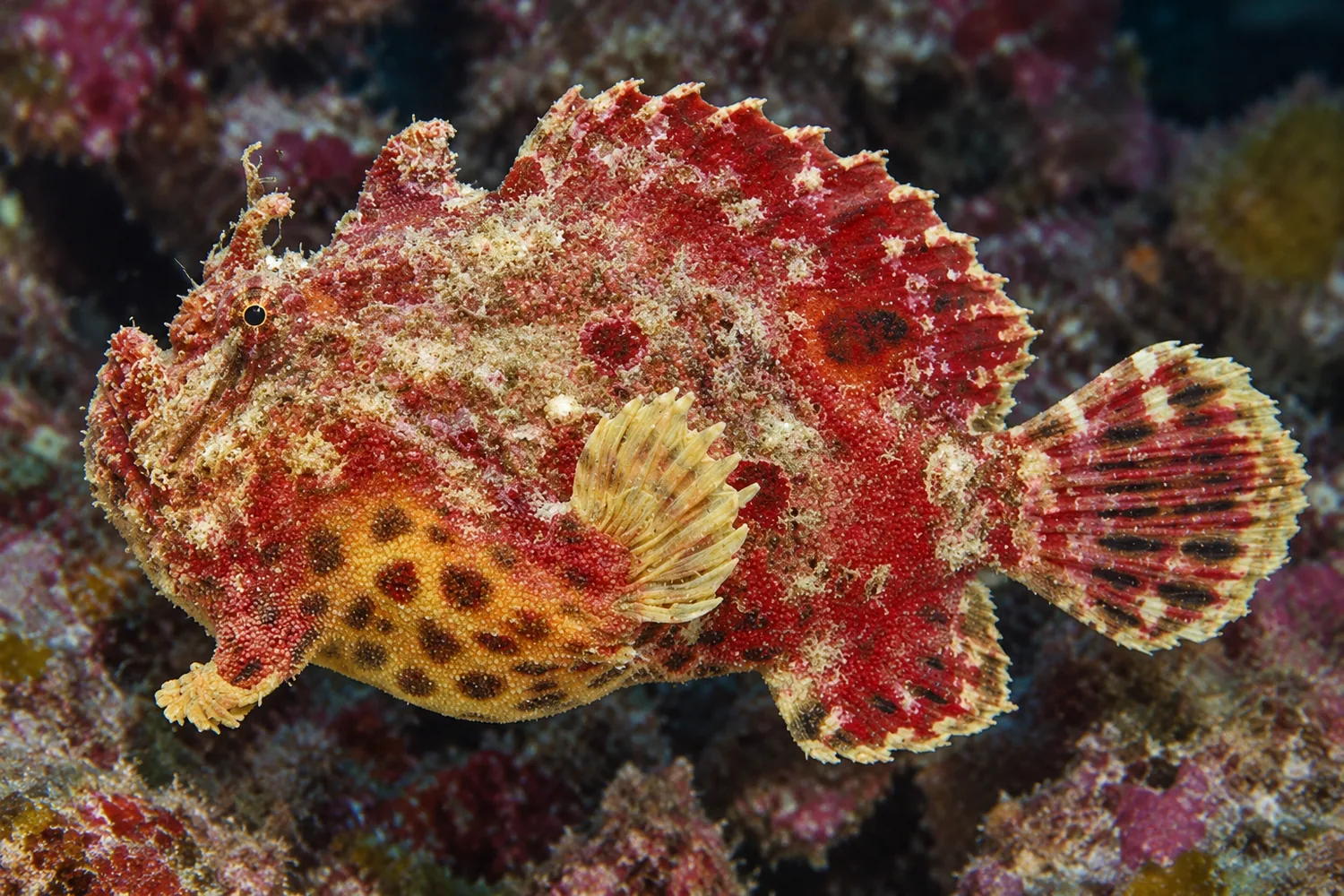
A small, lumpy frogfish that sits still on rocky reefs, disguised as a sponge, and waves a lure on its snout to bring prey within reach. It was first described from Cabo San Lucas in 1863 and is the most common frogfish in the eastern Pacific.
A globe-shaped, slightly compressed fish with rough skin covered in tiny spicules, a very large upturned mouth and limb-like pectoral fins with an 'elbow'. The first dorsal spine is a fishing pole about as long as the second spine, tipped with a tapering lure with thin filaments and a cluster of dark round swellings at its base. Color is yellow or yellow-brown to red, with brown spots and mottling; the belly has conspicuous brown spots, and there is sometimes a faint eyespot or dark round spot below the rear of the dorsal fin. The small round gill opening sits below and behind the base of the pectoral fin.
The sanguine frogfish lives only in the eastern Pacific, from the Gulf of California to Chile, including the Revillagigedo, Clipperton, Cocos, Malpelo and Galápagos islands. It lives on rocky bottoms from about 1 to 40 m, usually above 20 m, tucked into small recesses in the reef and especially along rock walls, where it blends in so well that it looks like an encrusting sponge.
Like all frogfishes it is an ambush hunter: it sits still, waits for small fish and crustaceans to come close and swallows them with its huge mouth. It can also change color to match its background, from yellow to orange, red, violet or brown. It lays eggs, and its biology in the wild is poorly studied.
Theodore Gill named the species in 1863 from specimens collected at Cape San Lucas. The lectotype is kept at the Smithsonian (USNM 6393).
Source ↗In the same 1863 work, Gill also described the bandtail frogfish (Antennatus strigatus) from Cape San Lucas.
Source ↗STRI calls it the most common frogfish in the eastern Pacific.
Source ↗Sanguineus means blood red, for its color in life, but it can be cream, yellow, orange, reddish-brown, brown, lavender or purple.
Source ↗Its first dorsal spine works as a fishing pole, tipped with a lure that has slender filaments and a cluster of dark, round swellings at the base.
Source ↗An underwater photographer writing for REEF noted that the first thing they usually see when finding one is the star-burst pattern of its eye; only then do the mouth, head and body take shape.
Source ↗The sanguine frogfish is a fish for divers and snorkelers, not anglers. Around Los Cabos it sits motionless in holes and on rock walls, so most people swim right past it. Search slowly along ledges and sponge-covered rock and look for an eye or the outline of a mouth.
It is not a sport fish and is almost never hooked. Local records from Los Cabos include specimens brought in by commercial fishermen and one coughed up by a larger fish caught in the area. If you ever find one on a line, put it back. Sport fishing is not allowed inside Cabo Pulmo National Park.
| Mexico (NOM-059-SEMARNAT-2010) | Not listed |
|---|---|
| IUCN Red List | Least Concern (assessed 2008) |
| CITES | Not listed |
| Cabo Pulmo National Park | Sport fishing not allowed |
A dive and snorkel fish. If one is ever hooked, release it.
The bandtail frogfish (Antennatus strigatus), also found around Cabo, has no big brown spots on the belly; it is yellowish to pinkish red with dark marbling, and its third dorsal spine forms a fixed hump bound down by skin. The scarlet frogfish (Abantennarius coccineus) has a speckled belly without large dark spots. The stone scorpionfish (Scorpaena mystes) is also mottled and sits still on the reef, but it has a normal fish shape with a bony, spiny head and venomous fin spines, and no lure.
No. Its standard English name is sanguine frogfish (STRI and the American Fisheries Society); bloody frogfish is also used. 'Pacific frogfish' is not the name STRI or FishBase use for this species.
No. FishBase lists it as harmless to people. It is only about 10 cm long.
Move slowly along rocky walls and ledges at snorkeling to diving depths and look for a round eye or a big upturned mouth in what looks like a patch of sponge. Its brown-spotted belly confirms the ID.

Top illustration: Top Anglers. Photos: iNaturalist contributors, credited on each photo.
Our charters leave the Cabo San Lucas marina every morning. From $698 with license included.