The only one of its kind
The Moorish idol is the only species in its family, Zanclidae.
Source ↗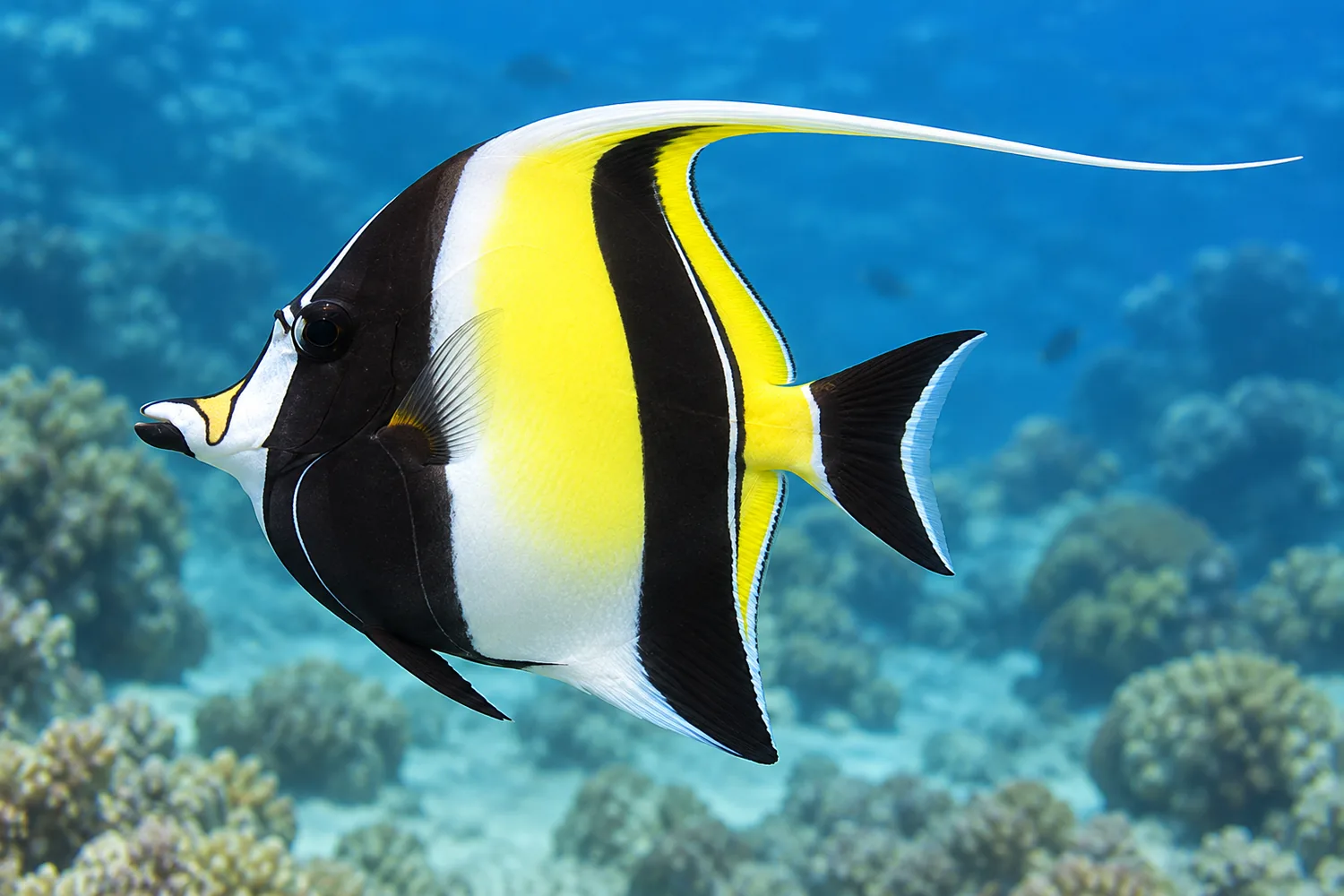
A disc-shaped reef fish with bold black, white and yellow bands, a long tube snout and a white streamer trailing from its back. It lives across most of the tropical Pacific and reaches the southern Gulf of California, but around Los Cabos it is an uncommon sight.
A round, very flat body with a long, slender, pointed snout and a small mouth. Adults have a pair of short bony horns in front of the eyes. The front of the body is white and the rear yellow, with two broad black bars: one from the nape down over the chest, the other across the rear of the body and onto the dorsal and anal fins. The third dorsal spine grows into a long white whip-like filament. On top of the snout there is a black saddle edged in orange. The tail is black with a white rear edge.
The Moorish idol is one of the widest-ranging reef fish on Earth: from East Africa across the Indian and Pacific Oceans to Hawaii, southern Japan and Lord Howe Island, and in the eastern Pacific from the southern Gulf of California to Peru, including all the oceanic islands. Within the Gulf it was long known only from the southern part; in 2018 researchers reported it at the Coronados islands off Loreto and at San Pedro Nolasco in Sonora, about 200 km farther north than before.
It lives on rocky and coral reefs from about 3 m to 182 m. It is usually seen alone, in pairs or in small groups of 2 or 3, and only occasionally in large schools. It uses its long snout to pick small encrusting animals off the reef. Its larvae drift in the open ocean for a long time and only become juveniles at about 7.5 cm, which explains both its huge range and why it looks the same everywhere. At Cabo Pulmo it was rated scarce in fish counts made between 1987 and 1998.
The Moorish idol is the only species in its family, Zanclidae.
Source ↗Zanclus comes from the Greek for sickle, after the curved dorsal fin; cornutus means horned, for the small horns above the eyes of adults.
Source ↗Its larvae spend a long time drifting in the open sea before settling at about 7.5 cm. That is why the same fish, with the same colors, is found from East Africa to Mexico.
Source ↗In 2018 it was reported at the Coronados islands and San Pedro Nolasco, about 200 km north of its known limit in the Gulf of California. The authors see it as part of a trend of tropical fish spreading north, possibly because the Gulf is warming.
Source ↗In fish counts made at Cabo Pulmo from 1987 to 1998 it was rated scarce, at 0.1 to 1% of all fish counted.
Source ↗It is popular in the aquarium trade, but it rarely survives in tanks.
Source ↗The Moorish idol is a fish for snorkelers and divers, not anglers, and around Los Cabos it is a lucky find rather than an everyday sight. Look for it on rocky and coral reefs, alone or in pairs. It is not a sport fish.
Its mouth is tiny and it picks food off the reef, so it is almost never hooked. If one ever comes up, unhook it gently and put it back. Aquarium collectors need a federal fishing permit. Sport fishing is not allowed inside Cabo Pulmo National Park.
| Mexico (NOM-059-SEMARNAT-2010) | Not listed |
|---|---|
| General sport-fishing limit (NOM-017-PESC-1994) | 10 fish per angler per day, no more than 5 of one species |
| Aquarium collection | Needs a federal fishing permit (pesca de fomento, CONAPESCA) |
| IUCN Red List | Least Concern (2015) |
| Cabo Pulmo National Park | Sport fishing not allowed |
Uncommon around Los Cabos. Not a sport fish.
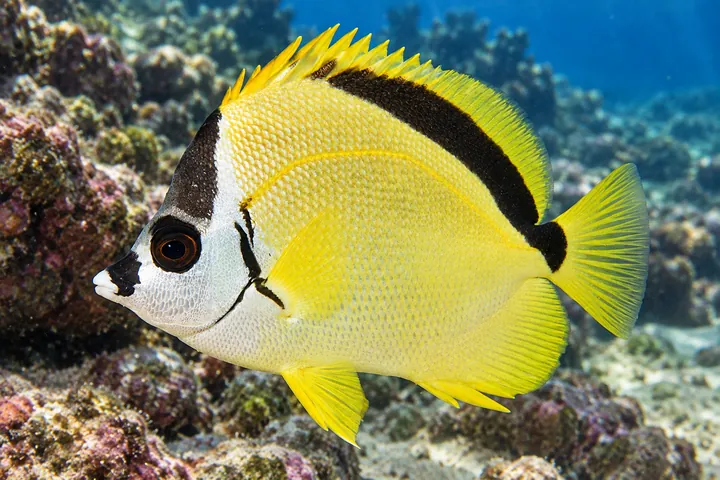
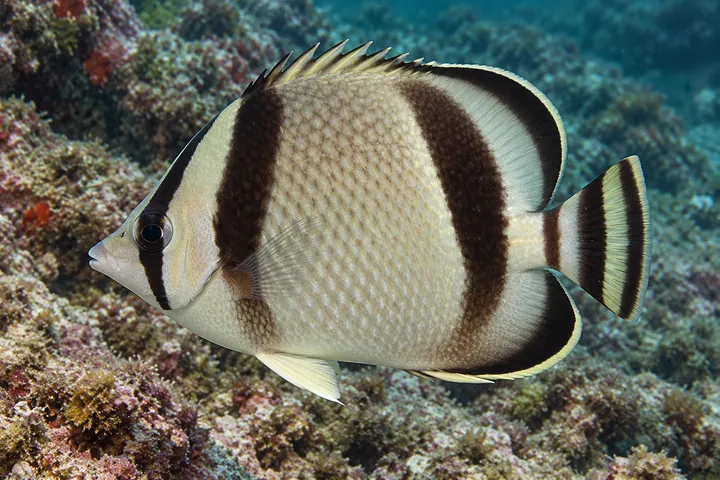
Around Los Cabos nothing else looks quite like it. The threeband butterflyfish (Chaetodon humeralis) also has black bars on a pale body, but it has no yellow, a short snout and no long dorsal filament. The Pacific spadefish (Chaetodipterus zonatus) is silvery with six black bars and a short, blunt snout. In the Indo-Pacific it is often confused with bannerfishes (Heniochus), which have longer bodies and shorter snouts.
Yes, but it is uncommon. Its eastern Pacific range starts in the southern Gulf of California, and at Cabo Pulmo it was rated scarce in long-term fish counts.
Yes. It is one species from East Africa to Mexico, and its colors do not change from place to place.
It is not a sport fish and almost never takes a hook. If one is caught by accident, release it.

Top illustration: Top Anglers. Photos: iNaturalist contributors, credited on each photo.
Our charters leave the Cabo San Lucas marina every morning. From $698 with license included.