A spine that grows back
The spine has no nerves and is replaced every year: a new one starts growing under the old one around June, the old one drops off around August, and a full replacement takes 3 to 4 months.
Source ↗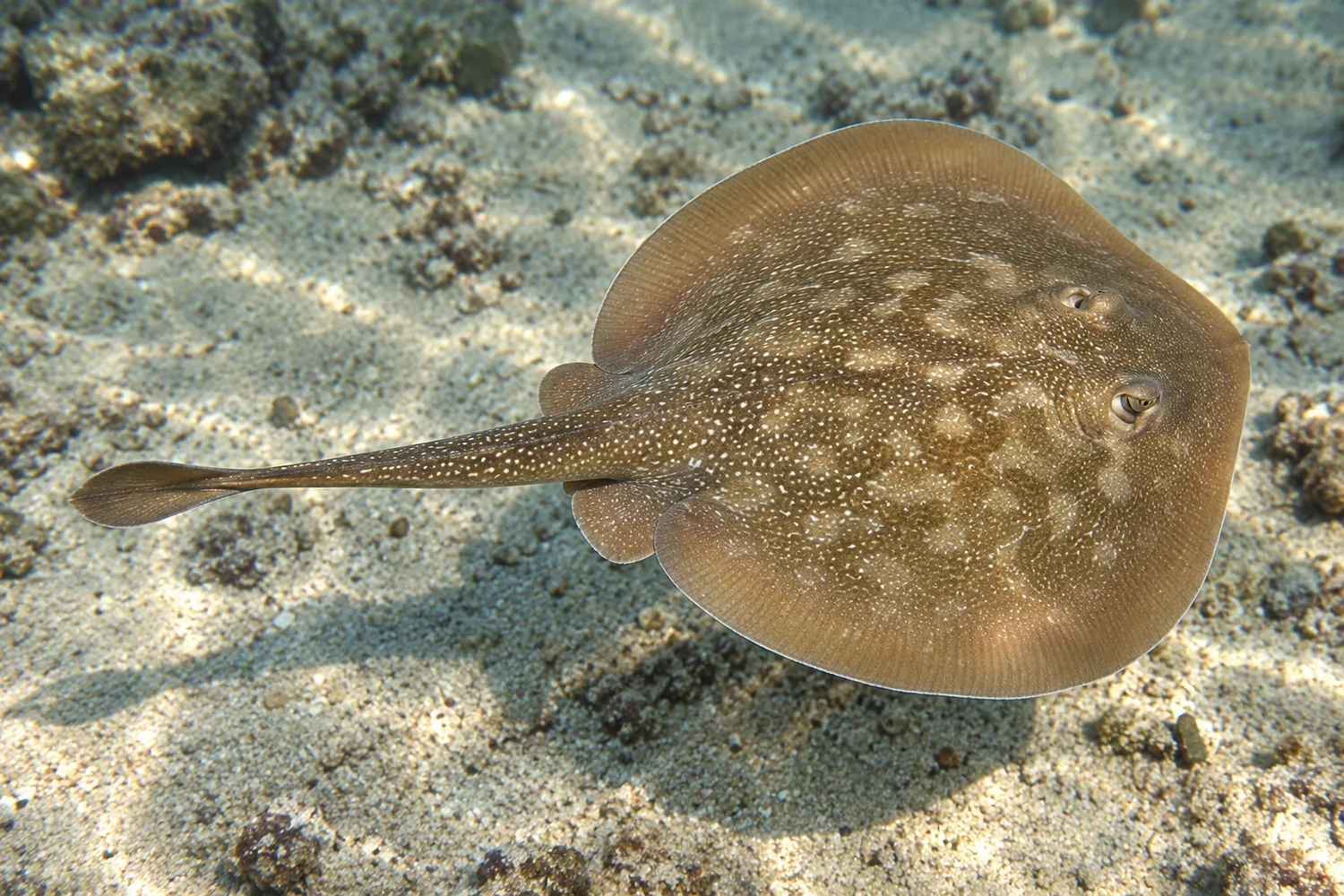
A small, round, sand-colored stingray that lies half-buried on sandy bottoms, often right where people wade. It isn’t aggressive, but stepping on one can drive a barbed tail spine into your foot. Shuffle your feet so it hears you coming and swims off.
A rounded disc, slightly broader than long, with a somewhat angular snout. Light brown or tan on top, with paler blotches in the middle of the disc and the whole back covered in small pale spots and short wiggly lines; some are plain pale brown. The tail is short and thick, less than half the total length, with a large serrated spine on top and a rounded tail fin at the tip. The skin is smooth, with no thorns.
Round stingrays live in the eastern Pacific from northern California to Ecuador, on sand, mud and rubble, often near reefs or seagrass and usually shallower than 15 m, though they reach about 90 m. In Mexico they are recorded along the whole Pacific coast, including fish caught from shore at Los Barriles and by commercial fishermen of the greater Los Cabos area. They often cover their backs with sand while resting and feed on bottom crustaceans, worms, clams and snails, octopus and small fish.
Most of what is known about their life comes from Southern California. There, mating peaks from May to July, pregnancy lasts only 3 to 4 months, and litters of 1 to 6 pups are born from August to November. They mature at about 4 years, at roughly 15 cm across, and can live 14 years or more. Each year they shed and regrow the tail spine.
The spine has no nerves and is replaced every year: a new one starts growing under the old one around June, the old one drops off around August, and a full replacement takes 3 to 4 months.
Source ↗At Seal Beach, California, nicknamed “Ray Bay”, hundreds of stingray injuries are reported each summer, mostly in the afternoon, at lower tide and in warmer water.
Source ↗In the Seal Beach studies most rays were within about 30 m of shore.
Source ↗Roughly 750 to 2,000 stingray injuries are reported in the United States each year.
Source ↗Pregnancy lasts only 3 to 4 months, one of the shortest of any shark or ray.
Source ↗Nobody targets round stingrays in Los Cabos; they turn up when you fish bait on sandy bottoms from shore or close to it. If you catch one, keep your hands away from the tail, unhook it with pliers or cut the leader close to the hook, and let it go. Sport fishing for rays isn’t allowed during the Pacific ray closed season (May 1 – July 31), and Mexican rules don’t allow sport fishing within 250 m of beaches used by swimmers.
On sandy beaches, shuffle your feet instead of stepping: the vibration warns buried rays and they swim away. If you’re stung, get out of the water, tell a lifeguard, rinse the wound and soak it in water as hot as you can stand without burning, about 43–46 °C (110–115 °F), for 30 to 90 minutes or until the pain eases. Test the water with your other hand, because the stung area may feel less. Then clean the wound and watch it for infection. Get medical help right away if the spine went into the chest, belly, neck or throat (don’t pull it out), if you feel faint, short of breath or your heart races, or if a piece of spine may still be in the wound; see a doctor later if the wound gets red, swollen or oozes, and check that your tetanus shot is up to date.
| Daily limit (NOM-017-PESC-1994) | Max 10 fish per angler per day, no more than 5 of one species |
|---|---|
| Closed season (Pacific) | All rays, May 1 – July 31; no ray fishing during the closure |
| Near beaches (NOM-017) | No sport fishing within 250 m of beaches used by swimmers |
| Mexico (NOM-059) | Not listed |
| IUCN Red List | Least Concern (2024) |
| Cabo Pulmo National Park | Sport fishing not allowed |
Shuffle your feet when wading on sandy beaches.
The Cortez round stingray (Urobatis maculatus) is brown or gray-brown with scattered dark brown to blackish blotches and spots, not pale ones, and reaches about 42 cm. The reef stingray (U. concentricus), photographed on Cabo San Lucas reefs, is light gray with dark spots in rough concentric rows and two pale-and-dark stripes around the edge of the disc. The dwarf round ray (Urotrygon nana) is smaller, about 26 cm, with a fine darker mesh pattern and a slender tail longer than its disc. The diamond (whiptail) stingray is much larger, dark brown, with a long tail and no tail fin.
Leave the water and tell a lifeguard, rinse the wound, and soak it in water as hot as you can stand without burning (about 43–46 °C, 110–115 °F) for 30 to 90 minutes. Go to a doctor or emergency room if the spine hit the chest, belly or neck, if you feel unwell, if part of the spine may be in the wound, or if the wound later looks infected.
Sliding your feet along the sand instead of taking steps when you wade. The vibration warns buried rays, which swim off instead of being stepped on.
No. They sting only in self-defense, almost always when someone steps on or grabs them.

Top illustration: Top Anglers. Photos: iNaturalist contributors, credited on each photo.
Pangas and small boats that work the beaches, points and rocky reefs. From $698 with license included.