The Colola comeback
In the 1960s about 25,000 females nested in Michoacán. Decades of protection later, 86,000 nests were counted on Colola Beach alone in 2021–22, from roughly 28,000 females.
Source ↗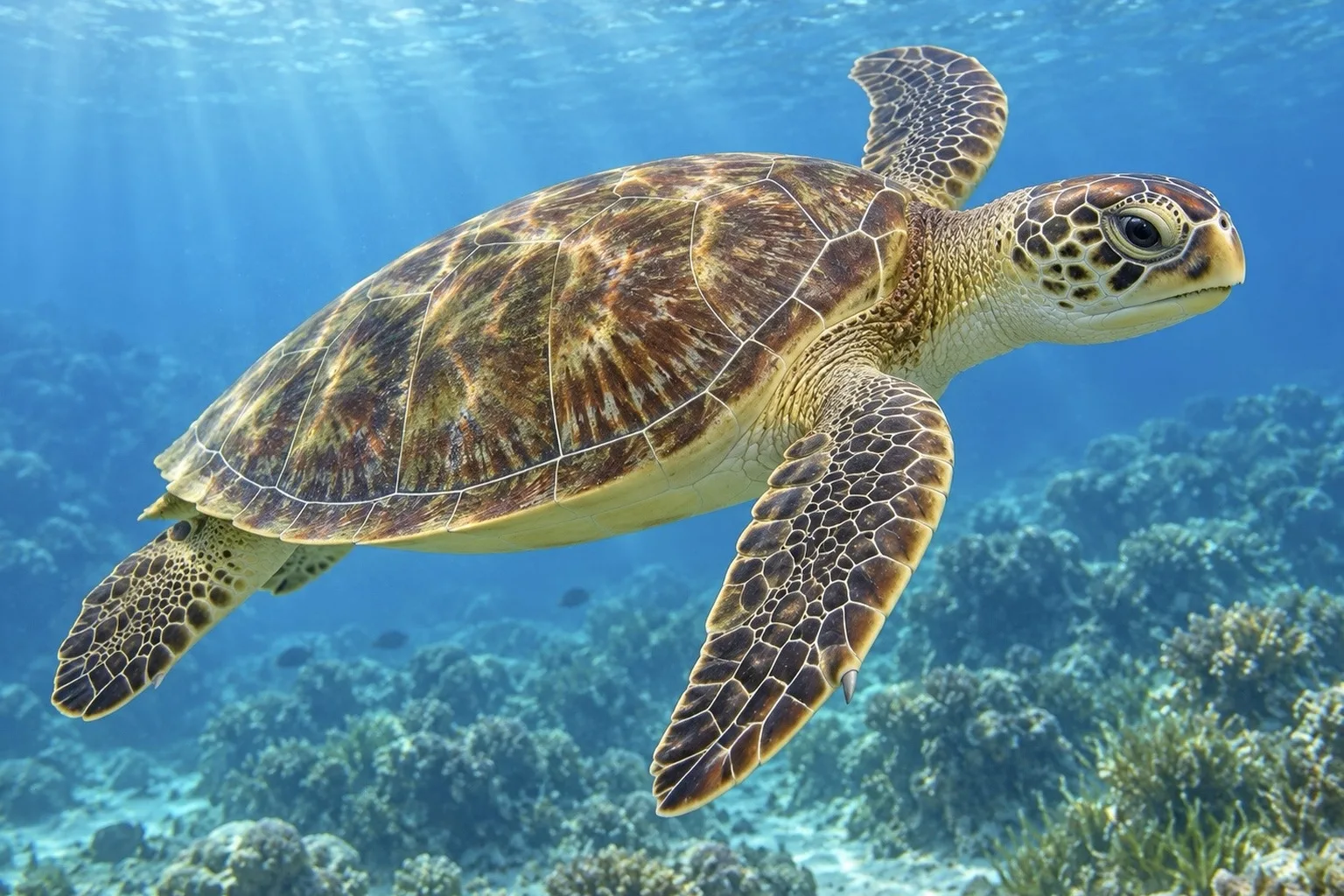
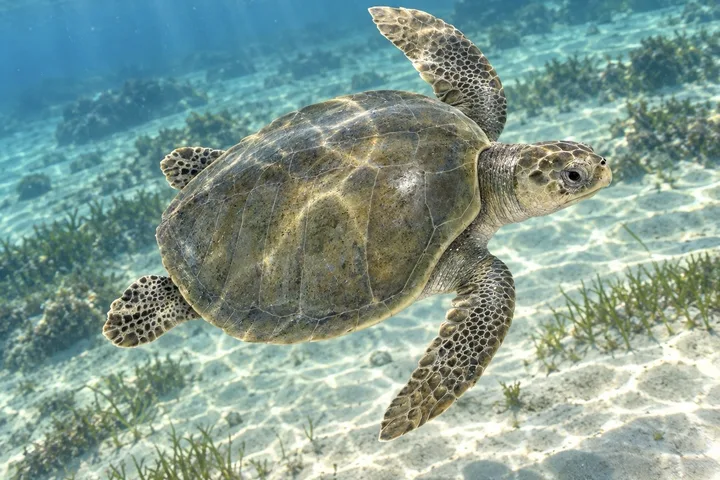
The Pacific’s darker green turtle grows up in the bays and lagoons of Baja California Sur and nests mainly in Michoacán. Hunted almost to collapse in the 20th century, it’s now one of the comeback stories of the Mexican Pacific.
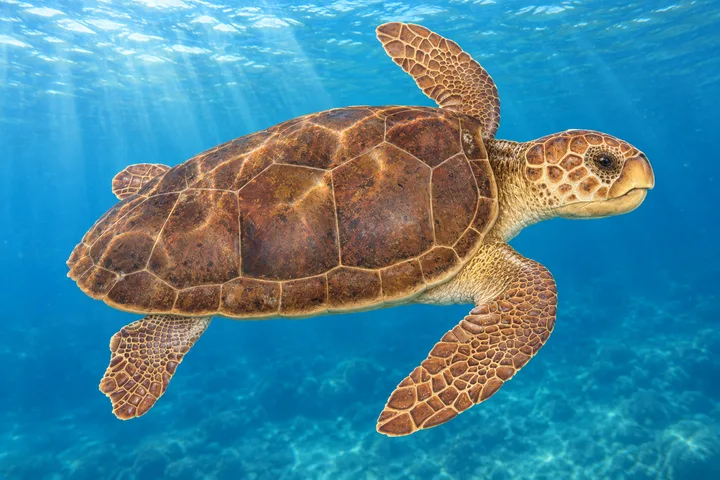
A smooth, heart-shaped shell, dark olive-gray to almost black in East Pacific turtles, with four scutes along each side that don’t overlap. Small rounded head with a single pair of large scales between the eyes and a serrated lower jaw. One claw (sometimes two) on each front flipper.
The black turtle ranges from Baja California to Peru and out to the Galápagos. Its main nesting beaches are Colola and Maruata in Michoacán, where females lay from August to January, about every three years. Satellite tags have followed females 1,337 to 2,928 km from feeding grounds in the Gulf of California, along the Baja coast, to their nesting beaches.
Young turtles eat both animals and plants; adults are mostly vegetarian, grazing on algae and seagrass. Juveniles can spend up to 20 years in bays like Bahía Magdalena before maturing at about 77 cm, and females take 25 to 35 years to reach breeding age. In the early 1970s, turtles were found overwintering near Isla Tiburón in the Gulf, lying motionless on the bottom at 10 to 30 m.
In the 1960s about 25,000 females nested in Michoacán. Decades of protection later, 86,000 nests were counted on Colola Beach alone in 2021–22, from roughly 28,000 females.
Source ↗Around 1900, about 1,000 black turtles a month were shipped from Baja’s Pacific coast to San Diego and San Francisco. From 1956 to 1963 they were the core of Mexico’s turtle fishery, with 3,430 tons landed.
Source ↗In Bahía Magdalena, juveniles grow about 1.6 cm a year, three times faster in summer than in winter, and may stay up to 20 years before leaving to breed.
Source ↗Halibut and guitarfish gill nets in Laguna San Ignacio drowned at least 1,172 turtles a year in 2006–2008. In 2009, with patrols and nets checked every 30 minutes, strandings fell more than 97%.
Source ↗Black turtle nesting in Los Cabos was first officially reported only in 2002. Since then hatchings have become more common, mostly on the East Cape.
Source ↗The name comes from the greenish color of its fat, not its shell. And while adults are mainly vegetarian, East Pacific turtles eat more animal prey than other green turtle populations.
Source ↗Black turtles gather mainly in the shallow feeding bays and lagoons farther north, like Magdalena Bay and San Ignacio, and in the Gulf of California. Around Cabo they’re an occasional sighting, sometimes resting or basking at the surface. Slow down, keep your distance and never chase or touch one.
If a turtle takes a bait, don’t yank it or haul it up by the line. Bring it alongside slowly; if it’s small enough, lift it with a net or by the shell, keeping hands away from its mouth and flippers. Otherwise cut the line as short as possible and let it go. By law, every turtle goes back in the water, and injured or entangled turtles can be reported to PROFEPA.
| Mexico (NOM-059) | In danger of extinction (P) |
|---|---|
| Total ban since 1990 (DOF) | No catching, chasing, disturbing or harming sea turtles, and no taking eggs. Turtles caught by accident must go back in the water |
| Federal Penal Code, art. 420 | 1 to 9 years in prison for capturing, harming or killing a sea turtle or taking its products |
| Nesting beaches (NOM-162-SEMARNAT-2012) | Stay at least 10 m from a turtle until she starts laying; no lights (only the guide may use a red-filtered lamp) |
| IUCN Red List | Least Concern globally (2025); East Pacific subpopulation: Vulnerable |
| U.S. Endangered Species Act | East Pacific population listed as Threatened (2016) |
| CITES | Appendix I: no international trade |
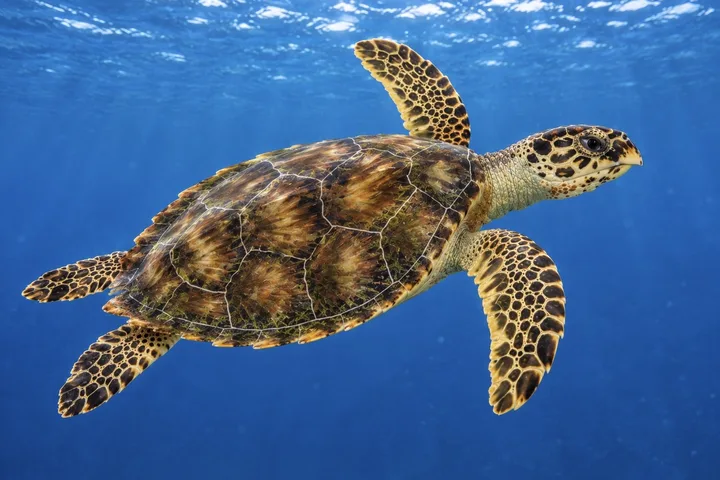
The olive ridley is smaller, with a rounder, olive shell and usually five or more scutes along each side. The hawksbill has overlapping scutes and a pointed, hawk-like beak, and the loggerhead has a very large head and a reddish-brown shell with five side scutes. The green turtle is the one with four side scutes and a small, rounded head.
It was once named Chelonia agassizii, but today it’s considered the East Pacific population of the green turtle, Chelonia mydas.
No. All sea turtles have been under a total ban since 1990. Catching, harming or killing one, or taking its eggs or meat, is a federal crime.
Don’t pull it up by the line. Bring it in slowly, lift it with a net or by the shell if it’s small, or cut the line as short as possible and release it.

Top illustration: Top Anglers. Photos: iNaturalist contributors, credited on each photo.
Our charters leave the Cabo San Lucas marina every morning. From $453 with license included.