Giant pavona (Pavona gigantea), illustration
Wildlife Pavona gigantea

Giant pavona in Los Cabos

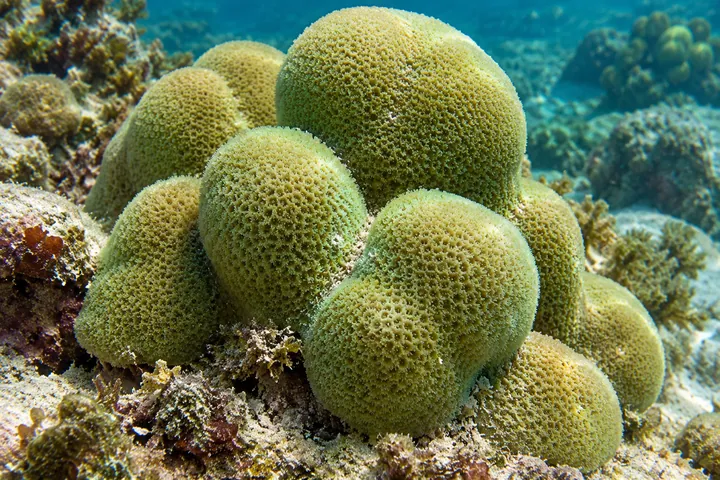
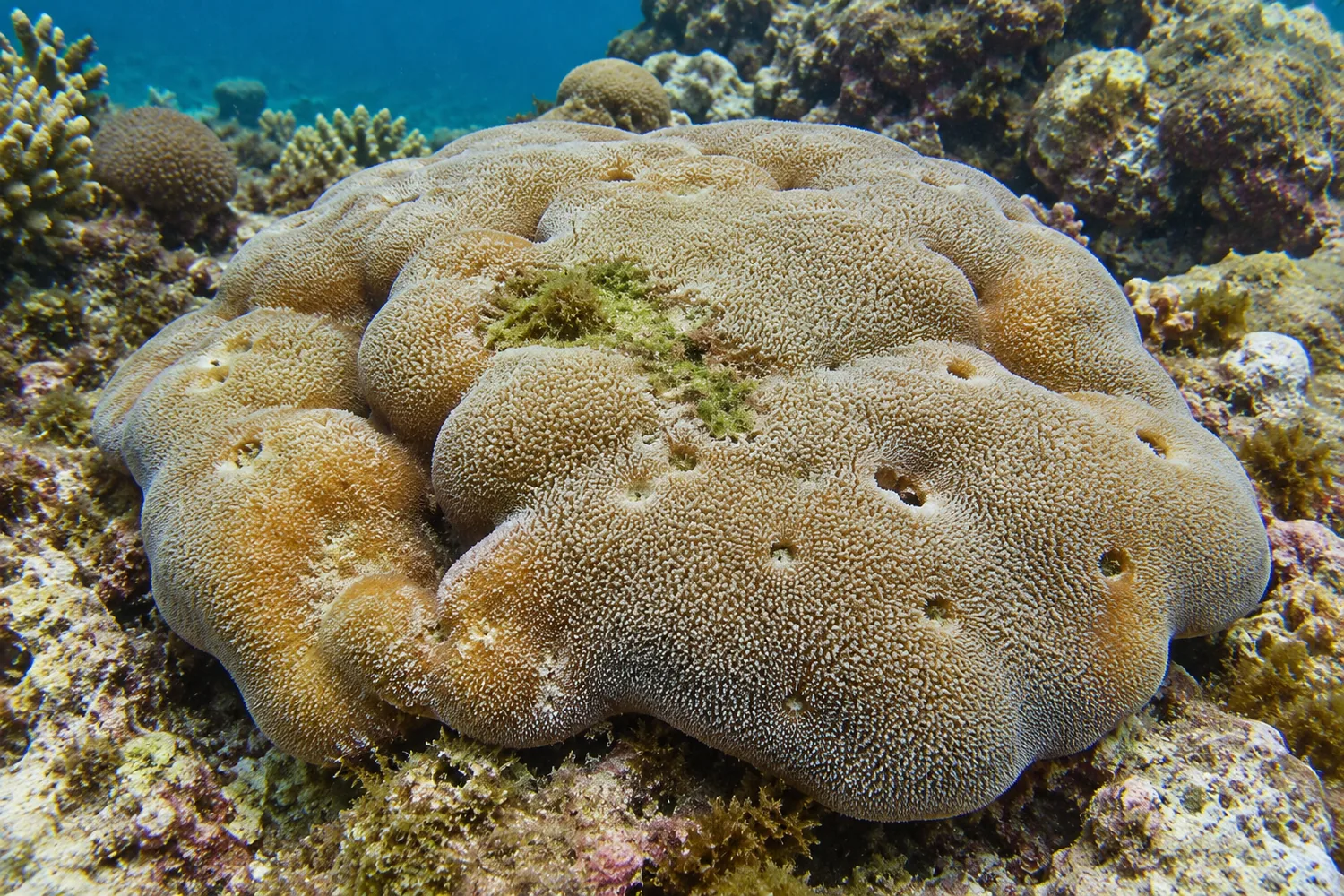
The big, rounded boulders of coral on the Cabo Pulmo reef are often giant pavona. It grows about a centimeter a year, so big colonies are decades old, and it keeps its tentacles out in daylight, which gives it a soft, furry look.

~1 cmGrowth per year at Cabo Pulmo
Up to 53 yearsOldest colony aged at Cabo Pulmo
0–40 mDepth range
NTIUCN Red List (assessed 2023)

When to see them

●● best months · ● regular · · occasional. Based on scientific studies and local reports; it changes year to year.

Tap a month to see everything biting in Cabo that month ›

How to recognize it

A massive coral that forms rounded mounds and boulders, sometimes flattened on top. The polyp cups (corallites) are close together, well defined, with thick walls and a star-shaped pattern of ridges. Colonies are green, grey or brown, and because the tentacles are often extended during the day, the surface looks furry or velvety.

Biology

Giant pavona is an eastern Pacific coral, found from Baja California to Ecuador. In shallow water it is uncommon, but at Cabo Pulmo it is one of the four corals that build the reef: a 2011 CONANP survey found it made up about 9% of the live coral, after the two cauliflower coral forms and the Panamic porites coral. It has been recorded in the park and at Bahía Chileno, between Cabo San Lucas and San José del Cabo.

Most colonies are either male or female; in a two-year study in Oaxaca, only one hermaphrodite colony turned up. Reproduction is seasonal, roughly April to September, shifting a little each year, and day length was the factor that best predicted it. At Cabo Pulmo, colonies grow about 10 mm a year, and researchers estimate that a cohort could live about a century.

Things you probably didn't know

01

A coral you can age

Using a stain that marks the skeleton, researchers measured growth of 10.1 mm a year at Cabo Pulmo. From colony heights, they aged 87 colonies at 3 to 53 years, with an average of about 15.

Source ↗
02

Built to last a century

The same study estimated a natural death rate of about 5% of colonies a year and a maximum cohort lifespan of about 101 years. It was the first such estimate for any coral in its family, Agariciidae.

Source ↗
03

Furry by day

Giant pavona often keeps its tentacles extended during the day, which makes colonies look furry instead of stony.

Source ↗
04

Timed by daylight

Off Oaxaca, the share of colonies ready to reproduce rose and fell with the seasons, and day length explained more of it than any other factor measured.

Source ↗
05

Lost farther south in 2023

After the 2023 marine heat wave, about 80% of the corals in Huatulco National Park, Oaxaca, died, and photos from the park show bleached giant pavona. Cabo Pulmo fared far better.

Source ↗
06

Hit in 1997

During the 1997 El Niño, bleaching killed corals of all four reef-building genera at Cabo Pulmo, Pavona included, and more than half of the live coral cover was lost.

Source ↗

Seeing them from the boat

Giant pavona is for snorkelers and divers to look at, not something to fish or collect. The place to see it near Cabo is Cabo Pulmo National Park, where the big mounds sit among the cauliflower corals on the reef bars; it has also been recorded at Bahía Chileno. Look for rounded, greenish-brown boulders with a velvety surface. At Cabo Pulmo, scuba diving is allowed only with a park-accredited guide, and snorkelers must wear a life vest in the reef areas.

A boulder that has grown for decades looks tough, but its living layer is thin: don't touch it, stand on it or rest on it. Inside the park, keep at least 2.5 m from rock and coral formations; gloves and knives are banned and boats may anchor only on sand.

Rules & conservation

Sport fishing (NOM-017-PESC-1994, 2013 update)Only fish may be taken; coral cannot be collected
Anchoring (NOM-017, 4.16 b)Never on coral; at least 15 m from the edge of a coral reef
Federal Penal Code, art. 420 Bis2 to 10 years in prison for damaging reefs, up to 2 more in a protected area
Mexico (NOM-059)Not listed
CITESAppendix II: moving coral across borders needs permits
IUCN Red ListNear Threatened (assessed 2023)
Cabo Pulmo National ParkNo collecting; keep 2.5 m from coral; no gloves or knives; anchor only on sand

Look, don't touch: breaking or taking coral is illegal in Mexico.

Don't confuse it with

The Panamic porites coral also forms mounds and lumps, but its greenish-grey surface is smooth to wavy, without star-shaped cups or a furry daytime look. Pavona clavus, recorded at Bahía Chileno, has similar thick-walled cups but grows as columns, clubs or plates rather than boulders. Pavona explanulata forms crusts, plates or columns with more widely spaced cups.

Questions

How old are the coral boulders at Cabo Pulmo?

Giant pavona colonies measured at Cabo Pulmo were 3 to 53 years old, with an average of about 15, based on a growth rate of about 1 cm a year.

Why does this coral look furry?

Its tentacles are often extended during the day, so the surface looks soft and velvety instead of stony.

Can I touch it?

No. Touching or standing on coral damages its living tissue, and inside Cabo Pulmo you must keep 2.5 m away from coral and rock formations.

By Max VargasTop Anglers, Cabo San Lucas · international judge at big game fishing world championships · reviewed October 2026

Sources

Top illustration: Top Anglers. Photos: iNaturalist contributors, credited on each photo.

See Cabo from the water

Our charters leave the Cabo San Lucas marina every morning. From $698 with license included.
More species

Pacific sierra
Pacific sierra
Scomberomorus sierra
California yellowtail
Seriola dorsalis
Pacific crevalle jack
Caranx caninus
Skipjack tuna
Skipjack tuna
Katsuwonus pelamis
Shortfin mako
Shortfin mako
Isurus oxyrinchus
Leopard grouper
Leopard grouper
Mycteroperca rosacea
Colorado snapper
Colorado snapper
Lutjanus colorado
Striped bonito
Striped bonito
Sarda orientalis
Black skipjack
Black skipjack
Euthynnus lineatus
Finescale triggerfish
Balistes polylepis
Scalloped hammerhead
Sphyrna lewini
Humpback whale
Humpback whale
Megaptera novaeangliae
Gray whale
Gray whale
Eschrichtius robustus
California sea lion
California sea lion
Zalophus californianus
Whale shark
Whale shark
Rhincodon typus
Olive ridley sea turtle
Lepidochelys olivacea
Bottlenose dolphin
Bottlenose dolphin
Tursiops truncatus
Munk's devil ray (mobula)
Mobula munkiana
Swordfish
Swordfish
Xiphias gladius
Almaco jack
Almaco jack
Seriola rivoliana
Bigeye trevally
Bigeye trevally
Caranx sexfasciatus
Spotted cabrilla
Spotted cabrilla
Epinephelus analogus
Pacific dog snapper
Pacific dog snapper
Lutjanus novemfasciatus
Barred pargo
Barred pargo
Hoplopagrus guentherii
Blue whale
Blue whale
Balaenoptera musculus
Green sea turtle (black turtle)
Chelonia mydas
Leatherback sea turtle
Dermochelys coriacea
Rainbow runner
Rainbow runner
Elagatis bipinnulata
Gulf grouper
Gulf grouper
Mycteroperca jordani
Yellow snapper
Yellow snapper
Lutjanus argentiventris
Pacific white snook
Pacific white snook
Centropomus viridis
Mexican barracuda
Mexican barracuda
Sphyraena ensis
Silky shark
Silky shark
Carcharhinus falciformis
Mexican needlefish
Mexican needlefish
Tylosurus fodiator
Humboldt squid
Humboldt squid
Dosidicus gigas
Giant manta ray
Giant manta ray
Mobula birostris
Fin whale
Fin whale
Balaenoptera physalus
Orca (killer whale)
Orca (killer whale)
Orcinus orca
Hawksbill sea turtle (carey)
Eretmochelys imbricata
Brown pelican
Brown pelican
Pelecanus occidentalis
Magnificent frigatebird
Fregata magnificens
Shortbill spearfish
Shortbill spearfish
Tetrapturus angustirostris
Loggerhead sea turtle (caguama)
Caretta caretta
Osprey
Osprey
Pandion haliaetus
Blue-footed booby
Blue-footed booby
Sula nebouxii
Common dolphin
Common dolphin
Delphinus delphis
Oarfish
Oarfish
Regalecus russelii
Heermann’s gull
Heermann’s gull
Larus heermanni
Yellow-footed gull
Yellow-footed gull
Larus livens
Ocean sunfish
Ocean sunfish
Mola mola
Sperm whale
Sperm whale
Physeter macrocephalus
Sally Lightfoot crab
Grapsus grapsus
Blue spiny lobster
Blue spiny lobster
Panulirus inflatus
Chocolate clam
Chocolate clam
Megapitaria squalida
Pelagic red crab
Pelagic red crab
Grimothea planipes
Hubbs’ octopus
Hubbs’ octopus
Octopus hubbsorum
Jewel moray
Jewel moray
Muraena lentiginosa
Panamic green moray
Panamic green moray
Gymnothorax castaneus
Spinner dolphin
Spinner dolphin
Stenella longirostris
Risso’s dolphin
Risso’s dolphin
Grampus griseus
Short-finned pilot whale
Globicephala macrorhynchus
Bigeye tuna
Bigeye tuna
Thunnus obesus
Pelagic thresher
Pelagic thresher
Alopias pelagicus
Blue shark
Blue shark
Prionace glauca
Giant hawkfish
Giant hawkfish
Cirrhitus rivulatus
Pacific bonito
Pacific bonito
Sarda lineolata
Cortez angelfish
Cortez angelfish
Pomacanthus zonipectus
African pompano
African pompano
Alectis ciliaris
Barberfish
Barberfish
Johnrandallia nigrirostris
Black jack
Black jack
Caranx lugubris
Bumphead parrotfish
Bumphead parrotfish
Scarus perrico
Cortez rainbow wrasse
Thalassoma lucasanum
Ember parrotfish
Ember parrotfish
Scarus rubroviolaceus
Flag cabrilla
Flag cabrilla
Epinephelus labriformis
Golden trevally
Golden trevally
Gnathanodon speciosus
King angelfish
King angelfish
Holacanthus passer
Mexican hogfish
Mexican hogfish
Bodianus diplotaenia
Moorish idol
Moorish idol
Zanclus cornutus
Pacific creolefish
Pacific creolefish
Cephalopholis colonus
Pacific red snapper
Pacific red snapper
Lutjanus peru
Pacific seahorse
Pacific seahorse
Hippocampus ingens
Sanguine frogfish
Sanguine frogfish
Abantennarius sanguineus
Spotted rose snapper
Lutjanus guttatus
Threeband butterflyfish
Chaetodon humeralis
Yellowtail surgeonfish
Prionurus laticlavius
Spinetail devil ray
Spinetail devil ray
Mobula mobular
Golden cownose ray
Golden cownose ray
Rhinoptera steindachneri
Round stingray
Round stingray
Urobatis halleri
Pacific spotted eagle ray
Aetobatus laticeps
Whitetip reef shark
Whitetip reef shark
Triaenodon obesus
Pacific nurse shark
Pacific nurse shark
Ginglymostoma unami
Tiger shark
Tiger shark
Galeocerdo cuvier
Bull shark
Bull shark
Carcharhinus leucas
Bryde’s whale
Bryde’s whale
Balaenoptera edeni
Rough-toothed dolphin
Steno bredanensis
Cauliflower coral
Cauliflower coral
Pocillopora verrucosa
Panamic porites coral
Porites panamensis
Blue sea star (tan sea star)
Phataria unifascialis
Long-spined sea urchin
Diadema mexicanum
Cocos booby
Cocos booby
Sula brewsteri
Talk to the family

Questions? Message the family

The Vargas family answers personally. 7 days a week, 5 AM – 6 PM Cabo time.