Born male
Snook are protandrous: they start life as males and the largest become females. In Nayarit, every female white snook measured in 2010 was at least 88 cm long, and males outnumbered females 5.5 to 1.
Source ↗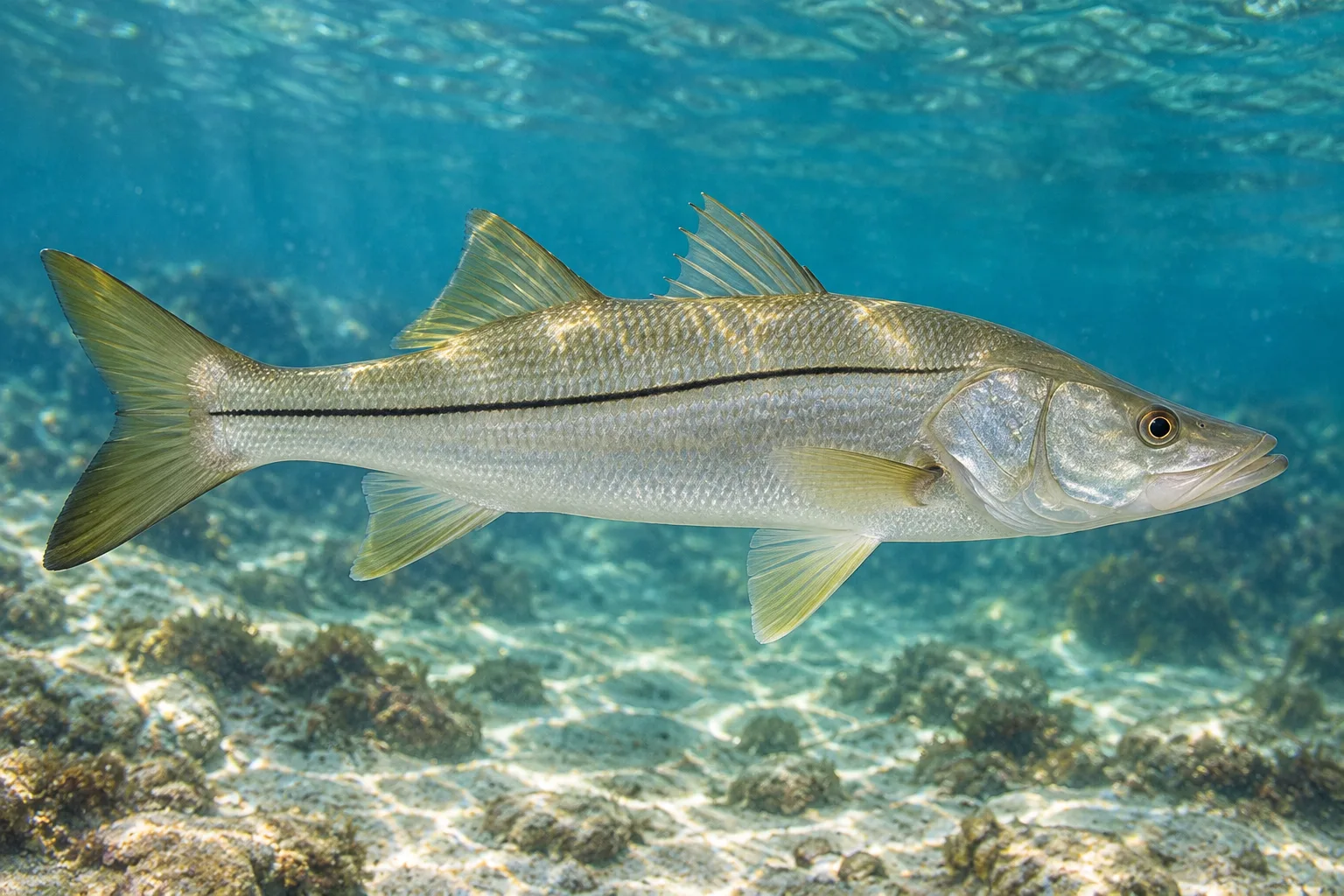
An estuary fish that hunts the surf. White snook range from southern Baja to Ecuador, and the last two all-tackle world records were both landed from beaches near Cabo San Lucas.
Long, slender silver body with a jet-black or dark-gray lateral line and a slightly concave forehead. The back is gray with greenish tints, fading gradually to a white belly; the pelvic fins usually show white or yellow.
White snook live from southern Baja and the central Gulf of California to southern Ecuador and the Galápagos. They use bays, estuaries, mangroves and the lower reaches of rivers, over mud, sand and gravel, from the surface to about 25 m.
They are predators of fish, especially anchovies, plus shrimp and crabs. The big fish are females: in a six-year study in Nayarit, females measured 88 to 131 cm in 2010 while males topped out at 97 cm. Snook need salt water to spawn, and the juveniles move into brackish or fresh water to grow.
Snook are protandrous: they start life as males and the largest become females. In Nayarit, every female white snook measured in 2010 was at least 88 cm long, and males outnumbered females 5.5 to 1.
Source ↗As fishing removed the big fish, white snook in Nayarit started becoming female at smaller sizes: the smallest female fell from 88 cm in 2010 to 67 cm in 2015.
Source ↗White and black snook look so alike that scientists have lumped them into one species and split them again several times since they were described in the 1800s.
Source ↗The surest sign is the swim bladder: white snook have a pair of small horn-like pouches on it, black snook don’t. Fishermen also note that white snook thrash in the net, while black snook go still.
Source ↗Snook tolerate water from almost fresh to far saltier than the sea, but not cold: they can’t survive below 14 °C. Eggs need salt water, and the yolk sac lasts about 12 days before larvae must feed.
Source ↗Wesley Brough set the all-tackle record from a Cabo San Lucas beach in 2021 with 51 lb 5 oz. In 2025 Roman Dueñas beat it with 60 lb 14 oz, surfcasting at Agua Blanca, Todos Santos.
Source ↗Around Los Cabos, snook are mostly a beach fish on the Pacific side, from the rocky beaches north of Cabo San Lucas up to Todos Santos. Both recent world records came in late June and early July, and in 2021 the fish hit at dusk with warm water and mullet schools along the shore (local reports).
Anglers cast big mullet-imitating lures, such as an 8.5-inch stick bait, on heavy spinning gear with 100 lb braid and a 125 lb mono leader. Mexican rules forbid sport fishing within 250 m of beaches with swimmers, so the surf spots are away from busy hotel beaches.
A prized food fish. In Mexico snook is sold at high prices in regional and national markets.
| Daily limit (NOM-017-PESC-1994) | Up to 5 per angler per day, within the 10-fish total |
|---|---|
| Beaches with swimmers | No sport fishing within 250 m of beaches used by bathers |
| Closed season / minimum size | None found for B.C.S.; Mexico’s snook closed season applies only to the Gulf of Mexico coast |
| IUCN Red List | Least Concern (2018) |
| IGFA all-tackle record | 60 lb 14 oz (27.60 kg), Agua Blanca, Todos Santos, B.C.S., 2025 |
The black snook or robalo prieto (Centropomus nigrescens) also reaches southern Baja. It has a dark blue-black back that changes abruptly to a white belly, all-dark fins, a straight forehead and usually 10 soft dorsal rays (white snook: 9). Its IGFA record, 72 lb 9 oz from Costa Rica (2026), is the heaviest snook IGFA has recorded. Smaller cousins include the blackfin snook (C. medius) and the yellowfin snook or constantino (C. robalito), which has no dark lateral line. Corvinas share the beaches but belong to a different family, the croakers.
Yes, mostly from Pacific-side beaches between Cabo San Lucas and Todos Santos. The last two IGFA all-tackle records were caught there, in 2021 and 2025.
None that we found. Mexico’s snook closed season covers only the Gulf of Mexico coast. The general limit of 5 per angler per day applies.
White snook have a concave forehead, a gray-green back that fades gradually to white and lighter pelvic fins. Black snook are darker, with a straight forehead and all-dark fins.

Top illustration: Top Anglers. Photos: iNaturalist contributors, credited on each photo.
Pangas and small boats that work the beaches, points and rocky reefs. From $453 with license included.