The reef barber
It is called barberfish because it works as a cleaner, picking crustacean parasites off other fish at fixed cleaning stations.
Source ↗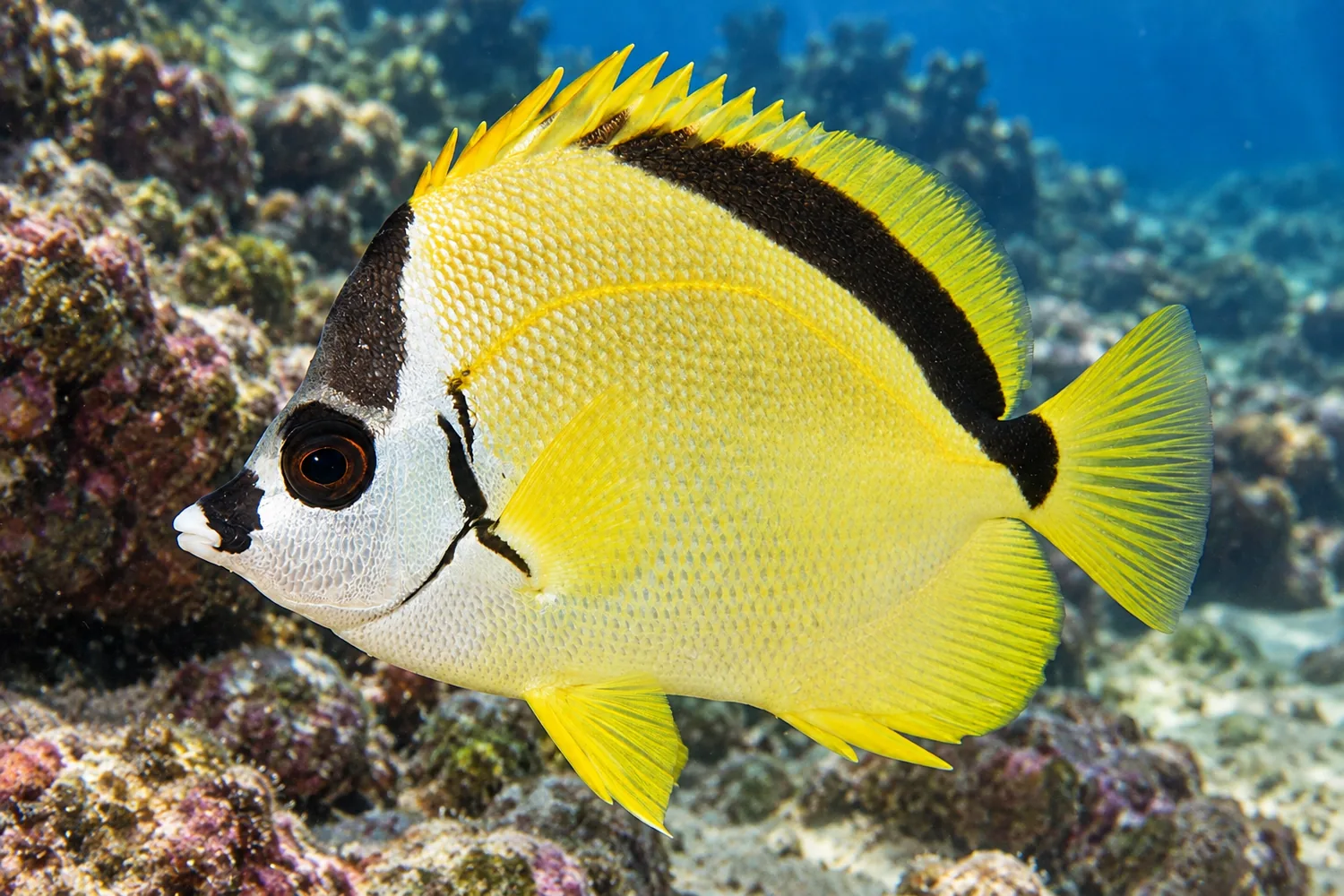
A yellow butterflyfish with a whitish head, a black snout and a black mask over the eyes. It gets its name from its day job: picking parasites off bigger fish. It is one of the most frequent fish on the reef at Cabo Pulmo.
A strongly compressed, oval, disc-shaped body with a short, pointed snout and a small mouth. The head is whitish to pale gray and the body and fins are yellow, with a yellow lateral line arching along the side. Look for a black band around the tip of the snout, a black band across the forehead and over the eyes, a dark area around the eye and a black edge on the gill cover. A black band runs along the base of the dorsal fin, from the middle of the back to the top of the tail base.
The barberfish lives only in the tropical eastern Pacific, from central Baja and the central Gulf of California to central Peru, including all the offshore islands. It is a resident of rocky and coral reefs from 5 to 50 m deep. It is usually seen in small to very large groups. In fish counts at Cabo Pulmo between 1987 and 1998 it was rated common and turned up in 75 to 100% of censuses, one of only eleven species seen that often.
It feeds by day on algae, small snails and small crustaceans, and it is best known as a cleaner. Barberfish hold cleaning stations where larger fish come to have parasites picked off; FishBase lists Pacific creolefish and Mexican goatfish among its clients. At night it shelters close to the reef. Pairs form for breeding.
It is called barberfish because it works as a cleaner, picking crustacean parasites off other fish at fixed cleaning stations.
Source ↗The genus honors John E. Randall (1924-2020) of the Bishop Museum in Honolulu, one of the great reef-fish scientists. Nigrirostris means black snout.
Source ↗In counts made at Cabo Pulmo from 1987 to 1998, it appeared in 75 to 100% of censuses, one of only eleven of the 236 species recorded there that showed up that often.
Source ↗FishBase lists Pacific creolefish (Cephalopholis colonus, formerly Paranthias colonus) and Mexican goatfish (Mulloidichthys dentatus) among the fish it cleans.
Source ↗Researchers at the Revillagigedo Islands report seeing barberfish clean scalloped hammerhead sharks.
Source ↗It is usually seen in small to very large aggregations on reefs.
Source ↗The barberfish is a fish for snorkelers and divers, not anglers. It is common on rocky reefs around Los Cabos and Cabo Pulmo, often in groups, and it is easy to watch at work cleaning bigger fish. It is not a sport fish.
Its mouth is tiny, so it is rarely hooked. If one ever comes up, unhook it gently and put it back. Aquarium collectors need a federal fishing permit. Sport fishing is not allowed inside Cabo Pulmo National Park.
| Mexico (NOM-059-SEMARNAT-2010) | Not listed |
|---|---|
| General sport-fishing limit (NOM-017-PESC-1994) | 10 fish per angler per day, no more than 5 of one species |
| Aquarium collection | Needs a federal fishing permit (pesca de fomento, CONAPESCA) |
| IUCN Red List | Least Concern (2009) |
| Cabo Pulmo National Park | Sport fishing not allowed |
Not a sport fish. If one is ever hooked, release it.
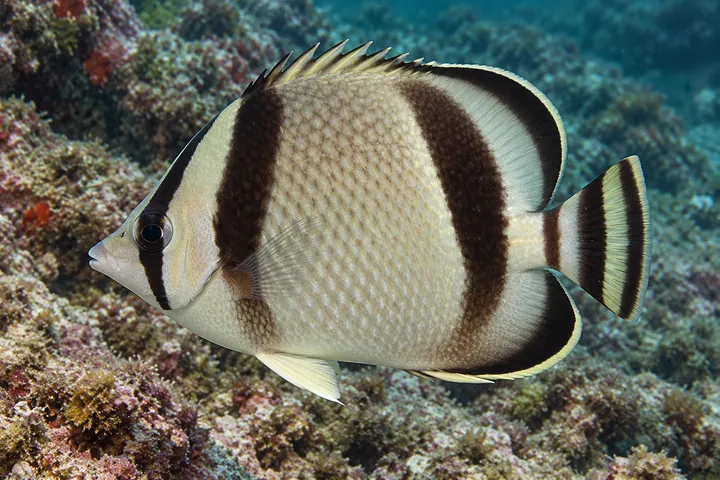
The threeband butterflyfish (Chaetodon humeralis) is white to silvery, not yellow, with black bars through the eye, over the pectoral fin and near the tail. The scythe butterflyfish (Prognathodes falcifer) is yellow but has a curved black scythe-shaped mark on the side and a mostly black spiny dorsal fin; it usually lives deeper. The barberfish is the one with a whitish head, black snout and mask, and a black stripe along the base of the dorsal fin.
Because it cleans other fish, picking off parasites, like a barber giving a shave. Other fish visit its cleaning stations.
It is not a sport fish and is rarely hooked because its mouth is tiny. If one is caught by accident, release it.
On rocky reefs while snorkeling or diving. It was one of the most frequently counted fish at Cabo Pulmo, where sport fishing is not allowed.

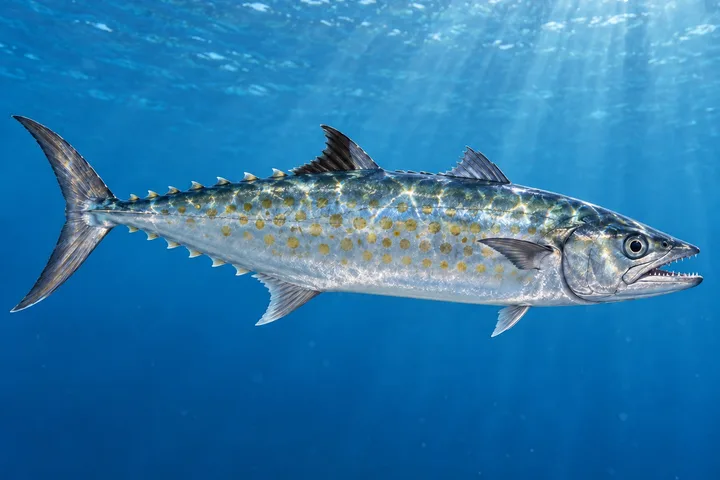
Top illustration: Top Anglers. Photos: iNaturalist contributors, credited on each photo.
Our charters leave the Cabo San Lucas marina every morning. From $698 with license included.