One island, one species
About 95% of all Heermann’s gulls nest on Isla Rasa, an island of roughly 56 hectares that rises only 35 m above the sea. In the best patches there are up to 110 nests per 100 square meters.
Source ↗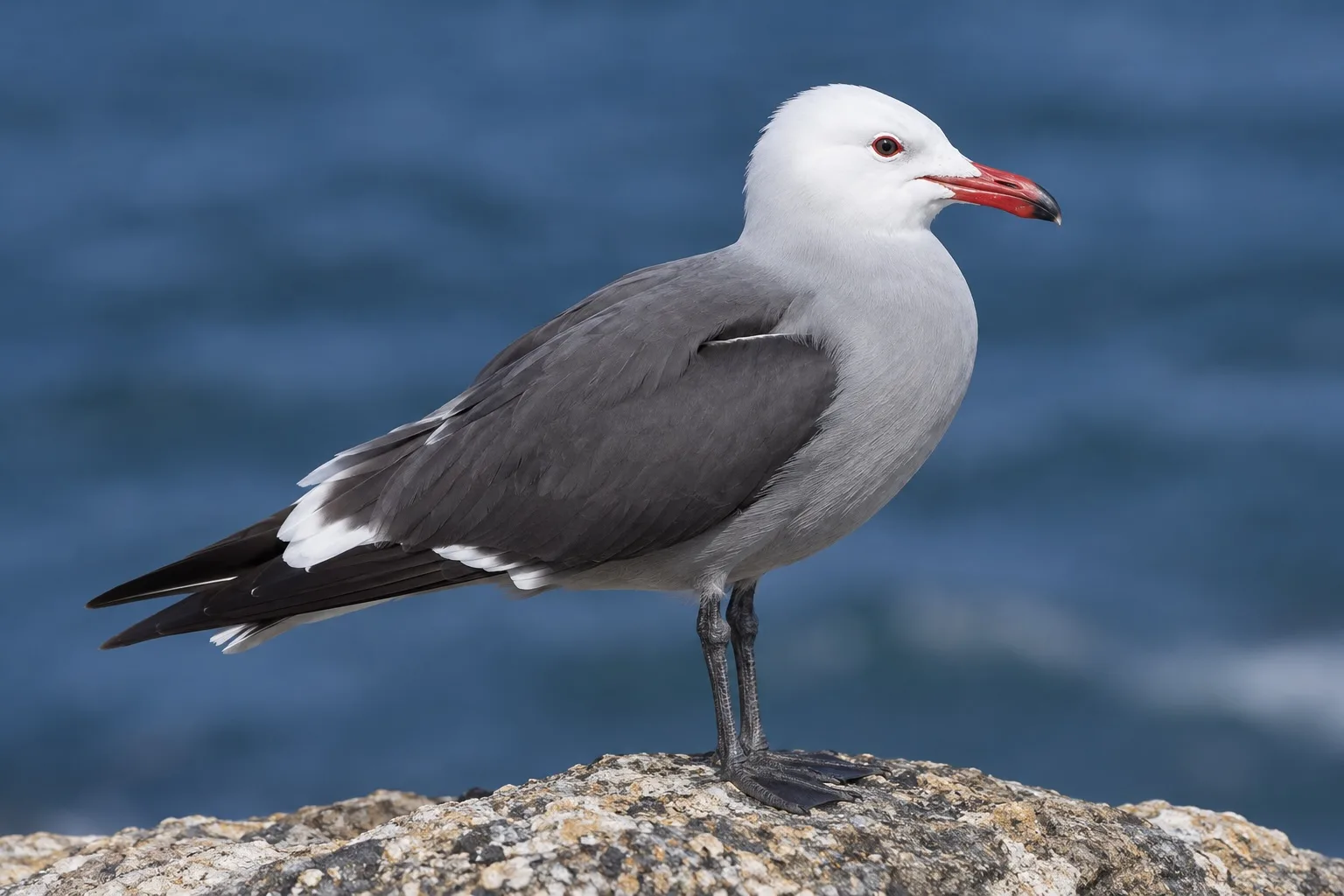
Among the white gulls on a Cabo beach, the one that looks charcoal gray with a bright red bill is a Heermann’s gull. About 95% of the species nests on a single 56-hectare island in the Gulf of California.
A medium-sized gull that is dark all over: slate-gray body, darker wings and a black tail. The bill is bright red with a black tip and the legs are black. Breeding adults have a clean white head; outside the breeding season the head is streaked gray-brown. Young birds are a fairly uniform sooty chocolate brown, without the heavy mottling of other young gulls, with a pale pinkish bill tipped dark. It takes about four years to reach adult plumage.
Heermann’s gull breeds almost only in the Gulf of California. About 95% of the population, some 130,000 pairs, nests on Isla Rasa, a flat island of about 56 hectares in the Midriff region of the northern Gulf; the next-largest colony, on nearby Isla Cardonosa, has about 4,000 pairs, and smaller colonies extend along the Mexican coast as far as Nayarit. Gulls arrive on Rasa in mid-February and lay 1 to 3 eggs, packed at densities of up to 110 nests per 100 m². They start breeding at about four years old. Egg collecting pushed the species down to an estimated 55,000 pairs in 1975; the island became a seabird sanctuary in 1964, introduced rodents were removed in the mid-1990s, and the species now numbers around 350,000 birds.
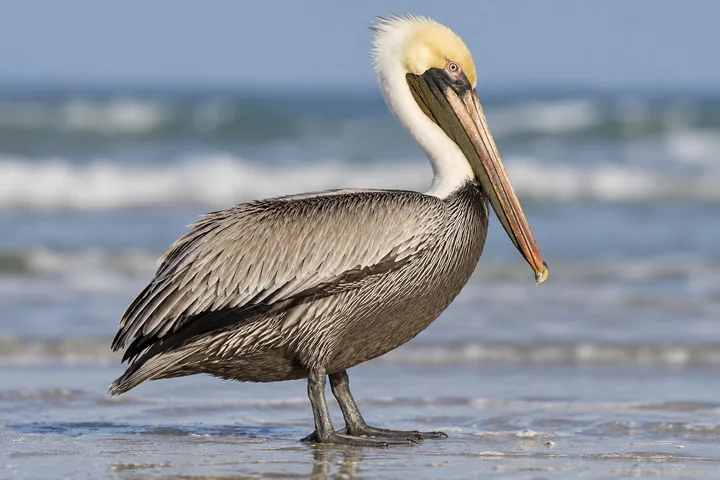
It lives mostly on small schooling fish: in the early 1980s Pacific sardine made up 60 to 97% of its diet, along with northern anchovy. It is also a pirate. It steals fish from brown pelicans, sometimes straight from the pouch, and from terns bringing food to their chicks; one study found that about 13% of pelican dives drew a theft attempt. After nesting, most of the population heads north along the Pacific coast, reaching British Columbia, while others disperse south along the Mexican coast as far as Guatemala.
About 95% of all Heermann’s gulls nest on Isla Rasa, an island of roughly 56 hectares that rises only 35 m above the sea. In the best patches there are up to 110 nests per 100 square meters.
Source ↗After nesting in Mexico in spring, most Heermann’s gulls fly north, not south, up the Pacific coast. Their numbers in Canada peak in July and August.
Source ↗Over 23 years, the share of sardine in the diet of Heermann’s gulls and elegant terns on Isla Rasa in spring predicted the sardine fleet’s catch in the season that began about five months later.
Source ↗In normal years each nest raises about 1.1 chicks; in years with warm sea-surface temperatures, fewer than a tenth of that. Adults then skip breeding and wait, helped by a life span that can reach 27 years.
Source ↗On Isla Rasa about 300,000 elegant terns nest among 260,000 Heermann’s gulls. A few gulls steal fish from terns feeding their chicks and take tern eggs, but gull territoriality keeps most of them from crowding the tern colony.
Source ↗DNA from 286 gulls shows the population began growing around 48,000 years ago, possibly tracking the rise of northern anchovy, one of its main prey.
Source ↗Heermann’s gull is on the Defenders of Wildlife list of common birds of Los Cabos. Look for it on beaches, at the marina and near fish-cleaning stations, and around brown pelicans diving on bait close to shore, where it waits to snatch a fish. It is a coastal bird that rarely goes far offshore, so you are much more likely to see it in the bay than on the marlin grounds. Sighting records (GBIF, iNaturalist) show it most often around Cabo from December to March, with another bump in July as birds disperse after nesting; in spring many adults are at the breeding colonies hundreds of kilometers north, and October–November records are scarce.
Gulls sometimes grab a bait or a fish being reeled in. Don’t cut the line, because trailing line can entangle the bird. Bring it in slowly, have someone control the head and bill, cover its head with a cloth to calm it, cut the barb before backing the hook out, remove all the line and release it. Don’t feed gulls fish scraps. Because it is a protected species in Mexico, a seriously injured bird should be reported to PROFEPA.
| Mexico (NOM-059, 2019 annex) | Subject to special protection (Pr); the list classes it as endemic to Mexico |
|---|---|
| Federal Penal Code, art. 420 | 1 to 9 years in prison for unlawfully capturing, possessing or harming a species subject to special protection; up to 3 more years in a protected natural area |
| Isla Rasa | Seabird sanctuary since 1964; part of the Islas del Golfo de California flora and fauna protection area since 1979 |
| IUCN Red List | Near Threatened (BirdLife International, 2020 assessment) |
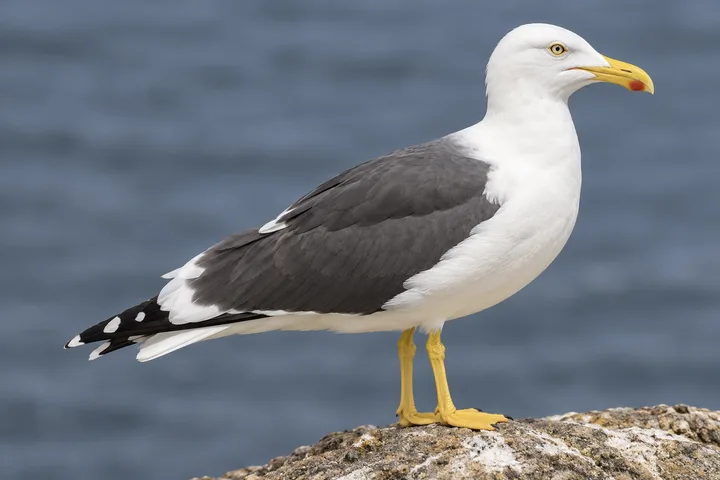
The yellow-footed gull, the big resident gull of the Gulf, is much larger, with a white head and underparts, a heavy yellow bill with a red spot and bright yellow legs. The western gull of Baja’s Pacific coast is also large and white-headed, with pink legs. Young big gulls are mottled and checkered brown with dark bills, while a young Heermann’s is a smooth, even dark brown with a pale, dark-tipped bill and black legs.
It is simply the species’ plumage: gray body, dark wings and black tail at every age, with a red bill in adults. That combination makes it possibly the easiest gull to identify in North America.
Yes. It is listed as subject to special protection (Pr) in NOM-059-SEMARNAT-2010, so capturing, keeping or harming one is a federal crime.
No. Almost all of the population nests on Isla Rasa and a few other islands in the Gulf of California. The birds seen around Cabo are feeding, resting or passing through.

Top illustration: Top Anglers. Photos: iNaturalist contributors, credited on each photo.
Our charters leave the Cabo San Lucas marina every morning. From $453 with license included.