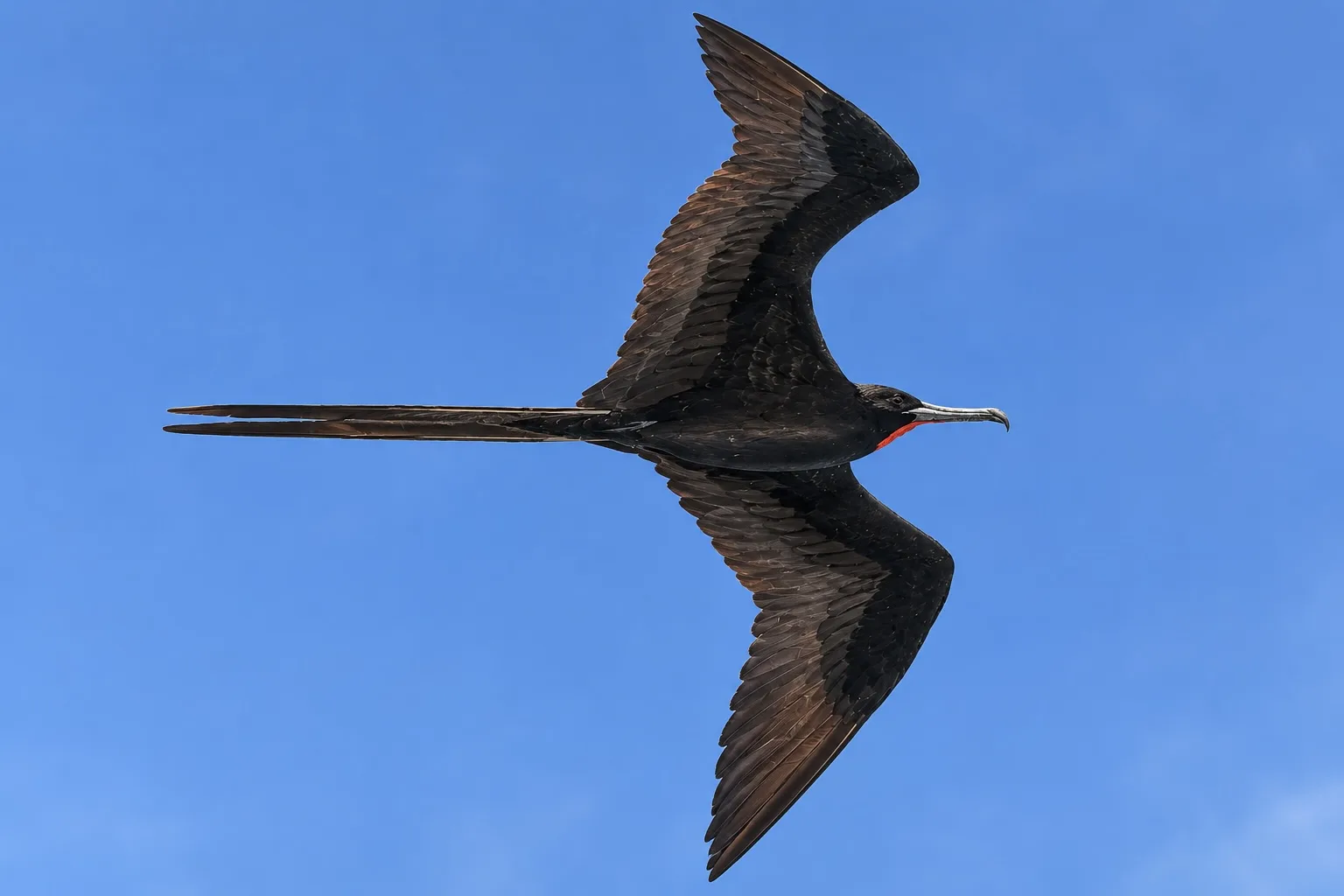
Magnificent frigatebird (Fregata magnificens), illustration
Wildlife Fregata magnificens

Magnificent frigatebird in Los Cabos

With a wingspan over two meters and a forked tail, the frigatebird hangs over the sea off Cabo almost without flapping. It almost never lands on the water, so it watches for whatever pushes fish to the surface, and so do the captains watching it.

~2.2 mWingspan
89–114 cmLength
Up to 1 yearMother feeds her chick
23,312 kmLongest trip tracked from Baja

When to see them

●● best months · ● regular · · occasional. Based on scientific studies and local reports; it changes year to year.

Tap a month to see everything biting in Cabo that month ›

How to recognize it

A big, all-dark seabird with long, angular wings, a deeply forked tail often held closed in a point, and a long bill with a hooked tip. Adult males are all black, with a red throat pouch they inflate like a balloon in the breeding season. Females have a white chest and a dark head, and are bigger than males. Juveniles have a white head and belly that darken as they age.

Biology

Magnificent frigatebirds live along tropical and subtropical coasts and islands of the Americas, foraging far offshore, along the coast and in shallow lagoons. In Baja California Sur they nest in colonies on Espíritu Santo, in the Gulf of California, and on Isla Santa Margarita and the Magdalena lagoon complex on the Pacific side. They lay a single egg in a flimsy stick platform on low trees or shrubs.

They eat mainly fish, including flying fish and tuna, plus squid, which they grab from the surface without getting wet, and they also feed on fishing waste. Breeding is unusually slow: incubation takes about 53 to 61 days and the chick stays in the nest 150 to 185 days. Males leave when the chick is three to four months old, and the female keeps feeding it for up to a year.

Things you probably didn't know

01

Sleeping on the wing

EEG recordings of great frigatebirds, a close relative, flying for up to 10 days showed they sleep in flight in bursts of about 11 seconds, often with one half of the brain at a time. In the air they slept only about 41 minutes a day, against more than half the time on land.

Source ↗
02

Months without landing

Satellite-tracked great frigatebirds from the Mozambique Channel stayed airborne for over two months, climbing to 3,000–4,000 m inside cumulus clouds to ride the updrafts.

Source ↗
03

A seabird that avoids the sea

Unlike other seabirds, frigatebirds lack waterproof feathers, so they rarely land on the water even though they have webbed feet. Their legs are so short they can barely walk on land either.

Source ↗
04

Pirates with a low hit rate

On Isla Isabel, Nayarit, frigatebirds chased blue-footed boobies to make them drop their catch. Most attacks were by females and young birds, only about 6% succeeded, and group chases worked three times better than solo ones.

Source ↗
05

23,312 km in 150 days

A male tagged in Baja California Sur flew 23,312 km between May 7 and October 10, 2017. Males leave the colony in early summer and return in autumn for the next breeding season.

Source ↗
06

Colonies in decline

At Estero Las Tijeras, in the Magdalena lagoon complex, nesting pairs fell from 20,117 in 1986–87 to 532 in 2015. Researchers estimate more than 18,000 pairs have been lost from Baja California Sur’s colonies.

Source ↗

Photos

iNaturalist contributor · iNaturalist · CC0
Roger Rittmaster · iNaturalist · CC BY 4.0
MarvalPhotography19 · iNaturalist · CC BY 4.0
Sue Carnahan · iNaturalist · CC BY 4.0

Seeing them from the boat

Out in the open ocean, tropical seabirds depend on tunas and other predators that drive small fish to the surface; researchers call feeding in flocks over tunas the most important foraging strategy for tropical seabirds. Frigatebirds are often found over dolphins, tuna or other predatory fish doing exactly that, which is why captains keep an eye on the sky.

Captains’ rules of thumb, as told to Marlin Magazine: one or two frigates circling high over one spot are watching something, maybe a marlin swimming deep or a school of bait; birds dropping low and swooping at the waves mean bait is on the surface, often pushed up by marlin, sailfish or dorado. Some captains find them a better sign of dorado than of blue marlin, while Pacific captains count them as a good sign for both. Frigatebirds also scavenge fishing waste, so a bird hanging over a fleet isn’t always over fish.

Rules & conservation

Mexico (NOM-059)Not listed as a species at risk (2019 update)
IUCN Red ListLeast Concern
Partners in FlightYellow Watch List; about 113,000 breeding birds worldwide
Nearest colonies to CaboEspíritu Santo (Gulf of California) and Isla Santa Margarita (Pacific)

Don't confuse it with

The great frigatebird nests on the Revillagigedo Islands, far south of Baja, and is rarely confirmed near the peninsula; adult males show a pale bar across the upper wing, and females have a pale throat, while magnificent females have a clean all-dark head. Boobies plunge-dive and rest on the water, and so do gulls; a frigatebird almost never touches down on the sea and steals or skims its food instead.

Questions

Why do fishermen watch frigatebirds?

Because they feed on fish pushed to the surface by tuna, dolphins and other predators. Birds circling or dropping low can point to bait, dorado or billfish below.

Can a frigatebird land on the water?

Rarely. Its feathers aren’t waterproof, so it catches food from the surface without getting wet or steals it from other birds in the air.

How do you tell a male from a female frigatebird?

Adult males are all black, with a red throat pouch in breeding season. Females have a white chest and are larger. Young birds have white heads.

By Max VargasTop Anglers, Cabo San Lucas · international judge at big game fishing world championships · reviewed October 2026

Sources

Top illustration: Top Anglers. Photos: iNaturalist contributors, credited on each photo.

See Cabo from the water

Our charters leave the Cabo San Lucas marina every morning. From $799 with license included.
More species

Pacific sierra
Pacific sierra
Scomberomorus sierra
California yellowtail
Seriola dorsalis
Pacific crevalle jack
Caranx caninus
Skipjack tuna
Skipjack tuna
Katsuwonus pelamis
Shortfin mako
Shortfin mako
Isurus oxyrinchus
Leopard grouper
Leopard grouper
Mycteroperca rosacea
Colorado snapper
Colorado snapper
Lutjanus colorado
Striped bonito
Striped bonito
Sarda orientalis
Black skipjack
Black skipjack
Euthynnus lineatus
Finescale triggerfish
Balistes polylepis
Scalloped hammerhead
Sphyrna lewini
Humpback whale
Humpback whale
Megaptera novaeangliae
Gray whale
Gray whale
Eschrichtius robustus
California sea lion
California sea lion
Zalophus californianus
Whale shark
Whale shark
Rhincodon typus
Olive ridley sea turtle
Lepidochelys olivacea
Bottlenose dolphin
Bottlenose dolphin
Tursiops truncatus
Munk's devil ray (mobula)
Mobula munkiana
Swordfish
Swordfish
Xiphias gladius
Almaco jack
Almaco jack
Seriola rivoliana
Bigeye trevally
Bigeye trevally
Caranx sexfasciatus
Spotted cabrilla
Spotted cabrilla
Epinephelus analogus
Pacific dog snapper
Pacific dog snapper
Lutjanus novemfasciatus
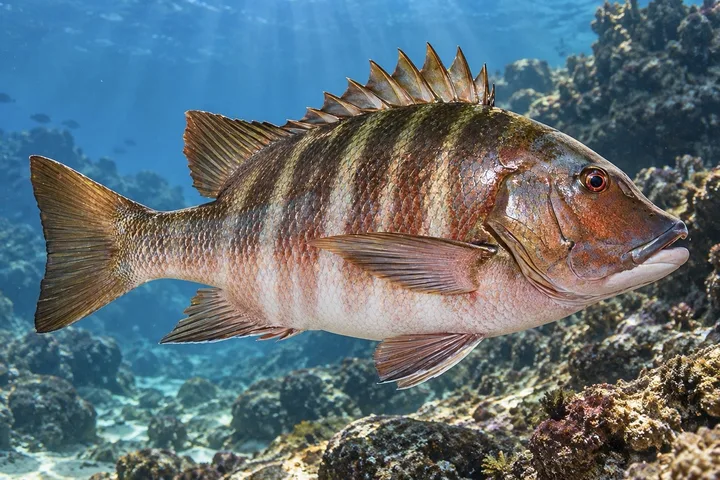
Barred pargo
Barred pargo
Hoplopagrus guentherii
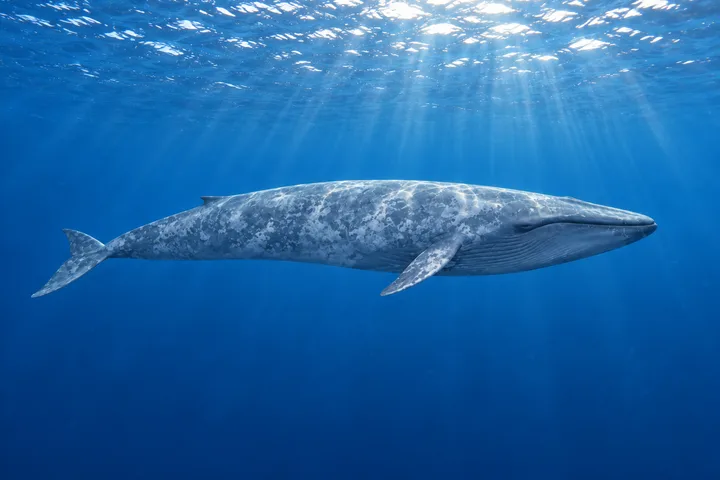
Blue whale
Blue whale
Balaenoptera musculus
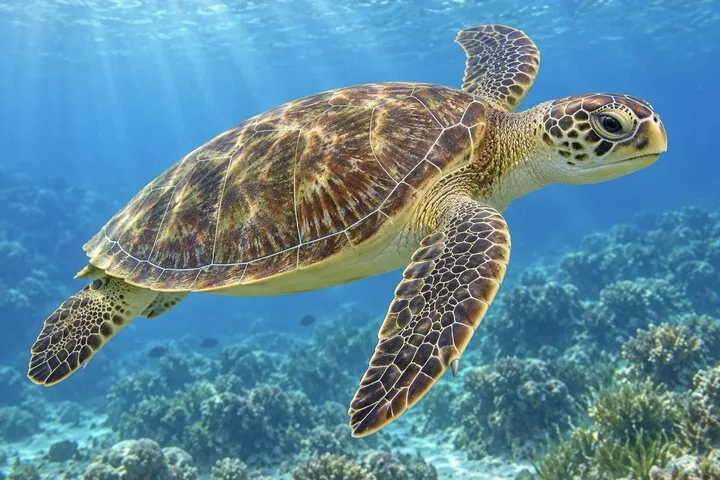
Green sea turtle (black turtle)
Chelonia mydas
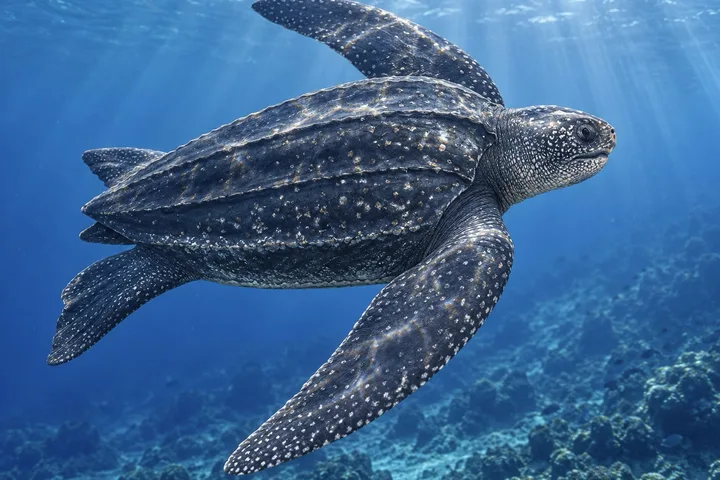
Leatherback sea turtle
Dermochelys coriacea
Rainbow runner
Rainbow runner
Elagatis bipinnulata
Gulf grouper
Gulf grouper
Mycteroperca jordani
Yellow snapper
Yellow snapper
Lutjanus argentiventris
Pacific white snook
Pacific white snook
Centropomus viridis
Mexican barracuda
Mexican barracuda
Sphyraena ensis
Silky shark
Silky shark
Carcharhinus falciformis
Mexican needlefish
Mexican needlefish
Tylosurus fodiator
Humboldt squid
Humboldt squid
Dosidicus gigas
Giant manta ray
Giant manta ray
Mobula birostris
Fin whale
Fin whale
Balaenoptera physalus
Orca (killer whale)
Orca (killer whale)
Orcinus orca
Hawksbill sea turtle (carey)
Eretmochelys imbricata
Brown pelican
Brown pelican
Pelecanus occidentalis
Shortbill spearfish
Shortbill spearfish
Tetrapturus angustirostris
Loggerhead sea turtle (caguama)
Caretta caretta
Osprey
Osprey
Pandion haliaetus
Blue-footed booby
Blue-footed booby
Sula nebouxii
Common dolphin
Common dolphin
Delphinus delphis
Oarfish
Oarfish
Regalecus russelii
Heermann’s gull
Heermann’s gull
Larus heermanni
Yellow-footed gull
Yellow-footed gull
Larus livens
Ocean sunfish
Ocean sunfish
Mola mola
Sperm whale
Sperm whale
Physeter macrocephalus
Sally Lightfoot crab
Grapsus grapsus
Blue spiny lobster
Blue spiny lobster
Panulirus inflatus
Chocolate clam
Chocolate clam
Megapitaria squalida
Pelagic red crab
Pelagic red crab
Grimothea planipes
Hubbs’ octopus
Hubbs’ octopus
Octopus hubbsorum
Jewel moray
Jewel moray
Muraena lentiginosa
Panamic green moray
Panamic green moray
Gymnothorax castaneus
Spinner dolphin
Spinner dolphin
Stenella longirostris
Risso’s dolphin
Risso’s dolphin
Grampus griseus
Short-finned pilot whale
Globicephala macrorhynchus
Bigeye tuna
Bigeye tuna
Thunnus obesus
Pelagic thresher
Pelagic thresher
Alopias pelagicus
Blue shark
Blue shark
Prionace glauca
Giant hawkfish
Giant hawkfish
Cirrhitus rivulatus
Pacific bonito
Pacific bonito
Sarda lineolata
Cortez angelfish
Cortez angelfish
Pomacanthus zonipectus
Talk to the family

Questions? Message the family

The Vargas family answers personally. 7 days a week, 5 AM – 6 PM Cabo time.