Born in Japan, raised in Baja
Hatchlings from Japan have been tracked crossing the Pacific to feed off Baja California, a journey of nearly 12,900 km (8,000 miles), before returning to their birthplace to nest.
Source ↗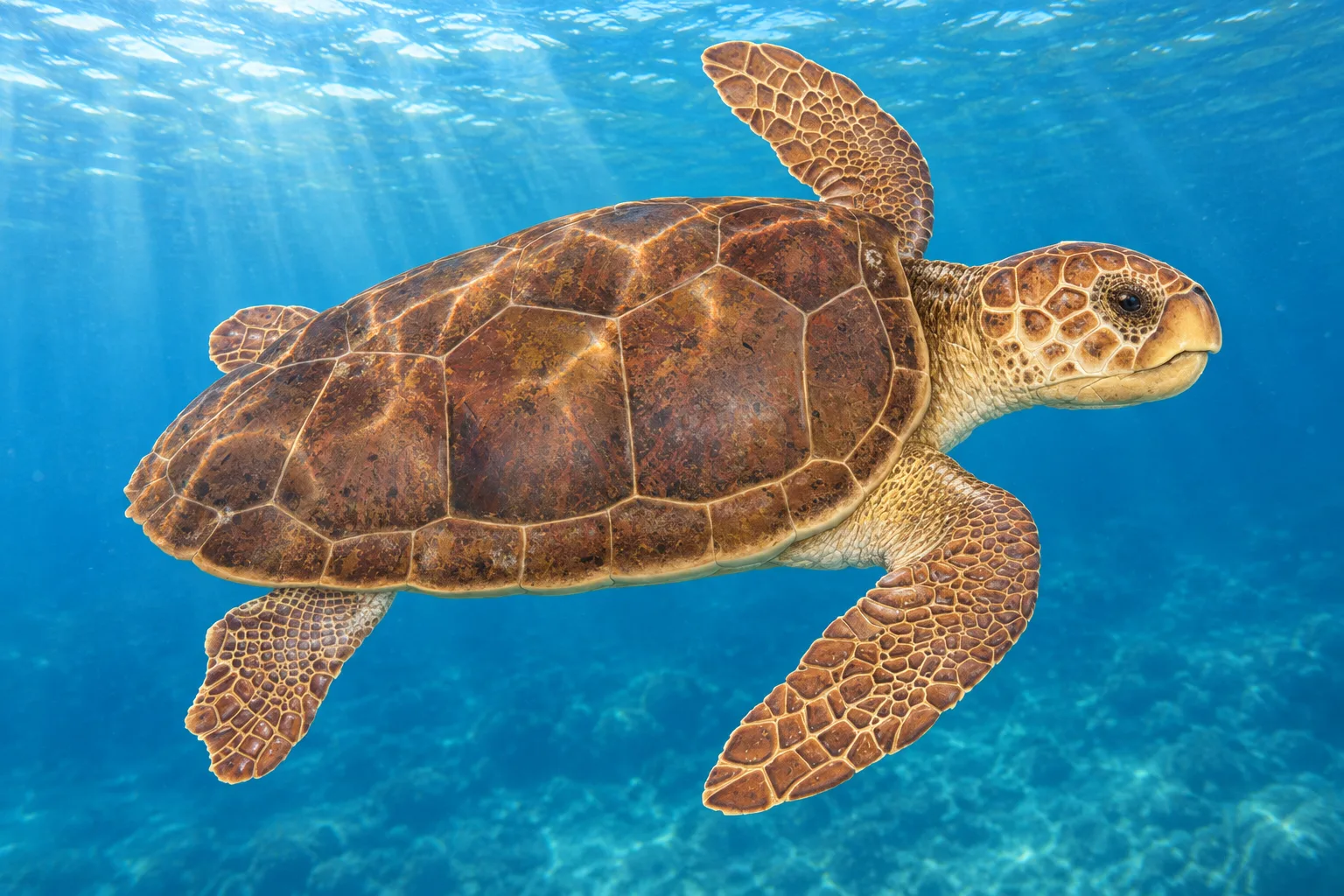
The loggerheads off Baja California Sur were born on beaches in Japan. They cross the whole North Pacific as youngsters and spend two decades or more feeding off the peninsula’s Pacific coast before swimming back to Japan to breed.
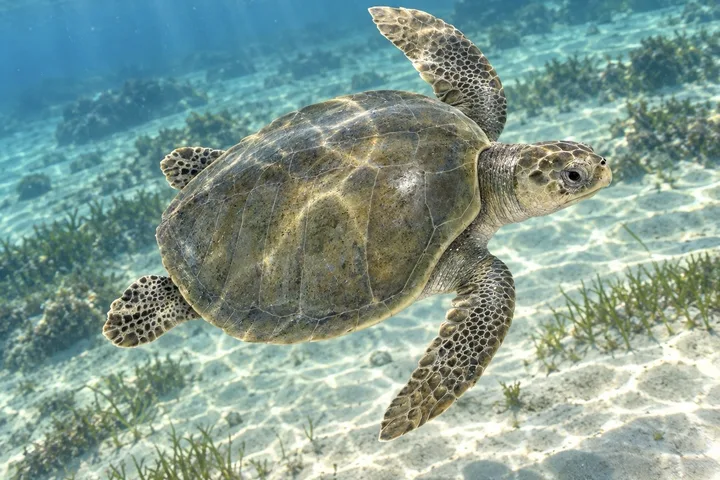
A very large, broad head, bigger for its body than any other sea turtle’s, with two pairs of scales between the eyes. Heart-shaped, reddish-brown shell with five scutes along each side that don’t overlap, and a pale yellowish belly. Short, thick front flippers with two claws each.
Loggerheads live in temperate and subtropical seas around the world. The North Pacific population nests only in Japan, and its numbers there have fallen 50 to 90% over the last 60 years. Young turtles cross the Pacific, and juveniles settle to feed off Baja California Sur. In 1996 a loggerhead named Adelita, released in Baja California, became the first sea turtle tracked by satellite across an ocean, all the way to Japan.
Loggerheads are carnivores, named for the big head that holds powerful jaws for crushing hard-shelled prey. Off Baja, juveniles averaging about 69 cm in shell length feed mostly on pelagic red crab, which gathers over the shelf in the Gulf of Ulloa, on the Pacific side of Baja California Sur. Growth rings in their bones show they can stay in the area for more than 20 years and reach maturity around age 25, when they head back across the Pacific to nest.
Hatchlings from Japan have been tracked crossing the Pacific to feed off Baja California, a journey of nearly 12,900 km (8,000 miles), before returning to their birthplace to nest.
Source ↗A loggerhead released at Santa Rosaliita, Baja California, on 10 August 1996 was tracked by satellite for 368 days and more than 11,500 km, reaching Sendai Bay, Japan.
Source ↗Pelagic red crabs are the main food of juvenile loggerheads off Baja. Where nearshore currents hold the crabs on the shelf, the Gulf of Ulloa becomes a loggerhead feeding hotspot.
Source ↗Aerial surveys from 2005 to 2007 estimated an average of about 43,000 loggerheads in the Gulf of Ulloa, and suggested up to 11% of them may die each year.
Source ↗Tracked juveniles spent 70% of their time within reach of small-scale fishing fleets. Two fleets alone killed over 1,000 loggerheads a year, and 982 carcasses washed up on Playa San Lázaro in 2003–2005.
Source ↗Bones of 146 stranded loggerheads showed ages from 3 to 24 years, which points to more than 20 years spent off Baja and maturity at around 25 years old.
Source ↗Loggerheads are not a regular sight around Cabo. The North Pacific turtles concentrate on the Pacific side farther north, especially in the Gulf of Ulloa, where their core feeding area is centered about 32 km from shore. If you spot a big-headed, reddish-brown turtle at the surface offshore, slow down, keep your distance and never chase or touch it.
If a turtle takes a bait or gets tangled in a line, don’t yank it or haul it up by the line. Bring it alongside slowly; if it’s small enough, lift it with a net or by the shell, keeping hands away from its powerful jaws and flippers, and carefully cut away any line wrapped around it. Otherwise cut the line as short as possible and let it go. By law, every turtle goes back in the water, and injured or entangled turtles can be reported to PROFEPA.
| Mexico (NOM-059) | In danger of extinction (P) |
|---|---|
| Total ban since 1990 (DOF) | No catching, chasing, disturbing or harming sea turtles, and no taking eggs. Turtles caught by accident must go back in the water |
| Federal Penal Code, art. 420 | 1 to 9 years in prison for capturing, harming or killing a sea turtle or taking its products |
| Gulf of Ulloa refuge (first created 2015; current agreement DOF 2023) | 19,934 km² fishing refuge off Baja’s Pacific coast to cut turtle bycatch: limits on gill nets, circle hooks only on longlines, and no diving or spearfishing for sportfishers. SEMARNAT also made it a loggerhead refuge area in 2018 |
| IUCN Red List | Vulnerable globally; North Pacific subpopulation: Least Concern, but dependent on ongoing conservation |
| U.S. Endangered Species Act | North Pacific population listed as Endangered (2011) |
| CITES | Appendix I: no international trade |
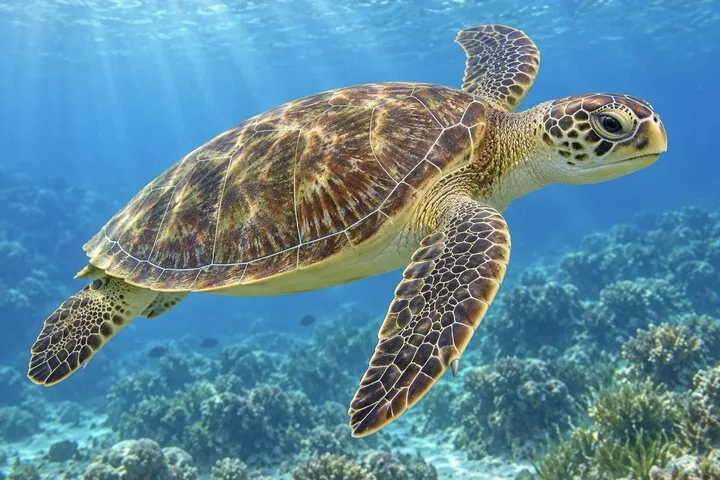
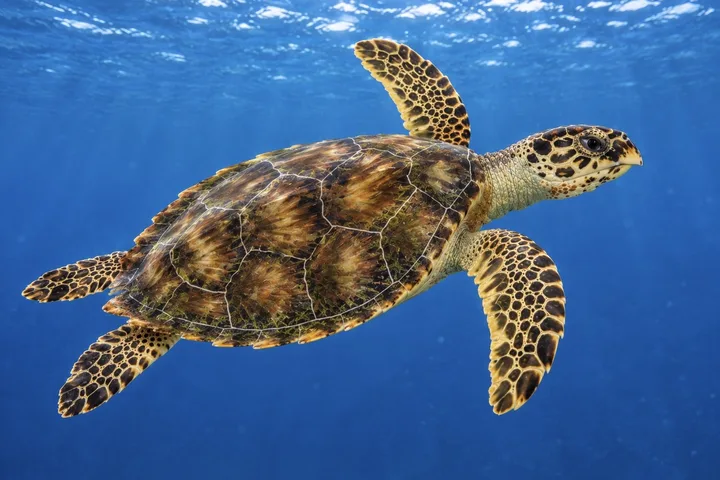
The olive ridley is much smaller, with a rounder, olive shell and usually five or more scutes along each side. The green turtle has four side scutes and a small, rounded head, and the hawksbill has overlapping scutes and a pointed, hawk-like beak. The loggerhead is the one with the huge head, a reddish-brown shell and five side scutes.
No. The loggerheads off Baja belong to the North Pacific population, which nests only in Japan. Baja’s Pacific coast is where they come to feed and grow.
Not always. In Los Cabos, “caguama” has long been the everyday word for sea turtles in general. The loggerhead is the true caguama, also called tortuga amarilla on Baja’s Pacific coast.
Don’t pull it up by the line. Bring it in slowly, lift it with a net or by the shell if it’s small, or cut the line as short as possible and release it.

Top illustration: Top Anglers. Photos: iNaturalist contributors, credited on each photo.
Our charters leave the Cabo San Lucas marina every morning. From $799 with license included.