Baja’s most common shark
A study of 1,033 blue sharks landed off the Pacific coast of Baja California Sur (2000–2003) found it to be the most abundant species in the region’s artisanal shark fishery, and most of the catch were juveniles.
Source ↗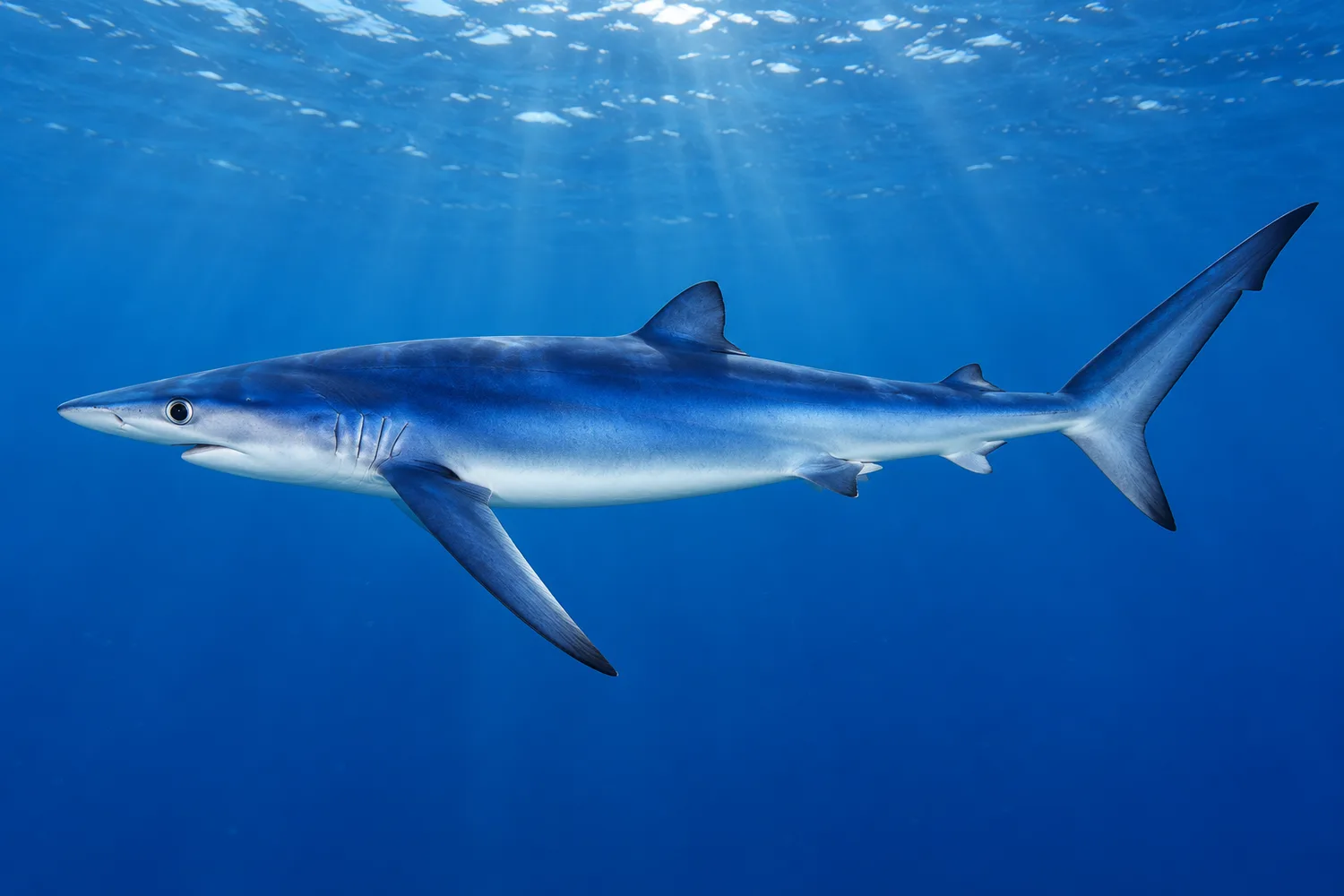
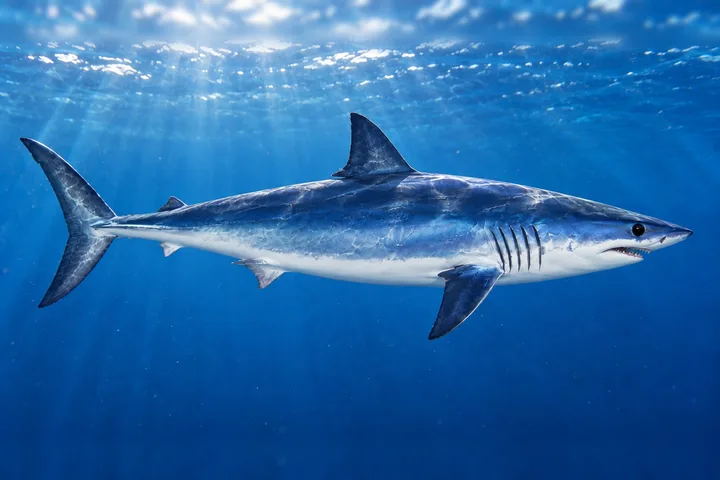
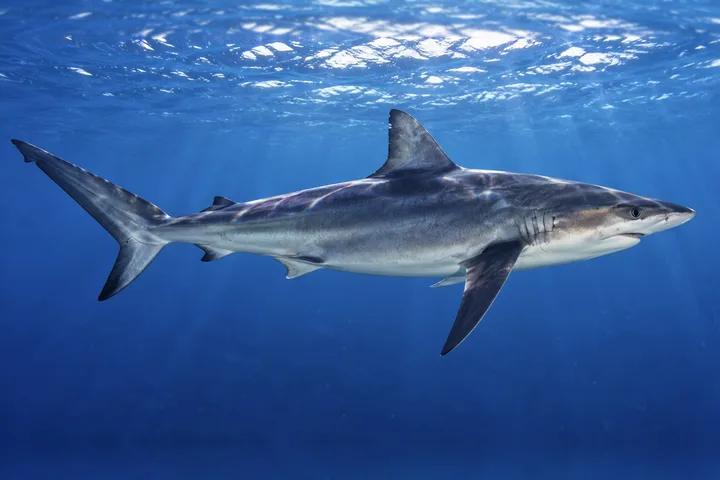
A long, slender shark of the open ocean, deep cobalt blue on top and bright white below. Off Baja California Sur it is most common in the cooler months and is the most abundant shark in local artisanal catches. We release every one.
Slender and graceful, with a long, conical snout and large eyes. The back is a deep, dark blue, the sides a brighter blue, and the belly a crisp, clean white. The pectoral fins are extremely long and pointed, and the first dorsal fin sits well back on the body, closer to the pelvic fins than to the pectorals.
Blue sharks live in temperate and tropical oceans worldwide and are found in the eastern Pacific from the Gulf of Alaska to Chile. They range from the surface to about 1,000 m but usually stay in the top 220 m, and they favor cool water. North Pacific blue sharks seem to travel less than once thought: a chemical-tracer study found that about 95% of eastern Pacific blues stayed on their side of the ocean.
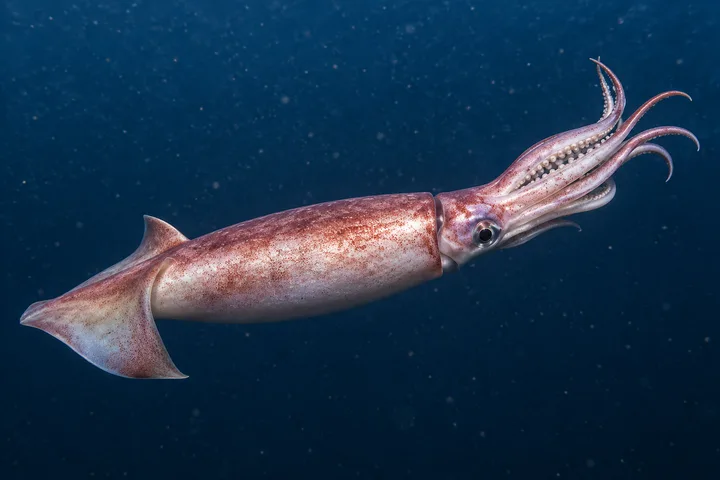
They eat mostly small fish and squid and feed day and night. Mothers nourish their young through a placenta for 9 to 12 months, and litters are among the largest of any shark, from 4 to as many as 135 pups of about 35 to 44 cm. Off Baja California Sur, males mature at about 180 cm and females at about 200 cm, litters run 9 to 64 pups (33 on average), and the smallest embryos appear in August and September. Blue sharks live 20 years or more.
A study of 1,033 blue sharks landed off the Pacific coast of Baja California Sur (2000–2003) found it to be the most abundant species in the region’s artisanal shark fishery, and most of the catch were juveniles.
Source ↗The outer shelf of Bahía Vizcaíno, on Baja’s Pacific coast, is recognized as an Important Shark and Ray Area for young blue sharks: newborns with unhealed umbilical scars have been recorded there, mostly at 50–100 m depth.
Source ↗Longline records from 2006–2010 placed most pregnant blue sharks between 20° and 23° N and 110° and 115° W, the open water south and southwest of Los Cabos toward the Revillagigedo Islands, with the most catches in October to December.
Source ↗Around 20 million blue sharks are caught each year worldwide.
Source ↗The blue shark is not aggressive but is very curious. The International Shark Attack File lists 13 unprovoked bites worldwide, and three documented attacks followed air or sea disasters.
Source ↗Blue shark numbers have crashed in the Mediterranean and fallen in the North Atlantic, while Pacific populations look comparatively stable, though uncertain.
Source ↗Off southern Baja, blue sharks are mostly a cool-season fish. Off the Pacific coast of Baja California Sur they were most abundant in artisanal catches in winter and spring, and on the Gulf coast of the state they made up about 19% of shark and ray landings in spring 1998–99. Off Cabo they are an offshore fish, listed among the sharks recorded in the Cabo San Lucas Important Shark and Ray Area.
We release every blue shark. Best practice: circle hooks that aren’t stainless steel, keep the shark in the water, unhook it quickly or cut the leader close to the hook, and hold it facing forward while the boat moves slowly so water runs over its gills. Never lift a big shark by the tail or gills.
| Daily limit (NOM-017-PESC-1994) | Sharks: 1 per angler per day, and it counts as 5 of the 10 fish |
|---|---|
| Closed season (Pacific) | All shark species, May 1 – July 31; no shark fishing during the closure |
| IUCN Red List | Near Threatened (assessed 2018) |
| CITES | Appendix II since November 25, 2023 (all requiem sharks): international trade needs permits |
| IGFA all-tackle record | 528 lb (239.49 kg), Montauk Point, New York, USA, 2001 |
Top Anglers practices catch-and-release for all sharks.
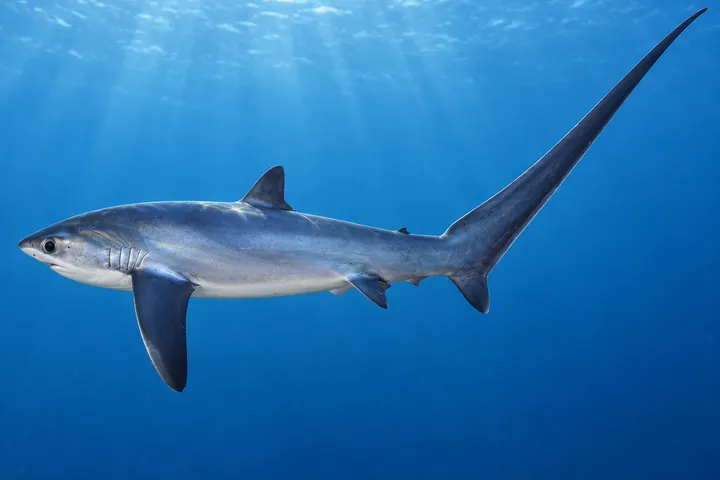
The shortfin mako is stockier, with a pointed snout, a crescent-shaped tail with nearly equal lobes and much shorter pectoral fins. The silky shark is bronze-gray rather than blue, with shorter pectorals and a first dorsal that starts just behind them. The oceanic whitetip has a broad, rounded first dorsal and mottled white fin tips. No other shark off Cabo combines the bright blue color with such long, narrow pectoral fins.
By law a sport angler may keep one shark per day outside the Pacific closed season (May 1 – July 31). The blue shark is Near Threatened, and we release every one.
Mostly in the cooler months. Studies of local catches found them most abundant off Baja California Sur’s Pacific coast in winter and spring, and pregnant females are caught south and southwest of Los Cabos mostly from October to December.
They are curious but not aggressive. Only 13 unprovoked bites are on record worldwide, and they live offshore, so contact with people is rare.

Top illustration: Top Anglers. Photos: iNaturalist contributors, credited on each photo.
Sportfishers with the range to reach the offshore banks. From $799 with license included.