Named for a parrot
Perrico was the local name in Mazatlán, where the species was first described, for parrotfish with green teeth. It is probably another spelling of perico, Spanish for parakeet.
Source ↗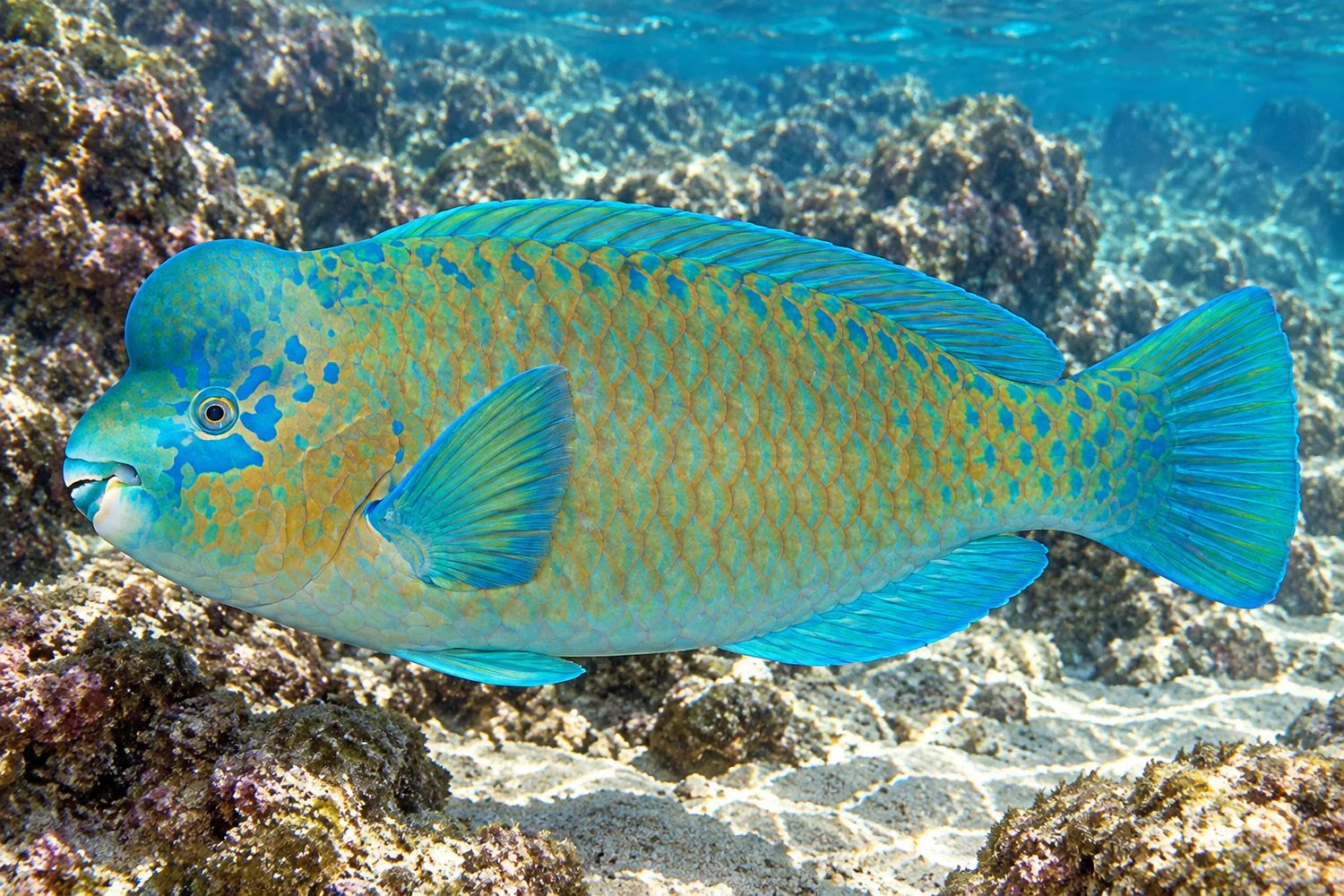
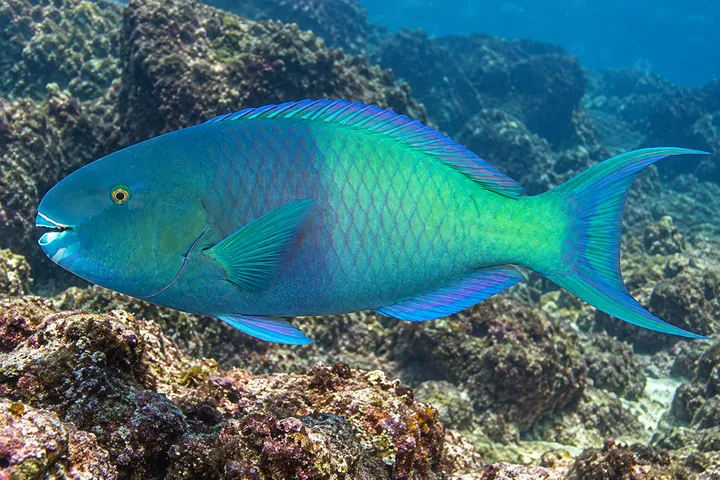
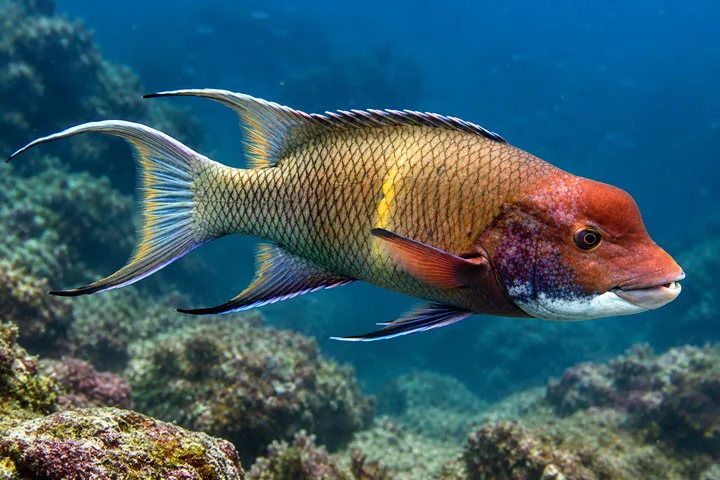
A big green parrotfish that grows a hump on its forehead as it gets larger. Small groups graze the rocky reefs, biting algae-covered rock with a parrot-like beak. It lives only in the eastern Pacific.
Deep, compressed body with a blunt, slightly rounded tail. The teeth are fused into a beak of two broad plates on each jaw, not covered by the lips. Large fish develop a prominent hump on the forehead. Adults are green to bluish green with dark blue fins, dark spoke-like lines radiating from the eye and a blue beak. Juveniles are tan, with a yellowish tail base and tail fin, blue lines radiating from the eye, blue-edged fins and a blue beak. It has only 2 rows of scales on the cheek; the other Scarus parrotfish in Cabo have 3.
The bumphead parrotfish is found only in the tropical eastern Pacific, from the southwestern and northeastern Gulf of California to northern Peru, plus the Revillagigedo, Galápagos, Cocos and Malpelo islands. It is a resident of rocky reefs from 1 to 30 m deep. Researchers who sampled it in La Paz Bay and Los Cabos describe it and the bluechin parrotfish as the two dominant reef parrotfish of the Gulf of California.
It is usually seen grazing on rocky reefs in small aggregations. It scrapes the bottom for coralline red algae and probably coral polyps; STRI also lists microalgae, detritus and hard corals in its diet. It can reach 80 cm (31 in).
Perrico was the local name in Mazatlán, where the species was first described, for parrotfish with green teeth. It is probably another spelling of perico, Spanish for parakeet.
Source ↗A study of fish from La Paz Bay and Los Cabos found the bumphead has more jaw-closing force and bite power than the bluechin parrotfish. The authors class it as an excavator, one of the main agents wearing down rocky reefs in the Gulf of California.
Source ↗At Islas Marietas, Nayarit, researchers documented bumphead and ember parrotfish grazing on live coral communities for the first time.
Source ↗In 2009, the largest individuals of 25 of 88 reef fish species surveyed in the Gulf of California, including Scarus parrotfish, were found at Cabo Pulmo National Park.
Source ↗Mexico's NOM-059 lists ten Caribbean parrotfish under special protection (Pr). None of the Pacific parrotfish, including this one, is on the list.
Source ↗FishBase estimates low resilience for this species (population doubling time 4.5 to 14 years) and rates its vulnerability to fishing as high (57 of 100).
Source ↗The bumphead parrotfish is a fish for snorkelers and divers, not a sport fish. Look for small groups of large green fish grazing over the rocks in shallow water. FishBase notes it is only caught occasionally.
It feeds by biting algae off rock with its beak, so it seldom takes baits or lures. If one is hooked by accident, release it. It is not protected under NOM-059, but sport fishing is not allowed inside Cabo Pulmo National Park.
Edible. FishBase lists it in commercial fisheries but notes it is only caught occasionally.
| Daily limit (NOM-017-PESC-1994) | General rule: up to 5 per angler per day, within the 10-fish total |
|---|---|
| Mexico (NOM-059-SEMARNAT-2010) | Not listed |
| IUCN Red List | Least Concern (2007) |
| CITES | Not listed |
| Cabo Pulmo National Park | Sport fishing not allowed |
Not a sport fish. If one is hooked by accident, release it.
The azure parrotfish (Scarus compressus) has a slight forehead hump too, but terminal males are green with orange-brown scale outlines and green spoke-like bands around the eye, and the tail is straight to slightly concave. The bluechin parrotfish (Scarus ghobban) has no hump; terminal males are blue-green on the back with salmon-pink scale edges and a pair of blue bands on the chin. The ember parrotfish (Scarus rubroviolaceus) has a steep snout but no hump, and its males have a deeply forked tail. A big hump and only 2 rows of cheek scales mark the bumphead.
The hump develops as the fish grows, and large individuals have a prominent one. It is the easiest way to pick this species out from other parrotfish in Cabo.
It is not listed in NOM-059; only Caribbean parrotfish are. Sport fishing is not allowed in Cabo Pulmo National Park.
It is edible and FishBase lists it in commercial fisheries, but it is only caught occasionally and is not a sport fish.

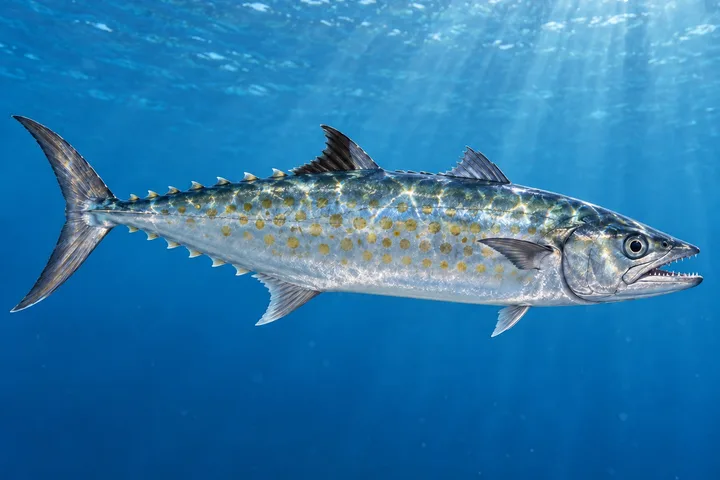
Top illustration: Top Anglers. Photos: iNaturalist contributors, credited on each photo.
Our charters leave the Cabo San Lucas marina every morning. From $698 with license included.