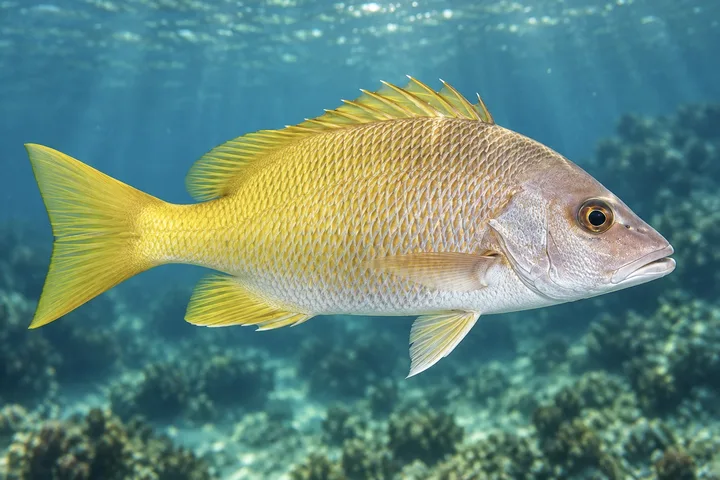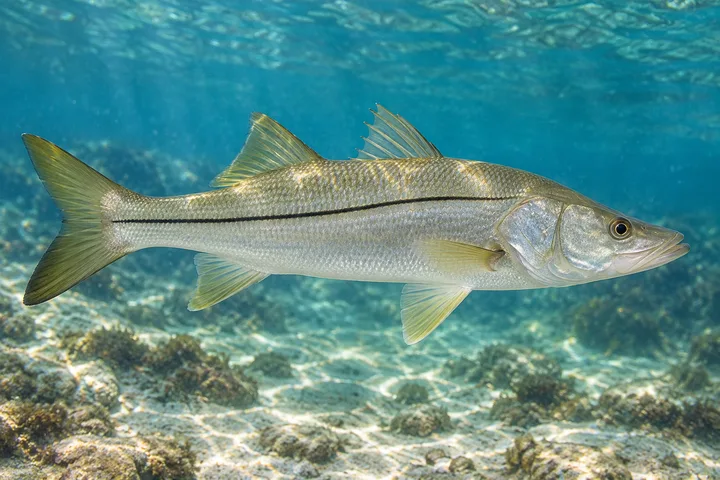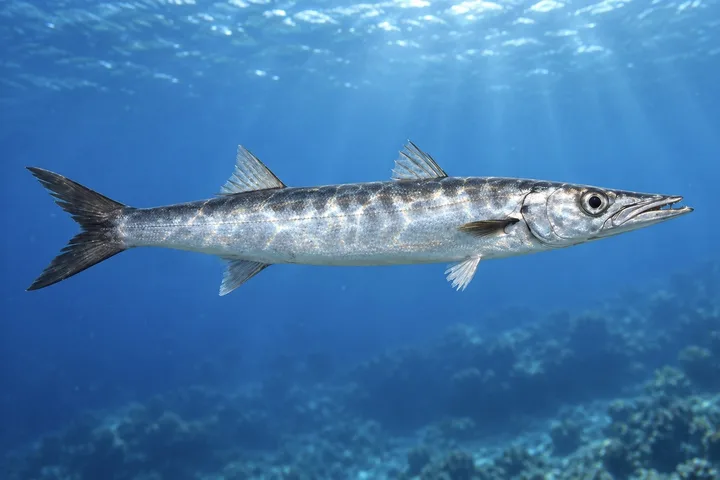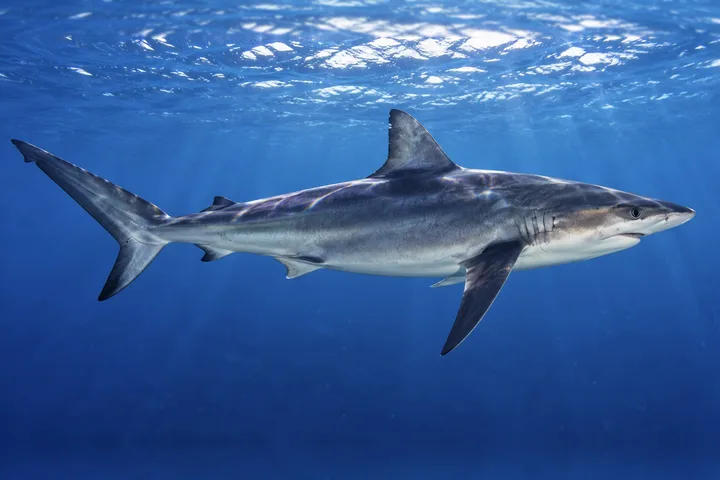
A grouper, not a snapper
It was known for decades as Paranthias colonus. Current catalogs place it in the grouper genus Cephalopholis, family Epinephelidae.
Source ↗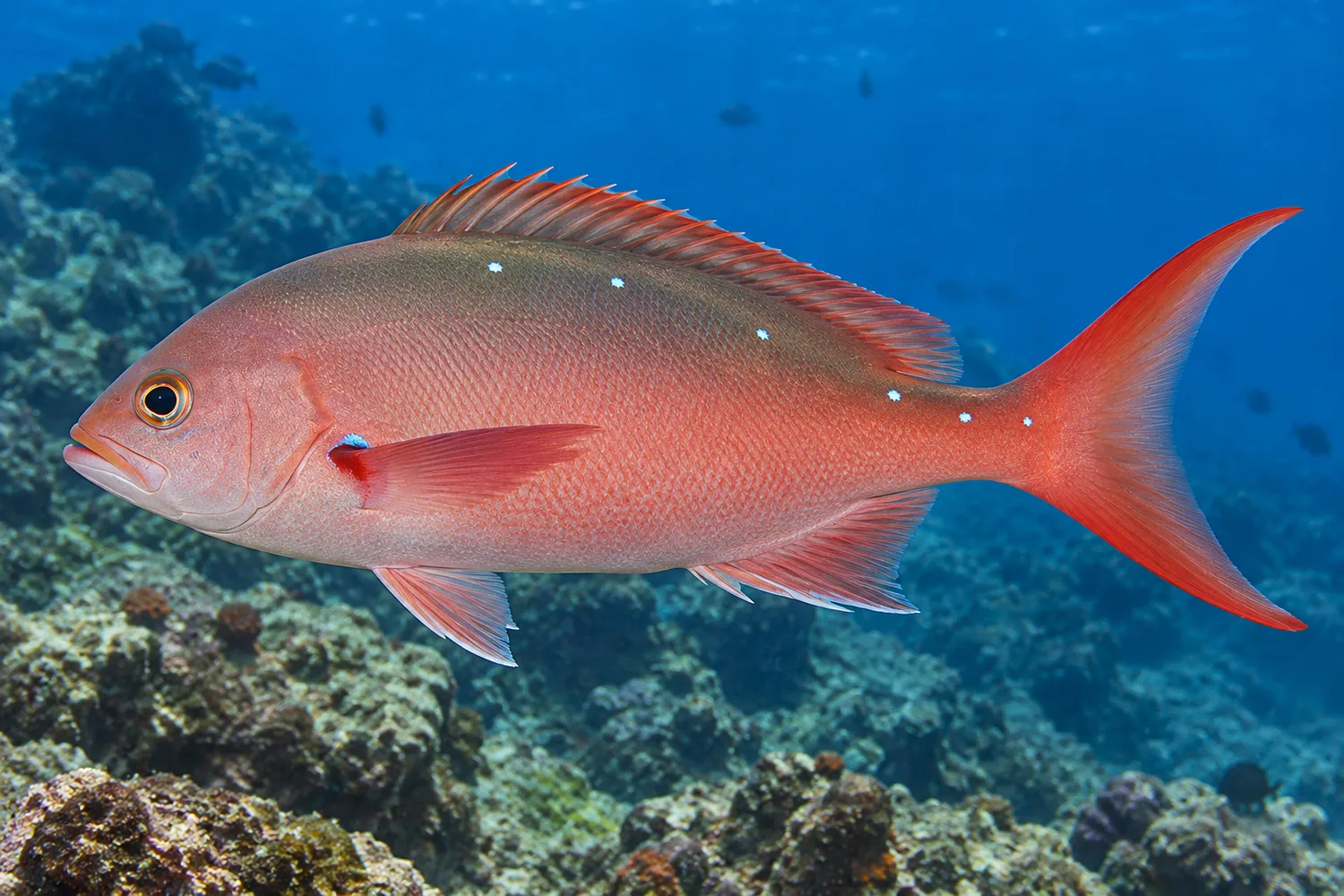
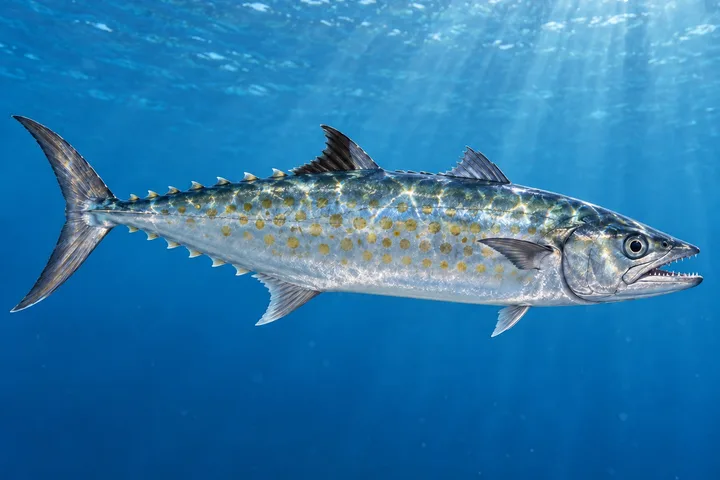
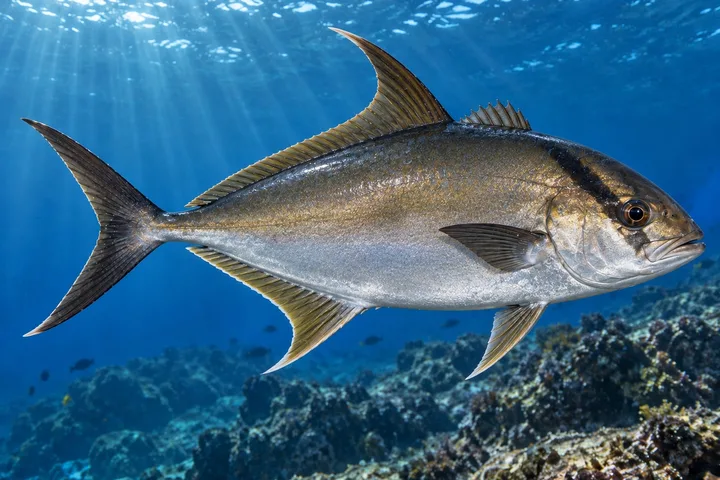
A slim, reddish fish that hangs in schools in open water above rocky reefs, picking plankton out of the current. Look for a row of small white spots on its back. It is a small cousin of the groupers, not a snapper.
A slender, spindle-shaped fish with a small head, a short snout and a strongly forked tail. Adults are greenish brown on the back and reddish below, with reddish fins. Along the back there are about five small white or blue-white spots: two or three under the rear of the dorsal fin and two on the side of the tail base. The base of the pectoral fin is red with a bright blue spot in the armpit. Young fish are often bright yellow, sometimes gray, with a row of five small dark spots on the back.
The Pacific creolefish lives only in the tropical eastern Pacific, from southern Baja and the central Gulf of California to Peru, including the Revillagigedo, Clipperton, Cocos, Malpelo and Galápagos islands. It is a resident of rocky reefs from the surface down to about 120 m and is commonly seen at dive depths around Cabo San Lucas.
It feeds in midwater, often in large schools well above the reef, and dives back into the rocks when danger comes close. It eats mainly small plankton, picked one at a time; its short snout gives it good close-range binocular vision for that job. Unlike many relatives in the grouper family, it does not change sex: a study of 1,541 fish off Jalisco found separate males and females, two spawning periods a year (March to June and November to December) and maturity at about 27 cm.
It was known for decades as Paranthias colonus. Current catalogs place it in the grouper genus Cephalopholis, family Epinephelidae.
Source ↗Colonus is a Latin form of Colon, a local name in the Antilles for the Atlantic creolefish, which this species closely resembles.
Source ↗It feeds mainly on small planktonic animals picked out of the water one by one. Its short snout gives it close-range binocular vision.
Source ↗Off Jalisco, researchers who examined 1,541 fish found separate sexes (gonochorism), unlike many fish in its family. Females and males matured at about 27 cm.
Source ↗In visual censuses at Cabo Pulmo reef between 1987 and 1998, it turned up in 25 to 50% of the counts.
Source ↗FishBase lists the Pacific creolefish among the fish that barberfish clean of parasites.
Source ↗The Pacific creolefish is mostly a fish for snorkelers and divers. Around Los Cabos it hangs in schools above rocky reefs and points, and it is easy to watch from the surface on a clear day. It is not a sport-fish target.
It feeds on plankton, so it is hooked only now and then by people fishing small baits near the reef. FishBase notes it is used mostly as bait and in subsistence fisheries, and off Jalisco it is landed in the commercial catch. If you keep one, the general daily limit applies. Sport fishing is not allowed inside Cabo Pulmo National Park.
Edible. It is landed in commercial and subsistence fisheries, though FishBase lists it mainly as bait. FishBase also lists reports of ciguatera poisoning for this species.
| Daily limit (NOM-017-PESC-1994) | General rule: up to 5 per angler per day, within the 10-fish total |
|---|---|
| Mexico (NOM-059-SEMARNAT-2010) | Not listed |
| IUCN Red List | Least Concern (assessed 2016) |
| CITES | Not listed |
| Cabo Pulmo National Park | Sport fishing not allowed |
A reef and dive fish. Not protected, but not a sport-fish target.
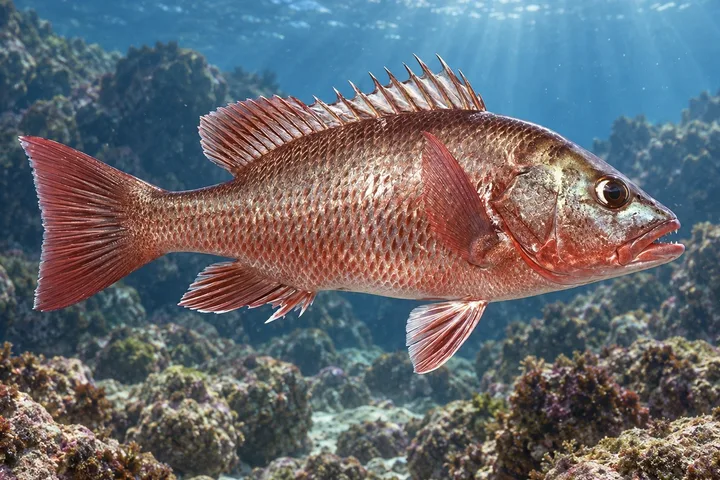
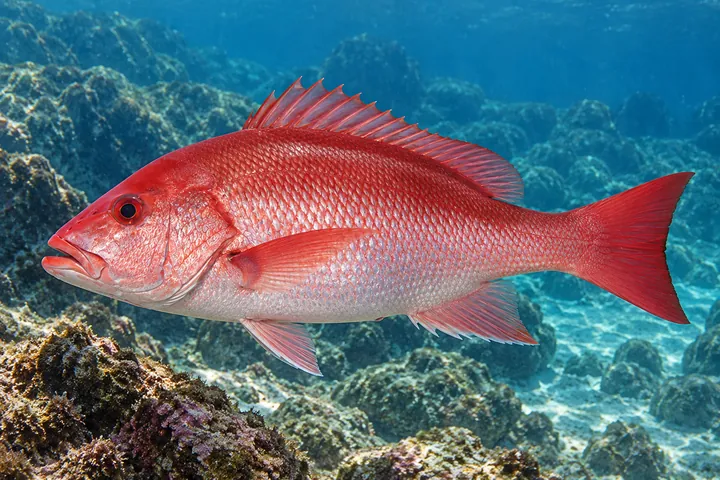
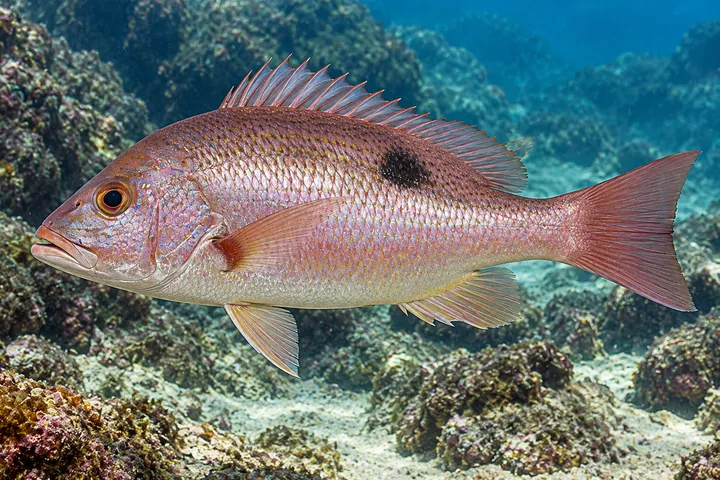
The scissortail chromis (Azurina atrilobata) also schools in midwater over Cabo's reefs, but it is much smaller (up to 13 cm), metallic gray, with a single white spot below the end of the dorsal fin and a black streak in each tail lobe. The Pacific red snapper (Lutjanus peru) is red too, but it is a bigger, deeper-bodied bottom fish with a larger mouth and no row of white spots on the back. The Pacific graysby (Cephalopholis panamensis), the only other Cephalopholis in the region, stays on the bottom, has a rounded tail and about nine dark bars across its body.
No. It looks a little like a small red snapper, but it belongs to the grouper family. It was long called Paranthias colonus and is now placed in Cephalopholis.
On snorkel and dive sites with rocky reef, where schools hang in open water above the rocks feeding on plankton. It is found from the surface down to about 120 m.
It is not protected, so the general sport-fishing limit applies: no more than 5 of one species within 10 fish per angler per day. Sport fishing is not allowed in Cabo Pulmo National Park.

Top illustration: Top Anglers. Photos: iNaturalist contributors, credited on each photo.
Our charters leave the Cabo San Lucas marina every morning. From $698 with license included.