Named "tortilla"
Mexico's official list of protected species includes "tortilla" among the common names of this ray.
Source ↗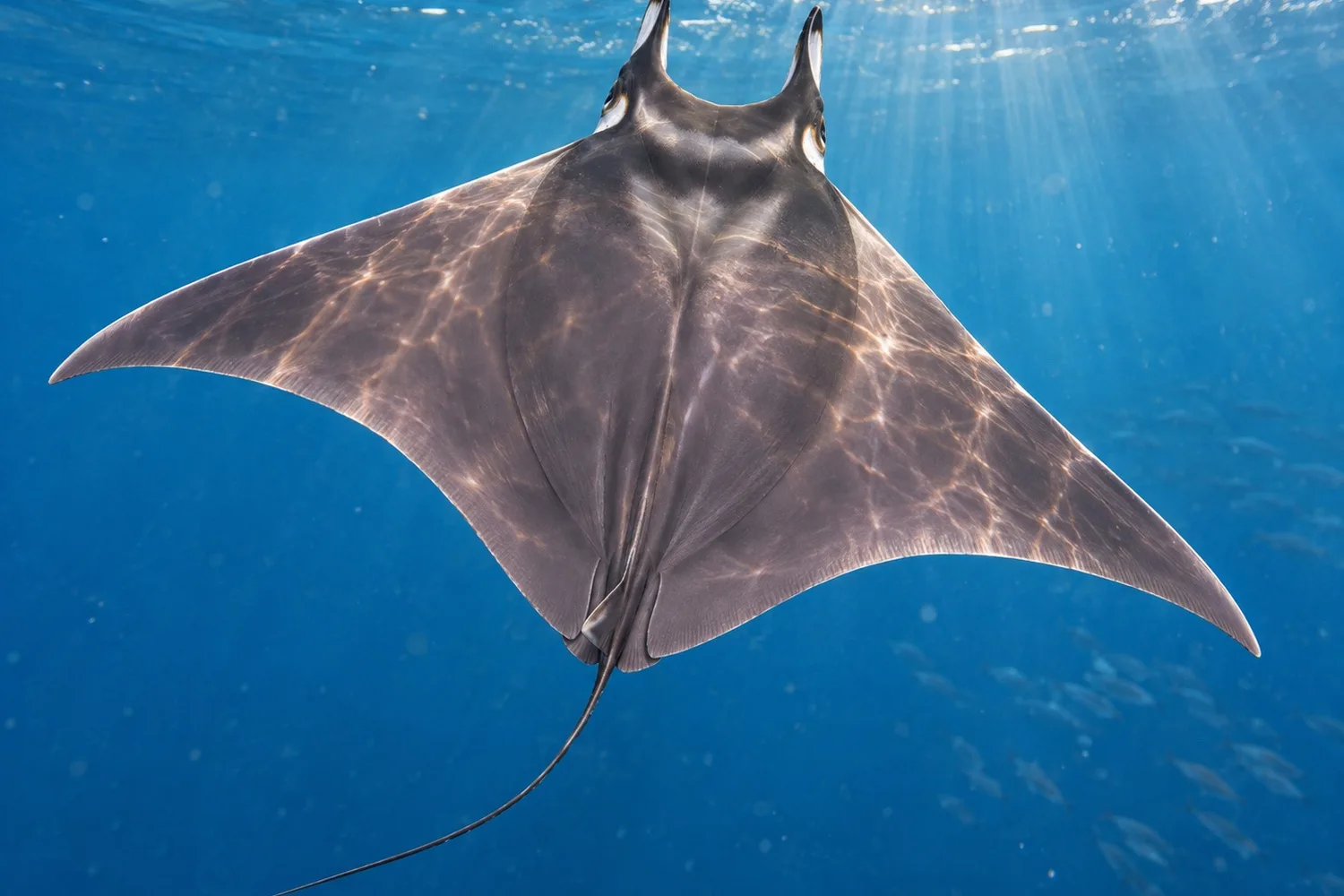
Thousands of small rays leaping clear of the water at once. Munk's devil rays gather in huge schools in the southern Gulf of California, and scientists are only now discovering what they're doing.
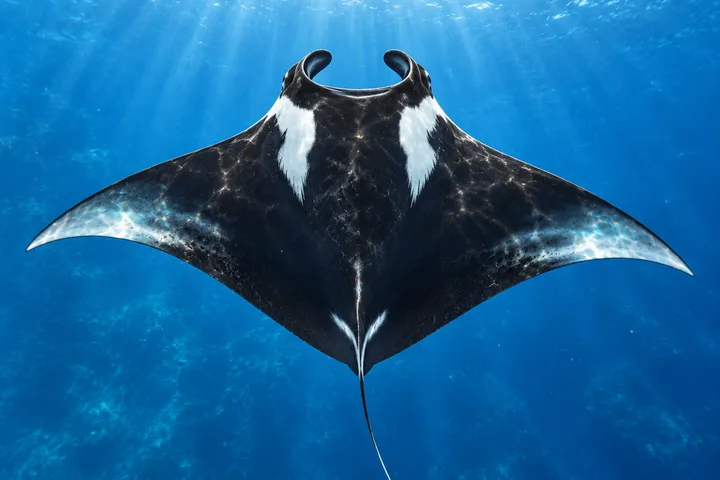
The smallest devil ray: purplish gray to brown on top and white below, with a dark collar-like band across the head, a small dorsal fin without a white tip and no spine on the tail. The two lobes at the front of the head can roll up or unfold.
Munk's devil rays live in coastal waters of the eastern tropical Pacific, from the Gulf of California to Peru. They feed on zooplankton, mainly tiny shrimp-like mysids and krill, filtering it through their gills.
A female has a single pup per pregnancy, born in spring, which gives them the lowest reproductive rate known among sharks and rays. Mating peaks in May, and the first known nursery was found at Ensenada Grande, on Isla Espíritu Santo, near La Paz.
Mexico's official list of protected species includes "tortilla" among the common names of this ray.
Source ↗Researchers filmed 122 rays circling clockwise together for five hours: a courtship behavior never described before.
Source ↗During courtship, males leap out of the water and land on a female's back, sometimes over and over before mating.
Source ↗A female has a single pup per pregnancy, the lowest reproductive rate of any shark or ray, which makes every animal count.
Source ↗Nobody knows for sure. The leading ideas are shaking off parasites, courtship and communication; mantas and devil rays are the sharks and rays most often seen leaping.
Source ↗In 2018 genetic work moved the giant manta into the genus Mobula, so today all mantas are officially devil rays.
Source ↗The big leaping schools appear in the southern Gulf of California, mainly from February into July, with a peak in May and June; local operators also report a smaller showing in December and January. From the boat, watch for splashes and rays flying out of the water.
Watch without chasing or driving through the school. If one is hooked by accident, keep it in the water, never gaff it or grab it by the head lobes or gills, and cut the line close to the hook. Mexican law requires releasing it.
| Capture (NOM-029) | Catching or keeping mobulas is banned; any caught by accident must be returned to the water |
|---|---|
| Mexico (NOM-059) | Subject to special protection (Pr) |
| IUCN Red List | Vulnerable (2019) |
| CITES | Appendix I since 2026 (Appendix II 2017–2026) |
The spinetail devil ray grows to about 3 m and has a white-tipped dorsal fin and a tail spine. The smoothtail devil ray (Mobula thurstoni) has a double curve on the front edge of each wing. The giant manta is many times larger.
Mainly from February into July, peaking in May and June, in the southern Gulf of California.
No. Munk's devil ray has no tail spine and feeds on plankton.
No. Mexican law bans catching or keeping them, and any caught by accident must be released.

Top illustration: Top Anglers. Photos: iNaturalist contributors, credited on each photo.
Our charters leave the Cabo San Lucas marina every morning. From $799 with license included.