Named after a sparrow
Passer is Latin for sparrow. The author who named it in 1846 never explained why.
Source ↗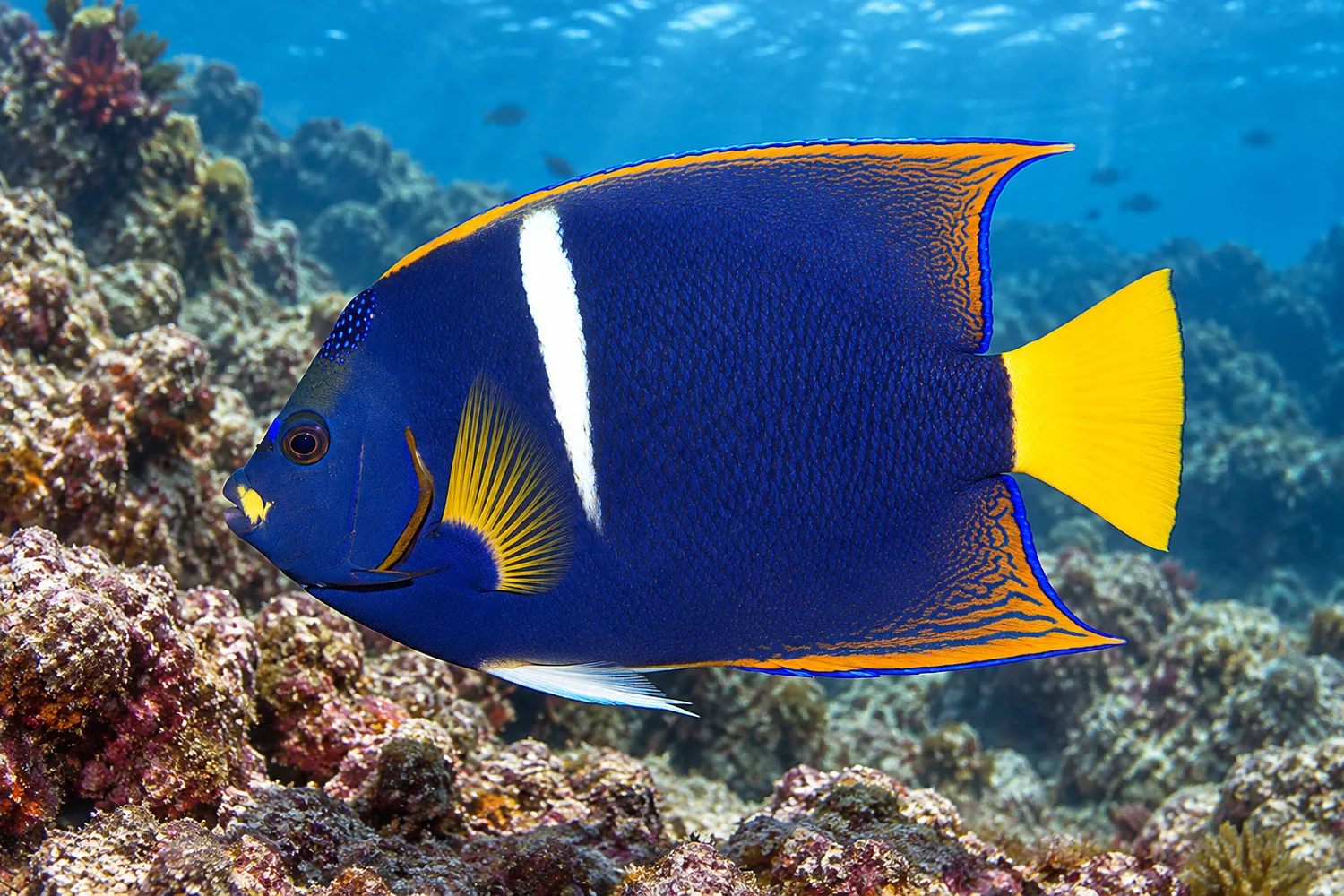
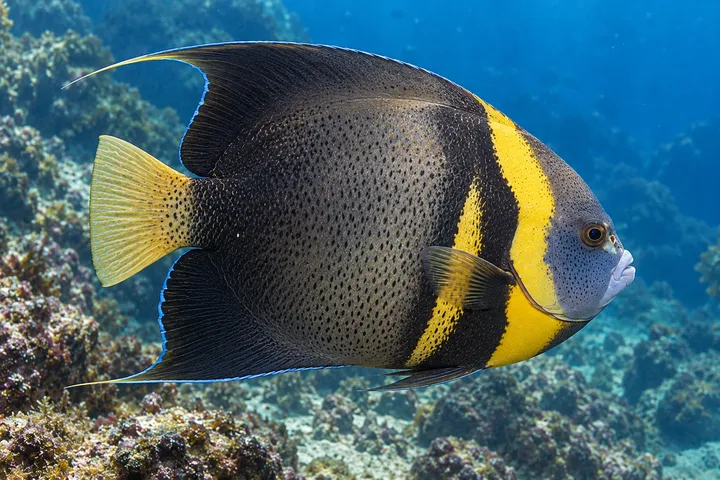
A dark blue-gray angelfish with one narrow white bar on its side and a bright yellow tail. It is one of the most common angelfish on the rocky reefs of southern Baja. In Mexico it is a protected species.
Adults have a deep, flat body and a small mouth. They are velvety blue-gray with blue scale centers, and have a single narrow white bar on the side, level with the rear edge of the pectoral fin. The tail is yellow. On the nape, just in front of the dorsal fin, there is a dark patch with small pale-blue spots. The dorsal and anal fins have a bluish base, a pink to reddish outer band and blue edges, and end in filaments. The pelvic fins are white in males and pale yellow in females. Juveniles are orange in front and brown behind, with 5 to 6 narrow blue bars on the side, a pair of blue bars on the head around a broad brown bar through the eye, and an orange tail.
The king angelfish lives only in the tropical eastern Pacific, from Isla Guadalupe and southern Baja through the Gulf of California to northern Peru, including the Revillagigedo, Galápagos, Malpelo and Cocos islands. It is a resident of rocky reefs and coral areas from 1 to 80 m deep, and young fish sometimes turn up in tide pools. At Cabo Pulmo it was rated common and appeared in 75 to 100% of underwater fish counts made between 1987 and 1998.
It feeds by day on sponges, plus algae, other attached invertebrates and plankton. Adults usually live in pairs that share a home range rather than defending a strict territory, and they spawn in late summer. Juveniles pick parasites off other fish, and adults have been seen cleaning sharks. Holacanthus angelfishes are thought to start life as females and change to males as they grow; for this species FishBase says that is still awaiting confirmation.
Passer is Latin for sparrow. The author who named it in 1846 never explained why.
Source ↗It is one of five Mexican ornamental reef fish under special protection (Pr), together with the Cortez angelfish. It can only be collected for aquariums in federally authorized areas, yet it was the best-selling species under those permits from 2005 to 2009. The average beach price was about 9.07 USD per fish.
Source ↗Juveniles clean parasites from other fish, and Reef Life Survey reports adults cleaning parasites off sharks.
Source ↗Males have white pelvic fins and females have pale yellow ones, so you can tell a pair apart underwater.
Source ↗When the Isthmus of Panama closed about 3 million years ago, Holacanthus angelfish were split into an Atlantic and a Pacific group. A genome study of king angelfish from La Paz found its populations grew before the last ice-age peak, earlier than expected for most species.
Source ↗It sometimes gathers in mixed groups with the Cortez angelfish.
Source ↗The king angelfish is a fish for snorkelers and divers, not anglers. It is common on the rocky reefs around Los Cabos and Cabo Pulmo, often in pairs. It is not a sport fish.
It has a small mouth and feeds mostly on sponges, so it is rarely hooked. If one ever comes up on a bait, unhook it gently and put it straight back: it is protected in Mexico. Sport fishing is not allowed inside Cabo Pulmo National Park.
| Mexico (NOM-059-SEMARNAT-2010) | Subject to special protection (Pr) |
|---|---|
| Aquarium collection | Only under federal wildlife authorization (Ley General de Vida Silvestre), in approved areas |
| IUCN Red List | Least Concern (2009) |
| CITES | Not listed |
| Cabo Pulmo National Park | Sport fishing not allowed |
Protected in Mexico. If one is ever hooked, release it right away.
The Cortez angelfish (Pomacanthus zonipectus) is bigger and gray, with a broad yellow band behind the head and a narrower yellow band behind the pectoral fin, and no white bar. Its juveniles are black with six curved yellow bars and thin blue bars between them, while young king angelfish are orange in front and brown behind with thin blue bars. The Clarion angelfish (Holacanthus clarionensis) is orange-brown with an orange tail; it lives mainly at the Revillagigedo Islands and only strays to southern Baja.
It is not a sport fish and is protected in Mexico (Pr). If one is hooked by accident, release it right away.
Look at the pelvic fins under the belly: white in males, pale yellow in females.
No. Sport fishing is not allowed in Cabo Pulmo National Park.

Top illustration: Top Anglers. Photos: iNaturalist contributors, credited on each photo.
Our charters leave the Cabo San Lucas marina every morning. From $698 with license included.