How it's caught in Los Cabos
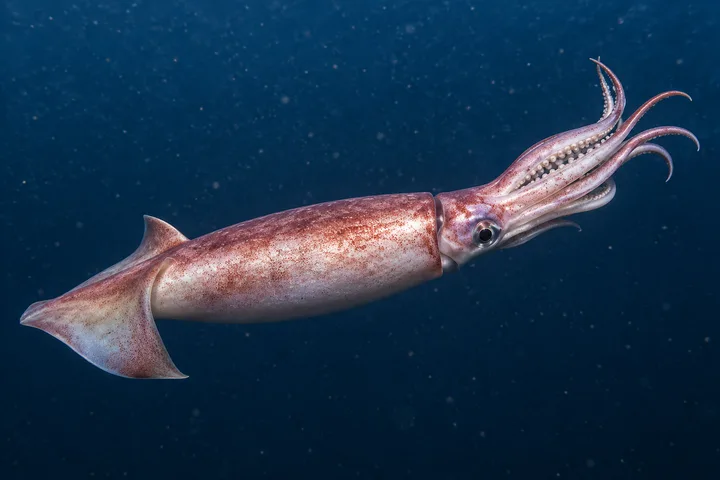
In Baja California Sur octopus is a small-boat commercial fishery. On the Pacific coast, pangas set traps; in the Gulf of California, divers breathing air from a compressor (hookah) pull octopus from their holes with a metal hook. Mexico’s fishery chart lists 458 boats authorized for octopus in Baja California Sur. Sport anglers and spearfishers may not take octopus at all: under Mexican rules, squid is the only mollusk they can keep.
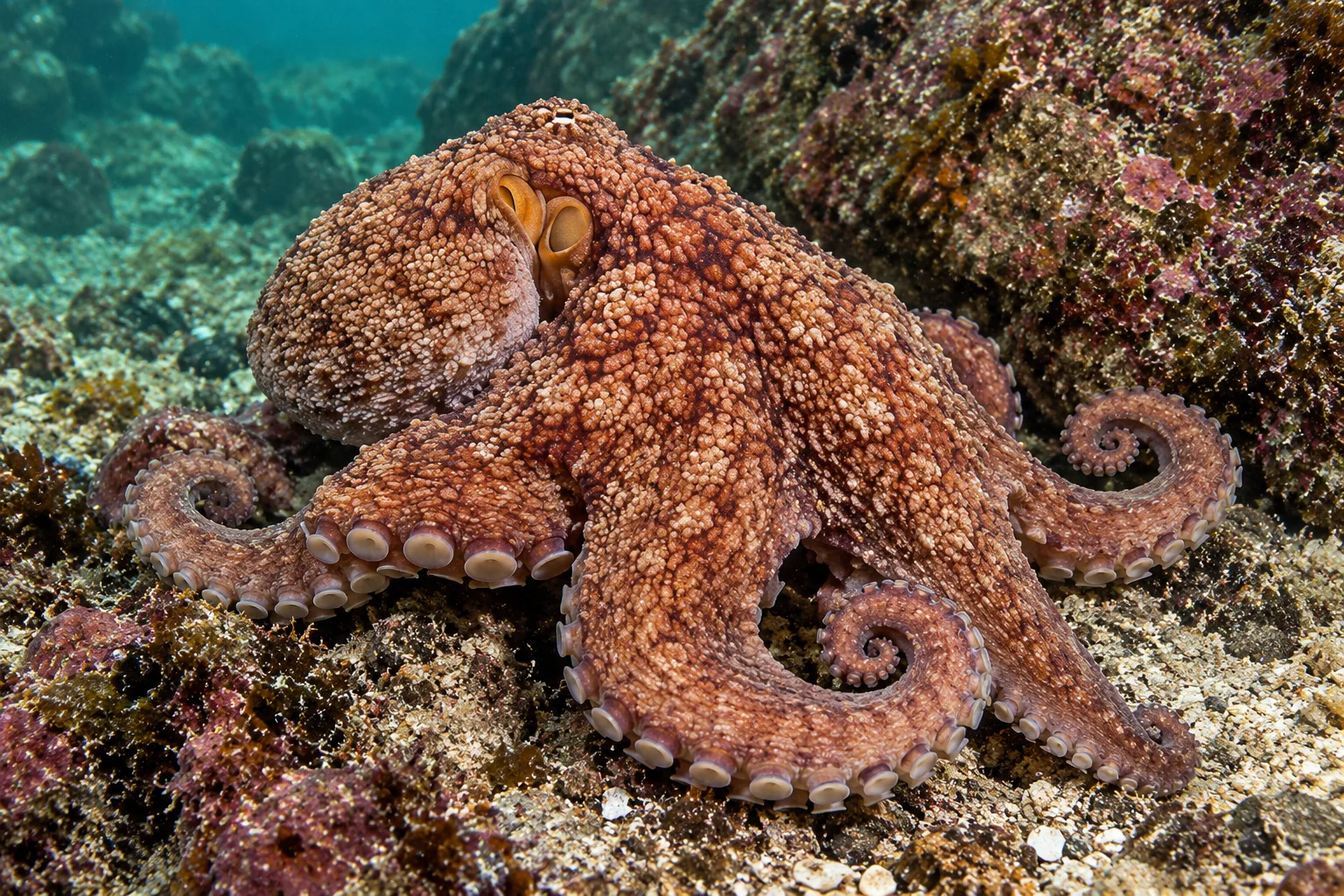
Around Los Cabos you are more likely to meet one with a mask than on a line. Green octopus hunts at night, so by day snorkelers and divers usually find it wedged into a crevice, watching, or see it flash through color changes when it moves. Inside Cabo Pulmo National Park, where most iNaturalist sightings near Cabo come from, commercial fishing is banned. Look, don’t grab: octopus bite with a hard beak.
On the table
Green octopus is the octopus served across Baja California Sur, mostly from local traps and hookah divers. Baja California Sur has no closed season or minimum size for octopus; Mexico’s only Pacific octopus closure is in Bahía de los Ángeles, Baja California, where green octopus is closed September 1 to November 30. In a study of octopus from metal-polluted Santa Rosalía, the mantle, the part people eat, stayed within international limits for human consumption.
Rules, records & conservation
| Sport fishing (NOM-017-PESC-1994, 2013 update) | Octopus may not be taken; squid is the only mollusk anglers may keep |
|---|
| Spearfishing | Fish only; hooks and gaffs are not allowed underwater |
|---|
| Commercial fishery | Permit required; traps on the Pacific coast, hookah diving with a hook in the Gulf |
|---|
| Closed season and minimum size in BCS | None; Mexico’s only Pacific octopus closure is in Bahía de los Ángeles, BC |
|---|
| Cabo Pulmo National Park | Commercial fishing banned; sport fishing catch-and-release only |
|---|
| Mexico (NOM-059) | Not listed |
|---|
| IUCN Red List | Least Concern (2016) |
|---|
Don't confuse it with
The two-spot octopus (Octopus bimaculatus) has a dark eyespot below each eye and is caught mainly in Baja California and Sonora; the green octopus has no eyespots. Museum collections from off Cabo also hold Octopus veligero and Octopus penicillifer, and even experts struggle to tell octopus apart underwater because they change color, pattern and shape.
Questions
Can you catch octopus in Cabo San Lucas?
Not as a sport angler or spearfisher. Mexican sport fishing rules allow squid as the only mollusk; octopus is caught by commercial fishermen with permits.
Where can I see an octopus in Los Cabos?
Snorkeling or diving on rocky reefs. Most recent sightings near Cabo come from Cabo Pulmo and Los Frailes, and museum specimens have been collected in Bahía San Lucas. By day they hide in crevices; they hunt at night.
How long do octopus live?
The green octopus lives only about 1.5 to 2 years. After reproducing, both males and females die.

By Max VargasTop Anglers, Cabo San Lucas · international judge at big game fishing world championships · reviewed October 2026
Sources
- Carta Nacional Pesquera 2023, Pulpo del Pacífico (DOF)
- NOM-017-PESC-1994, 2013 amendment (DOF)
- Pliego-Cárdenas et al. 2011, reproduction at Isla Espíritu Santo (Ciencias Marinas)
- Alejo-Plata et al. 2009, reproduction, diet and fishery in Oaxaca (Rev Biol Trop)
- Diet and isotopic niche of Octopus hubbsorum in the Mexican Pacific, 2023 (J Molluscan Stud)
- Albertin et al. 2015, the octopus genome (Nature)
- Ramirez & Oakley 2015, light-sensing octopus skin (J Exp Biol)
- Ruiz-Mendoza et al. 2026, the Octopus mimus–O. hubbsorum complex (Ecol Evol)
- Scripps specimen SIO M8714, Bahía San Lucas, 1959 (GBIF)
Top illustration: Top Anglers. Photos: iNaturalist contributors, credited on each photo.