Magnetic road maps
At El Bajo de Espíritu Santo, near La Paz, tagged hammerheads swam out at night along the same routes, far from both surface and seafloor, apparently following magnetic patterns in the rock below.
Source ↗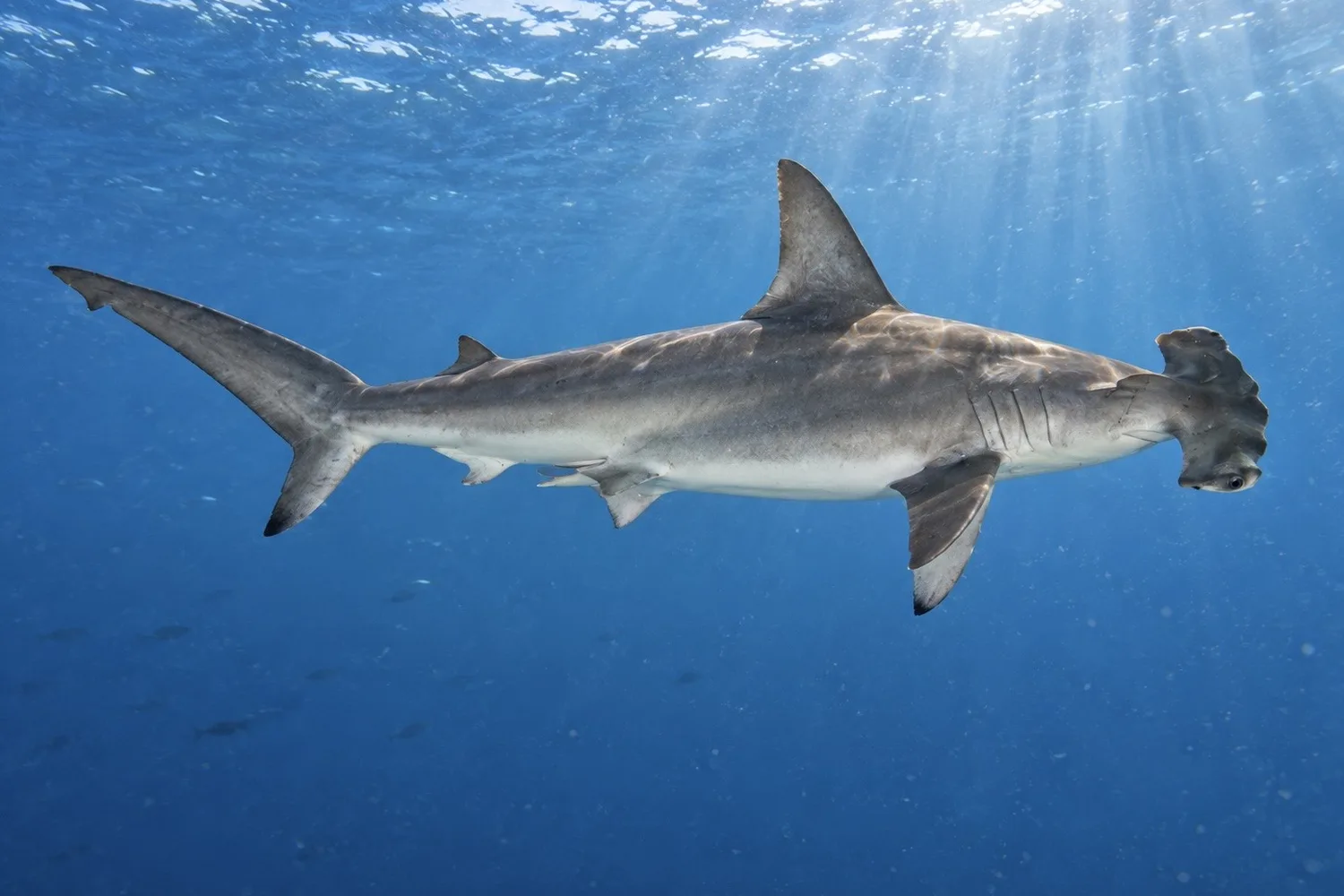
The schools of hammerheads over the seamounts of the Sea of Cortez were once one of the great sights of the ocean. Today the species is critically endangered, and every one we see is released.
A broadly arched head with a notch in the middle of its front edge and smaller notches along it, which give the "scalloped" look. Grey-brown above, white below, with straight rear edges on the pelvic fins.
Scalloped hammerheads live in warm seas worldwide; in the eastern Pacific they range from southern California to Ecuador. They spend the day in schools, often sorted by sex, around seamounts and close to shore, and move offshore at night to hunt fish, squid, octopus, stingrays and smaller sharks.
They give birth to live young, 12 to 41 pups per litter, after a pregnancy of 9 to 12 months. Nursery areas run along Mexico's Pacific coast, including Baja California, and females return to the nurseries where they were born. They can live 30 to 35 years.
At El Bajo de Espíritu Santo, near La Paz, tagged hammerheads swam out at night along the same routes, far from both surface and seafloor, apparently following magnetic patterns in the rock below.
Source ↗With eyes at the ends of the hammer, a scalloped hammerhead can see all the way around itself.
Source ↗The hammer doesn't make them more sensitive to electric fields than other sharks, but it lets them sweep about 2.3 times more seabed as they search, and turn more sharply.
Source ↗Hammerheads eat so many stingrays that some have been found with 50 or more stingray spines in their mouths.
Source ↗Divers' records from El Bajo de Espíritu Santo show schools of about 150 hammerheads in the 1970s and about 5 in the 2010s, a 97% decline. Protected Revillagigedo still holds healthy numbers.
Source ↗Genetic studies show related females return to the same nursery areas along Mexico's Pacific coast, where they were born.
Source ↗We don't target hammerheads. They're seen offshore and around the banks off Los Cabos, and divers regularly find them at Gordo Banks.
If one is hooked by accident: keep the fight short, keep the shark in the water, don't gaff it, and cut the leader close to the hook. Hammerheads handle capture stress badly; in longline studies, half were predicted dead after about three and a half hours on the hook.
We don't keep hammerheads. The species is critically endangered.
| Daily limit (NOM-017-PESC-1994) | Sharks: 1 per angler per day, and it counts as 5 of the 10 fish |
|---|---|
| Closed season (Pacific) | All shark species, May 1 – July 31 |
| IUCN Red List | Critically Endangered (2019) |
| CITES | Appendix II since 2014: international trade needs permits |
| U.S. Endangered Species Act | Eastern Pacific population listed as endangered (2014) |
| IGFA all-tackle record | 353 lb (160.1 kg), Key West, Florida, 2004 |
Top Anglers practices catch-and-release for all sharks.
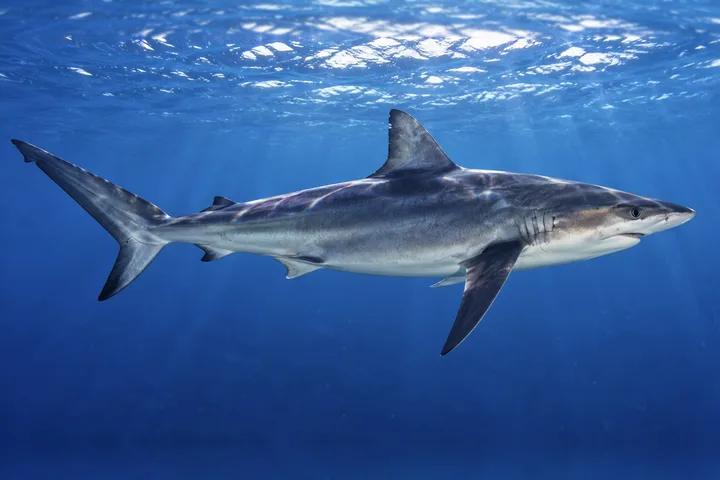
The great hammerhead has an almost straight front edge on the head and a very tall, curved first dorsal fin. The smooth hammerhead has an arched head with no notch in the middle.
Offshore and around the banks; divers regularly see them at Gordo Banks, off San José del Cabo. Revillagigedo, farther out, still has large schools.
Sharks are limited to one per angler per day and are closed from May 1 to July 31 in the Pacific. The scalloped hammerhead is critically endangered, and we release every one.
It lets them sweep more seabed as they hunt, turn sharply and see all the way around them.

Top illustration: Top Anglers. Photos: iNaturalist contributors, credited on each photo.
Sportfishers with the range to reach the offshore banks. From $799 with license included.