The Gulf's most common sea star
On rocky reefs from La Paz to Bahía de Los Ángeles, it made up 65.1% of all sea stars counted and turned up in 90.3% of survey transects.
Source ↗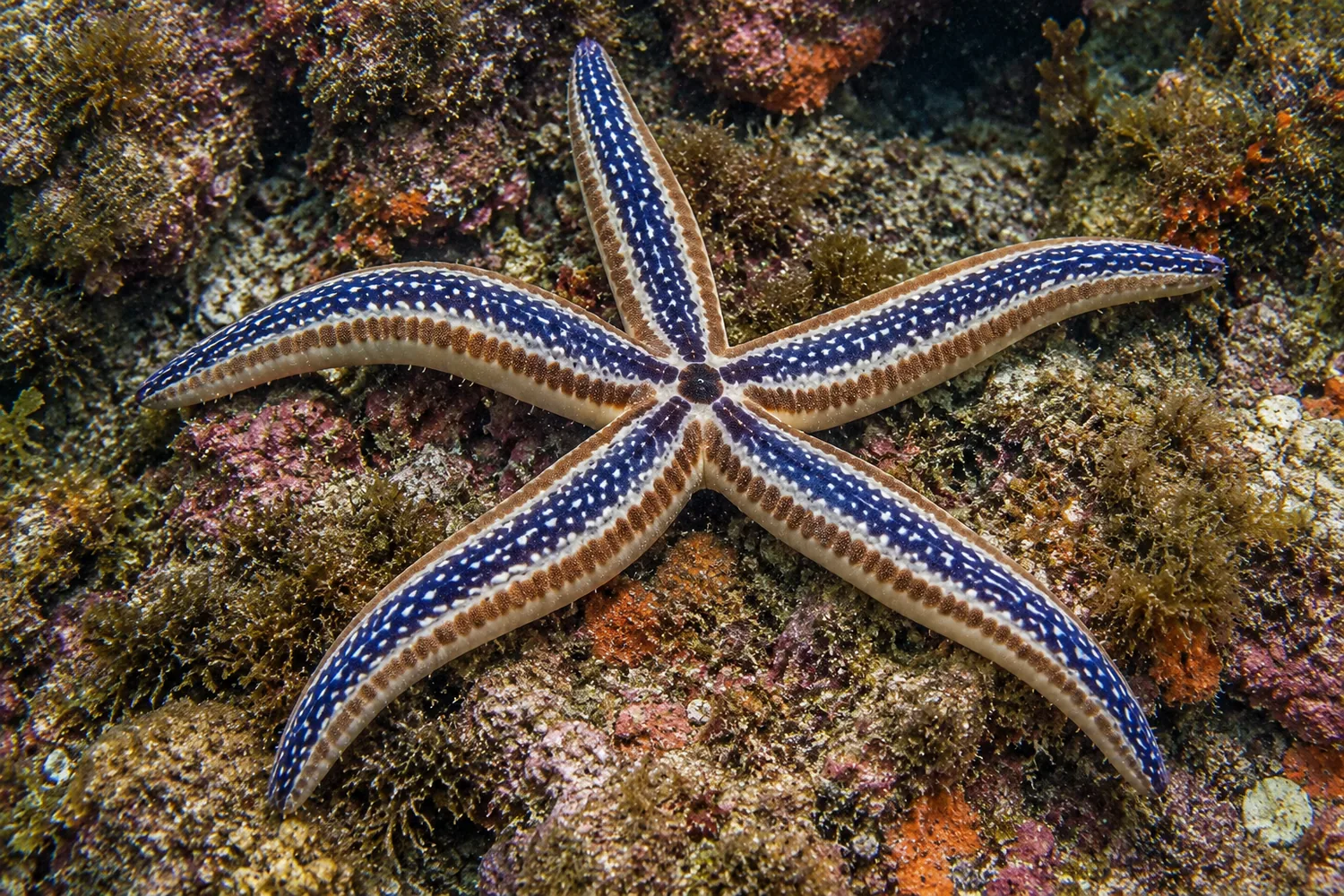
One of the sea stars you're most likely to spot on the rocks while snorkeling in Los Cabos: long arms, a stiff body and stripes. It goes by two names, blue sea star and tan sea star, because its color varies, but the two brown stripes running down each arm give it away.
A small central disc with five long, slender arms that are rounded like tubes and taper to the tips; the body is stiff, not floppy. The base color is grey, tan or brownish, sometimes strongly blue, with two brown stripes running the length of each arm and bluish spots between them. Along the top of each arm runs a main row of small, porous patches (papular areas), flanked by shorter rows on each side.
This sea star lives on rocky bottoms from the Gulf of California and the Pacific coast of Mexico south to Peru, including the Galápagos, from the shallows down to about 50 m. In a survey of rocky reefs from La Paz to Bahía de Los Ángeles, it was by far the most common sea star: 65% of all sea stars counted and present in 90% of transects, with up to about 11 per 50 m² around Loreto. That study classed it as a grazer that feeds on algae. It has been photographed at Cabo San Lucas and is regularly recorded at Cabo Pulmo.
Cold seems to hold it back in the north. A study comparing Loreto with Bahía de Los Ángeles, at the cold northern edge of its range, found it much more common at Loreto, and its activity and metabolism dropped in the low winter temperatures farther north. At Loreto, the population split by depth into a shallow group that was reproducing and a deeper group that was feeding.
On rocky reefs from La Paz to Bahía de Los Ángeles, it made up 65.1% of all sea stars counted and turned up in 90.3% of survey transects.
Source ↗In the southern Gulf, about 5% of 500 sea stars checked carried the parasitic snail Thyca callista, always on the upper side of the arms, mostly in the third closest to the center.
Source ↗Low winter temperatures at Bahía de Los Ángeles reduce its activity and metabolism, which may explain why it does worse there than at Loreto.
Source ↗At Loreto, researchers found the population divided by depth into a shallow, reproducing group and a deeper, feeding group.
Source ↗The genus Phataria has one other species, P. mionactis, which lives only in the Galápagos and has two continuous rows of papular areas on each side of the main row.
Source ↗This is a sea star to see while snorkeling or diving. Look on rocks and boulders in shallow water, from a few meters down; it is regularly recorded around Cabo San Lucas and the tourist corridor and at Cabo Pulmo.
Look, but leave it where it is. Mexico's sport fishing rules allow only fish to be taken, so sea stars can't be collected, and inside Cabo Pulmo National Park collecting wildlife needs a federal permit and visitors must keep 2.5 m from rock and coral formations.
| Sport fishing (NOM-017-PESC-1994, 2013 update) | Only fish may be taken; sea stars cannot be collected |
|---|---|
| Mexico (NOM-059) | Not listed |
| IUCN Red List | Not evaluated |
| Cabo Pulmo National Park | Collecting wildlife only with a SEMARNAT permit for research; keep 2.5 m from rock and coral |
Look, don't take: only fish may be taken under Mexico's sport fishing rules.
The pyramid sea star (Pharia pyramidata), the second most common sea star on Gulf reefs, also has long arms but grows bigger (to about 30 cm) and is lavender to brown with yellow-green spots that leave a clear line down the middle of each arm. The blue sea star's two lengthwise brown stripes per arm are the quickest way to tell it apart.
Both. Its base color ranges from grey and tan to blue, so it is called both blue sea star and tan sea star; the two brown stripes along each arm are what stay the same.
Leave it on the rock. Sea stars can't be taken under Mexico's sport fishing rules, and inside Cabo Pulmo you should keep your distance from rock and coral formations.
On rocky reefs in shallow water around Cabo San Lucas, in the bays along the tourist corridor and at Cabo Pulmo. It is the most common sea star on Gulf of California reefs.

Top illustration: Top Anglers. Photos: iNaturalist contributors, credited on each photo.
Our charters leave the Cabo San Lucas marina every morning. From $698 with license included.