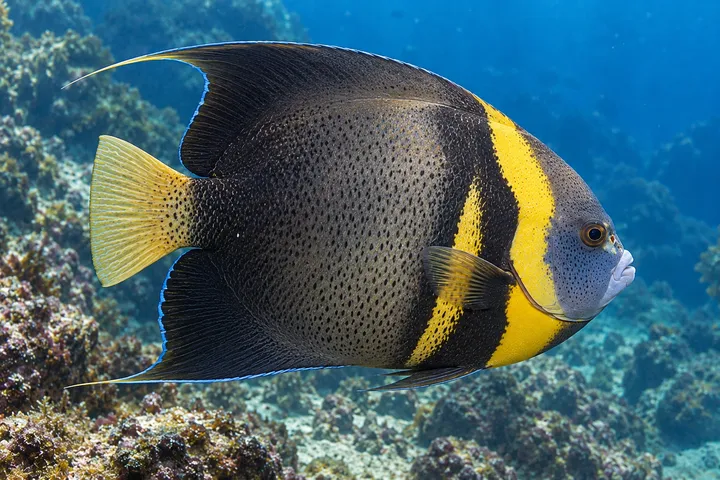
Stripes for courtship
When courting, and at feeding time, males flash strong vertical bars. In aquarium observations, a pair swam in tight circles together while releasing eggs and sperm into the water.
Source ↗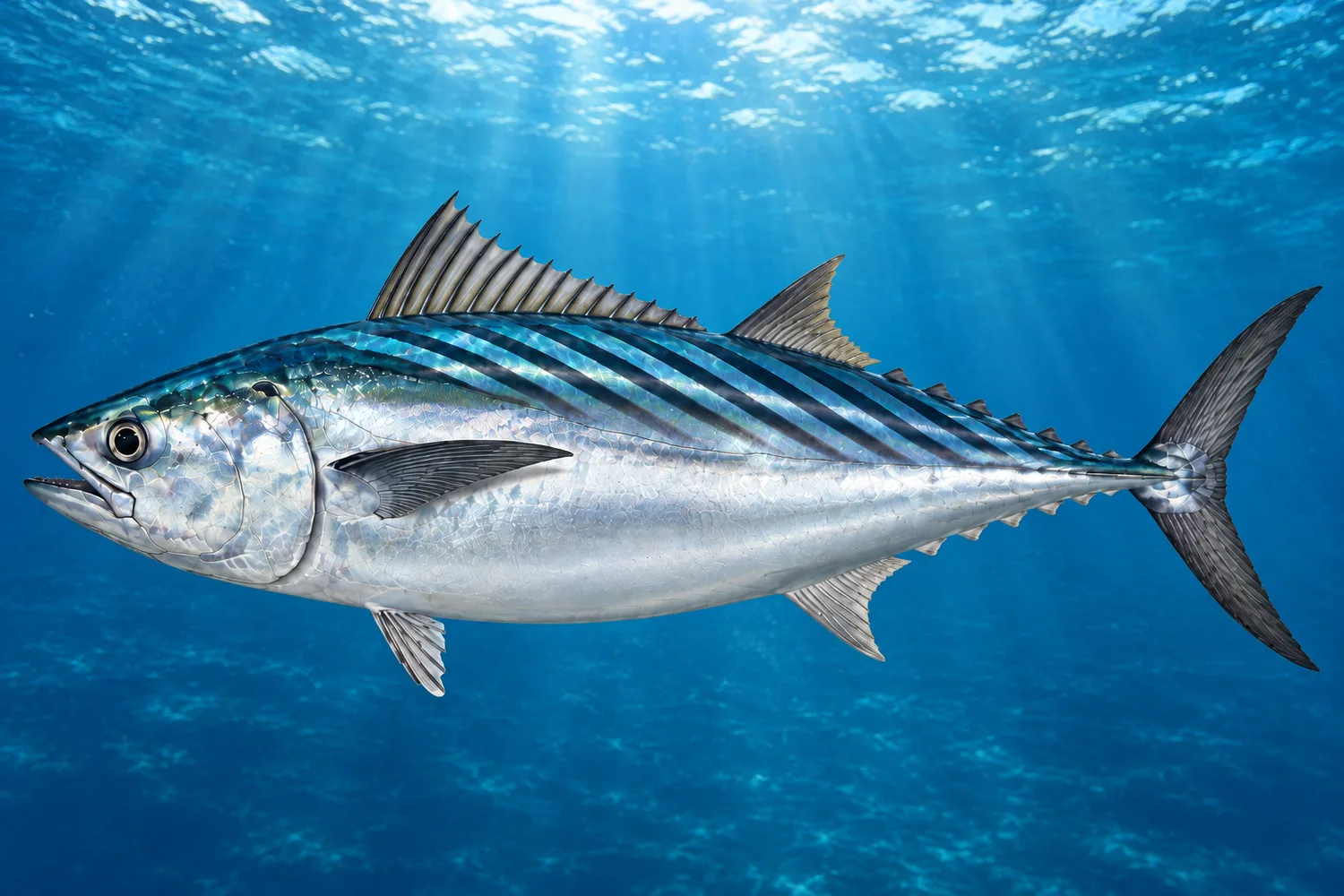
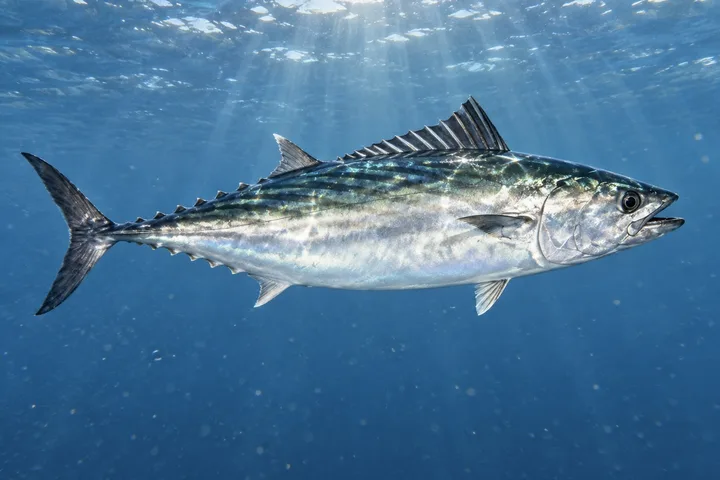
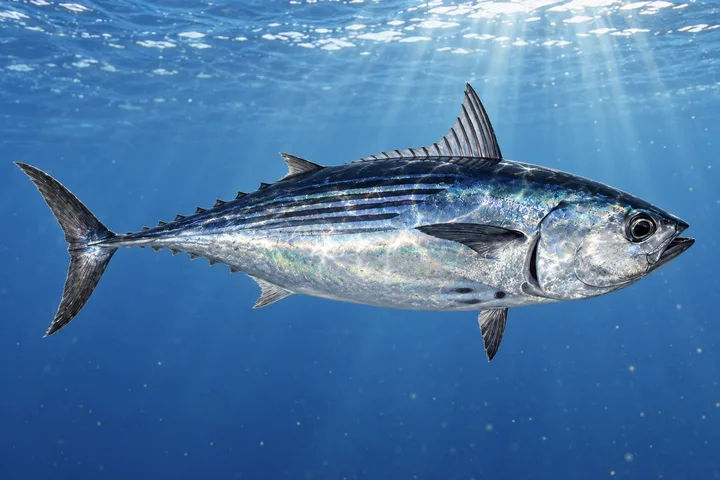
A fast, toothy little tuna relative with slanted stripes on its back. It’s a fish of the cooler Pacific coast of Baja and California, and Cabo sits at the very southern tip of its range, so here it shows up mostly in the cooler months.
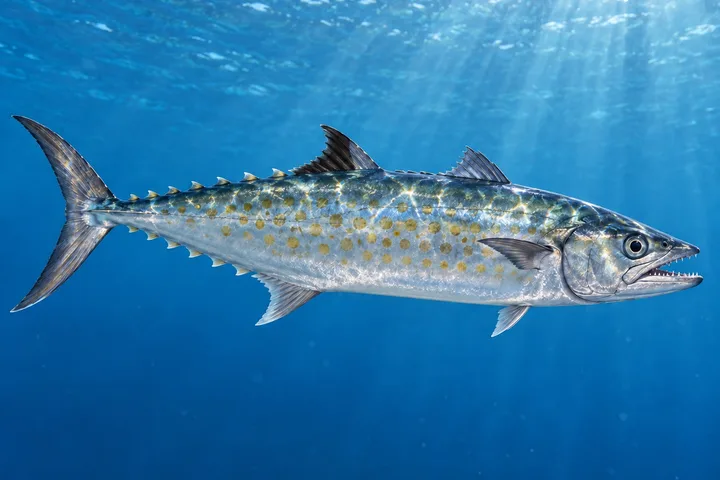
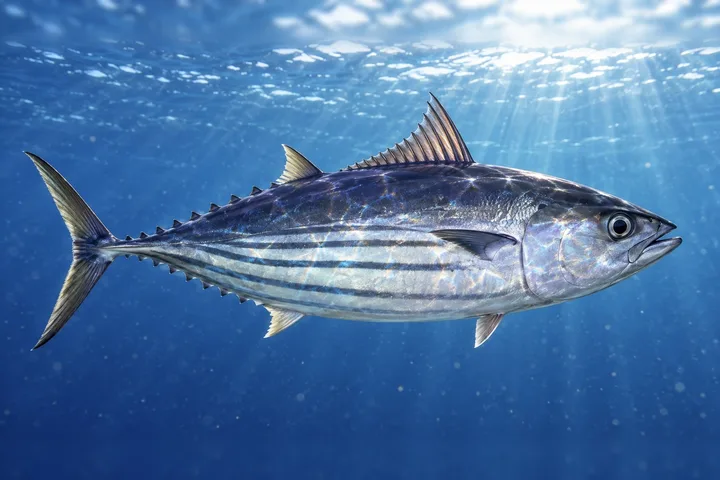
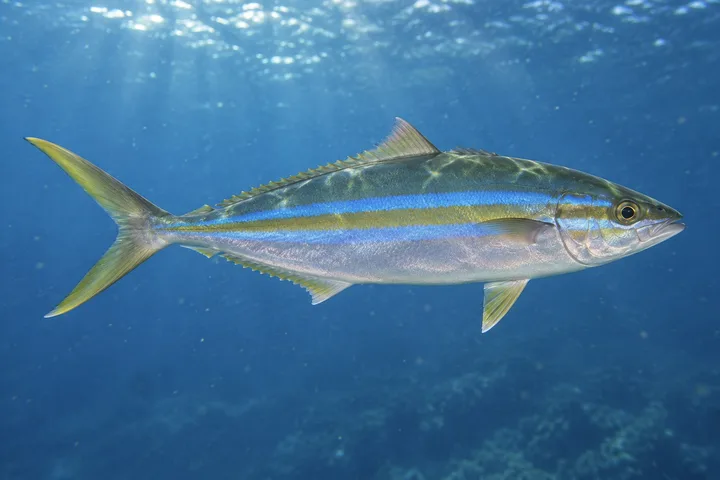
Blue-gray above, darker on the head, and silvery below, with about seven dark stripes that slant obliquely along the upper half of the body. The two dorsal fins sit close together, and the first has 17 to 19 spines. The mouth is fairly large, with big, prominent conical teeth. Behind the dorsal and anal fins run 6 to 8 finlets, and the tail base has a large keel between two small ones. There is a corselet of larger scales on the front of the body.
The Pacific bonito lives along the North American coast, from the Gulf of Alaska to the tip of Baja California, the southwestern Gulf of California and the Revillagigedo Islands. Its population is centered between southern California and central Baja, and it moves north in warm years. It’s a schooling fish of the upper water, most abundant within about 24 km (15 miles) of shore, and it can migrate up to 966 km (600 miles) along the coast, south in winter and north in summer. It was long treated as a northern subspecies of Sarda chiliensis, the bonito of Peru and Chile.
It eats northern anchovy and other small fish, market squid and small crustaceans, about 6% of its body weight a day. It grows fast: about 51 cm and 1.8 kg in its first year and 64 cm and 3.6 kg at two. Males can spawn at one year old; most females first spawn at three years and about 69 cm, several times a season, and the spawning season is longest off Baja California, near the center of the range. Few live more than 6 years.
When courting, and at feeding time, males flash strong vertical bars. In aquarium observations, a pair swam in tight circles together while releasing eggs and sperm into the water.
Source ↗Before Mexico restricted foreign boats in its nearshore waters in 1982, 50 to 90% of the Pacific bonito landed in the United States was caught off Baja California.
Source ↗A Pacific bonito can reach 51 cm (20 in) and 1.8 kg (4 lb) in its first year, but few live more than 6 years.
Source ↗Warm water from power plants in southern California created bonito that stay year round instead of migrating to Mexico in winter. Tagged fish released in those outflows were caught near the same spot 3 years later.
Source ↗California party boats landed a peak of 4.6 million bonito in 1966, and as few as 3,300 in 1999. Numbers rise and fall with decades-long warm and cold ocean cycles that also drive its main prey, the northern anchovy.
Source ↗Cabo is the southern end of the Pacific bonito’s range: it is found along the whole Pacific coast of Baja and only in the far south of the Sea of Cortez, and it virtually disappears from the south of its range when the water is warm. Documented catches include one off Puerto Los Cabos in February and one off Puerto Adolfo López Mateos, on the Pacific side near Magdalena Bay, in May. Off Cabo, the cooler months, roughly winter into spring, are the best bet.
Bonito school near shore and hit hard. They are caught on live sardines, on feathers trolled fast, and on chrome jigs worked up from the bottom, and they fight well above their size on light tackle.
A good food fish if handled right: bleed it and put it on ice as soon as it’s caught, and trim the dark bloodline. The meat is deep red to pink with a bold flavor.
| Daily limit (NOM-017-PESC-1994) | Up to 5 per angler per day, within the 10-fish total |
|---|---|
| IUCN Red List | Listed under Sarda chiliensis: Least Concern (2021) |
| IGFA all-tackle record (“Bonito, Pacific”) | 21 lb 5 oz (9.67 kg), 181 Spot, California, USA, 2003 |
The striped bonito or bonito mono (Sarda orientalis) has 8 to 11 nearly horizontal stripes on the back (the lower ones broken), an all-black second dorsal fin and only 8 to 13 gill rakers on the first arch, against 23 to 27 in the Pacific bonito. If the stripes slant, it’s a Pacific bonito; if they run along the body, it’s a striped bonito. The black skipjack (Euthynnus lineatus) has a patch of nearly horizontal black stripes on the back and dark spots on the lower sides between the pectoral and pelvic fins. The skipjack tuna (Katsuwonus pelamis) has a plain back and stripes on the belly.
Look at the stripes on the back: slanted in the Pacific bonito, nearly horizontal in the striped bonito. The striped bonito also has an all-black second dorsal fin.
Some, mostly in the cooler months. Cabo is the southern edge of its range; it is far more common up the Pacific coast of Baja and in southern California.
Up to 5 per angler per day, within the overall limit of 10 fish.

Top illustration: Top Anglers. Photos: iNaturalist contributors, credited on each photo.
Pangas and small boats that work the beaches, points and rocky reefs. From $453 with license included.