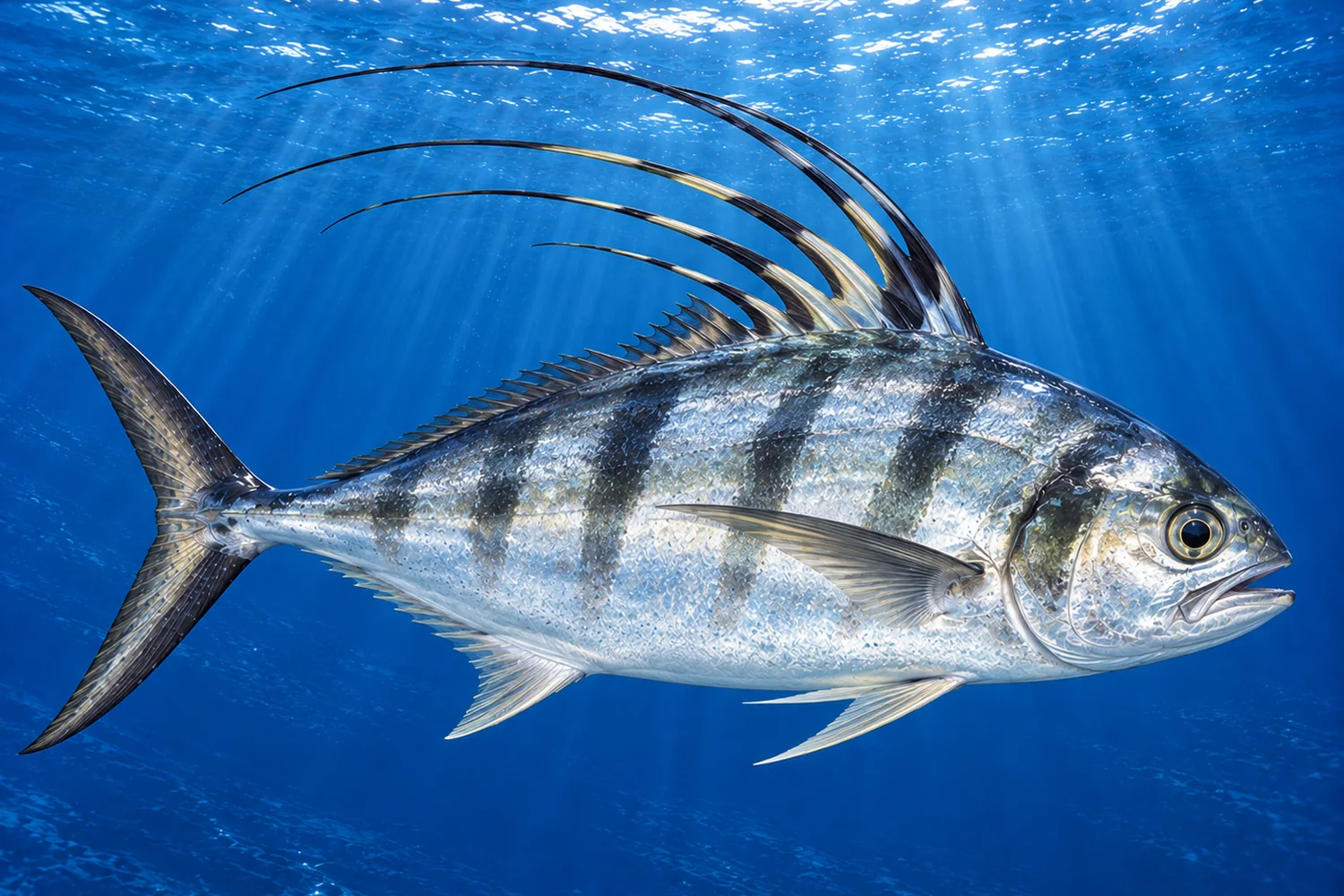
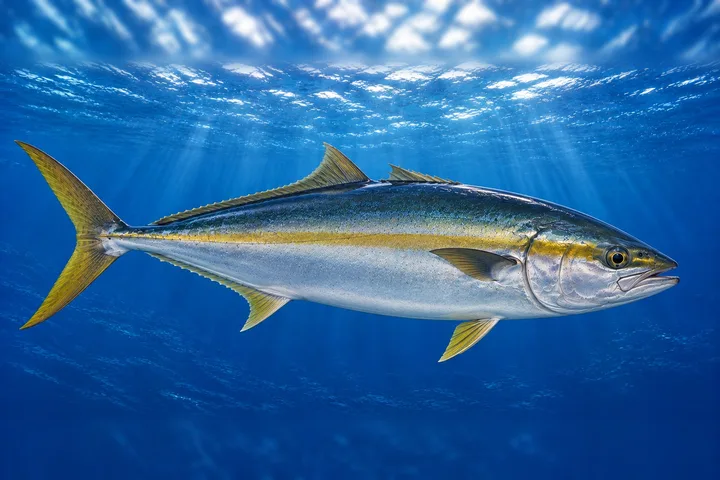
Tips for identifying them
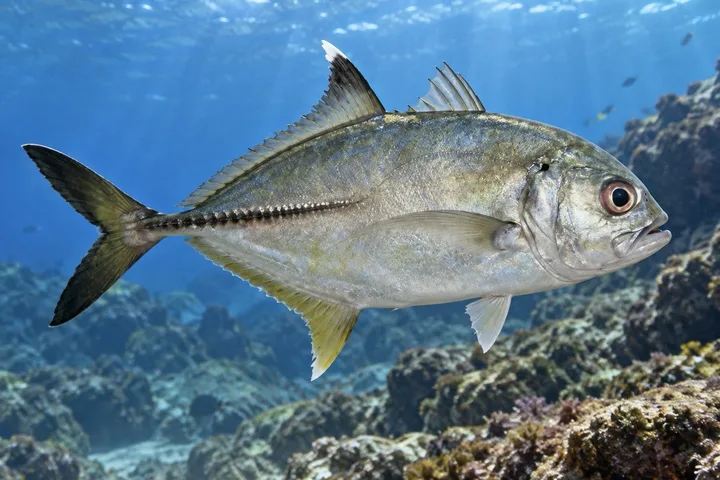
Feel before you look. A row of hard scutes along the rear lateral line is the quickest way to split Cabo’s jacks in two: the toro and the bigeye trevally have them, while yellowtail, almaco jack, rainbow runner and roosterfish don’t. FishBase’s yellowtail page (filed under Seriola lalandi) calls it “the only jack without scutella on the caudal peduncle,” but the Smithsonian’s Tropical Eastern Pacific guide describes the almaco jack and the rainbow runner without lateral-line scutes too, so the scute check tells you the group, not the species.
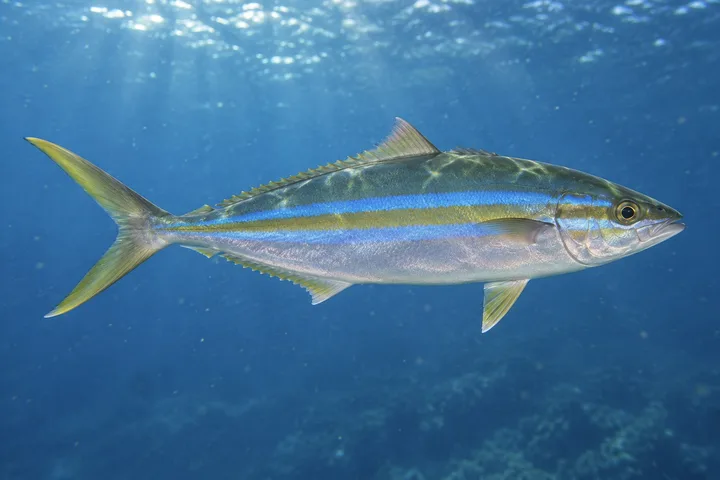
Don’t trust yellow. The yellowtail, the almaco jack and the rainbow runner can all show a yellow stripe, and the almaco’s dark nape band may be missing on adults. Young fish confuse things further: small yellowtail carry numerous narrow dark bars, young almaco jacks up to about 18 cm show a dark nape bar and six body bars plus a seventh on the tail base, and young bigeye trevally are golden yellow with 4 to 7 dark bars. Young almacos are often found far offshore around floating objects.
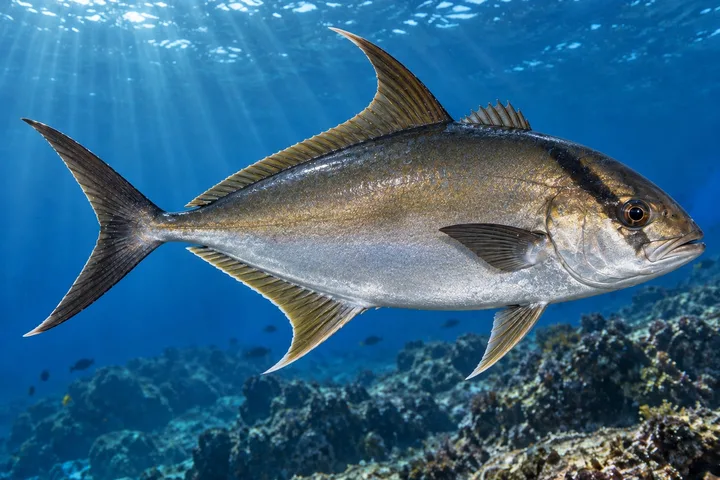
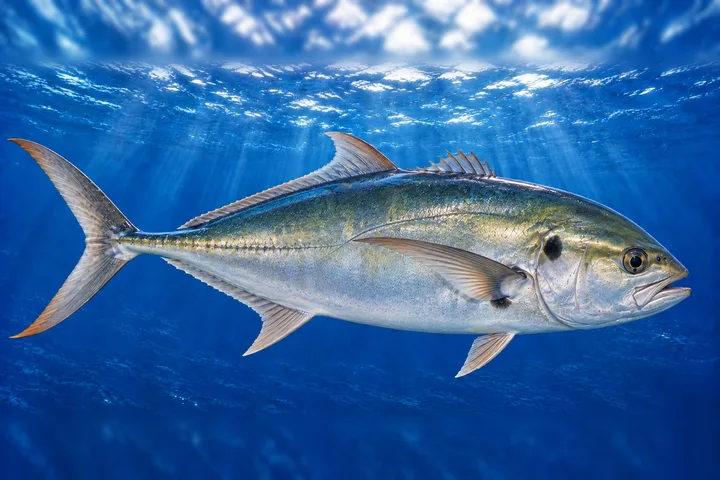
On deck, settle a yellowtail-or-almaco call with three looks: the profile from the side (equal curves or a high back), the end of the upper jaw against the pupil, and the second dorsal raised to show whether it rises into a long sickle. For a toro or a bigeye trevally, lift the pectoral fin and check its lower base, then look at the breast. If the fish is for a tournament or a record claim, photograph each of those details before it goes in the box or back in the water.
Questions
Is a yellow stripe proof of a yellowtail?
No. FishBase describes a yellow stripe along the side as usually present on the almaco jack, and IGFA notes an amber stripe from the eye along the body on some fish. The rainbow runner has one too. On a Seriola, separate them by body profile, the end of the upper jaw and the second dorsal lobe.
Is the roosterfish a jack?
Not in the family sense. The jacks are Carangidae, while the roosterfish is the only species in its genus and is placed in its own family, Nematistiidae, within the same order, Carangiformes. It is also an inshore fish of the surf and sandy bottoms, rather than of the offshore banks.
How do I tell a toro from a bigeye trevally quickly?
Lift the pectoral fin. The toro has a black blotch at its lower base and a mostly bare breast. The bigeye trevally has no pectoral spot, a fully scaled breast and a dark second-dorsal lobe with a white tip. Both have a spot on the gill cover, so don’t rely on that.
Where were the IGFA world records for these fish caught?
Two of them came from La Paz: the almaco jack, 132 lb (59.87 kg) in 1964, and the roosterfish, 114 lb (51.71 kg) in 1960. The rainbow runner record, 37 lb 9 oz, is from Isla Clarión in 1991. The California yellowtail record, 109 lb 2 oz, was caught in Japan in 2009.

By Max VargasTop Anglers, Cabo San Lucas · international judge at big game fishing world championships · reviewed October 2026
Sources
Fish for them with us →