Faster at Cabo Pulmo
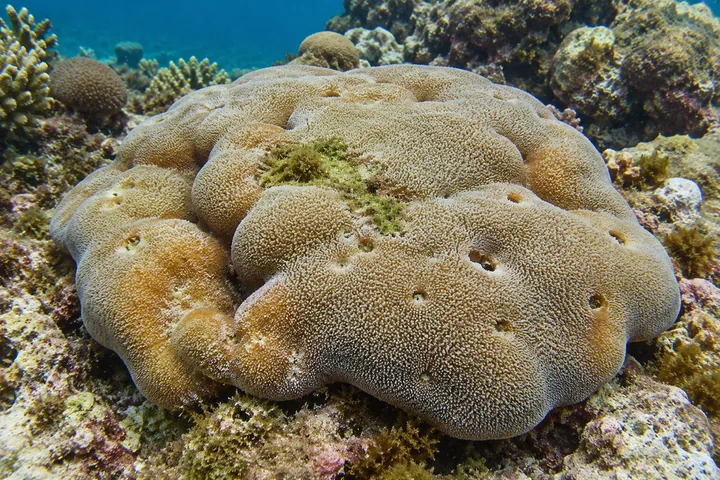
Colonies at Cabo Pulmo grew 0.92 cm a year, versus 0.37 cm at Islas Marietas, Nayarit, and had denser skeletons. Here they formed half-sphere lumps; at Marietas they were encrusting.
Source ↗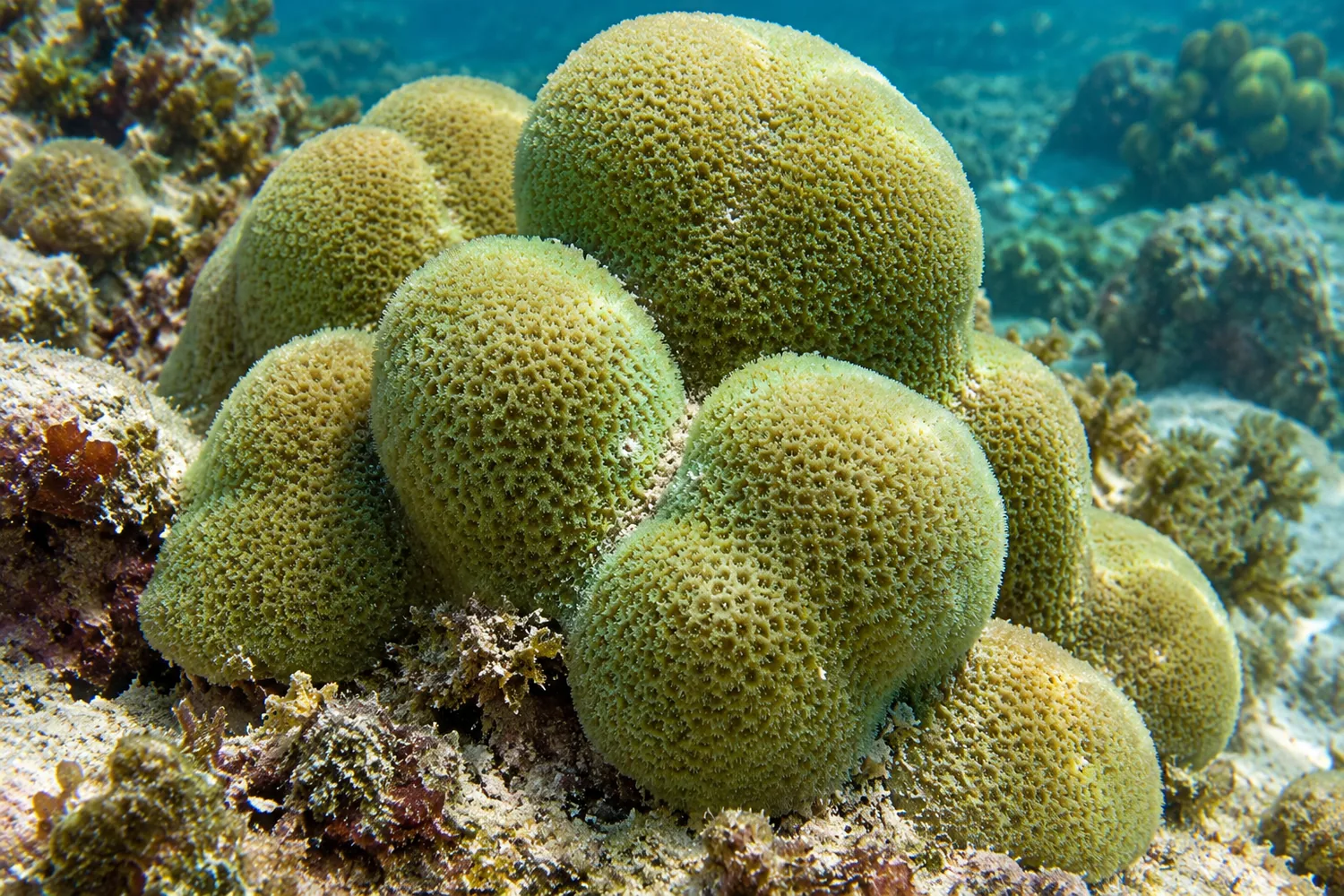
A slow-growing, lumpy coral that turns up on rocky shores all over the Gulf of California, far north of any true coral reef. At Cabo Pulmo it is the third most common coral, making up about a tenth of the live coral, and it also grows at Bahía Chileno near Cabo San Lucas.
Colonies are lumpy mounds, lobes or short, thick branches with a smooth to wavy surface, usually greenish grey to brown. The polyps are small and packed close together. The species comes in several growth forms that were once described as separate species: mound-shaped (massive), encrusting, columnar and branching. The mound form is the most common in the Gulf; at Cabo Pulmo colonies are rounded, half-sphere lumps, while the columnar form grows only from 1 to 5 m, mostly in sheltered spots.
Porites panamensis lives along the Pacific coast of the Americas from about 31°N in the Gulf of California to Isla Gorgona, Colombia. It is the most abundant coral in the central and northern Gulf, where it usually covers just 1–7% of the bottom on rocky reefs. At Cabo Pulmo, a 2011 CONANP survey found it made up about 11% of the live coral, after the two cauliflower coral forms. It has also been recorded at Bahía Chileno, between Cabo San Lucas and San José del Cabo.
Unlike the cauliflower corals, it broods its young. Each colony is male or female; eggs are fertilized inside the polyps and released as small swimming larvae (planulae). In Bahía de La Paz, planulae were found in most months, with a peak in February 2002, when 75% of female colonies carried them. Colonies start to reproduce when they are only about 5 cm² in area, and the larvae settle a few meters from their parents, so neighboring colonies are often related.
Colonies at Cabo Pulmo grew 0.92 cm a year, versus 0.37 cm at Islas Marietas, Nayarit, and had denser skeletons. Here they formed half-sphere lumps; at Marietas they were encrusting.
Source ↗This coral starts to breed at a size of about 5 cm², and its larvae settle only a few meters from the parent colony, which may limit how far it can spread.
Source ↗In Bahía de La Paz, female colonies carried larvae in most months of 2002 and 2003; the peak was February 2002, with 75% of females brooding.
Source ↗Small wounds made experimentally in La Paz colonies healed faster in the warm season (28–30 °C) than in the cold season, and the columnar and mound forms healed at the same rate.
Source ↗In the 2011 Cabo Pulmo survey, fish bites were recorded over the whole surface of Porites colonies; across all corals, half of the colonies checked showed fish bites.
Source ↗During the 1997 El Niño, bleaching at Cabo Pulmo killed corals of all four reef-building genera, Porites included, and more than half of the live coral cover was lost.
Source ↗This is a coral to look at while snorkeling or diving, not something to fish or collect. At Cabo Pulmo National Park it grows among the cauliflower corals on the reef bars; look for greenish-grey lumps and mounds between the branching colonies. It also grows on rocky shores, including at Bahía Chileno near Cabo San Lucas, and since the mound form lives from 1 m down, you can often see it from the surface. At Cabo Pulmo, scuba diving is allowed only with a park-accredited guide, and snorkelers must wear a life vest in the reef areas.
Don't touch, stand on or kick the colonies: a coral that grows less than a centimeter a year takes decades to replace what a careless fin can break. Inside Cabo Pulmo, keep at least 2.5 m from rock and coral formations; gloves and knives are banned and boats may anchor only on sand.
| Sport fishing (NOM-017-PESC-1994, 2013 update) | Only fish may be taken; coral cannot be collected |
|---|---|
| Anchoring (NOM-017, 4.16 b) | Never on coral; at least 15 m from the edge of a coral reef |
| Federal Penal Code, art. 420 Bis | 2 to 10 years in prison for damaging reefs, up to 2 more in a protected area |
| Mexico (NOM-059) | Not listed; its Gulf relative Porites sverdrupi is listed as endangered (P) |
| CITES | Appendix II: moving coral across borders needs permits |
| IUCN Red List | Near Threatened (assessed 2023) |
| Cabo Pulmo National Park | No collecting; keep 2.5 m from coral; no gloves or knives; anchor only on sand |
Look, don't touch: breaking or taking coral is illegal in Mexico.
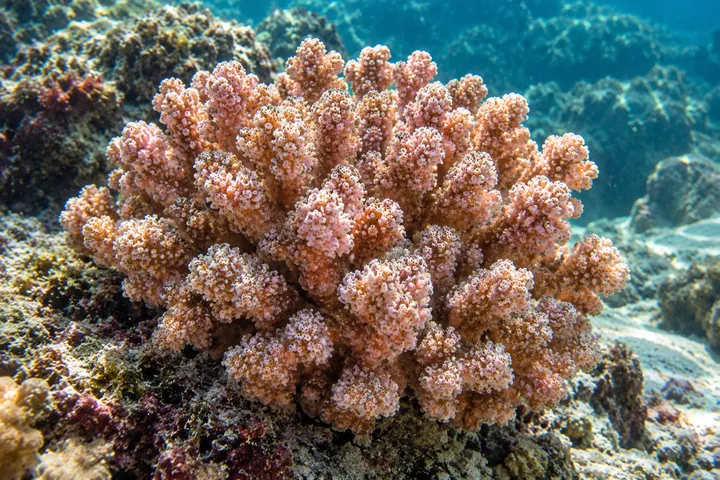
The giant pavona (Pavona gigantea) also forms mounds at Cabo Pulmo, but it builds big boulders with closely spaced, star-shaped polyp cups, and its tentacles are often out by day, giving it a furry look. Porites sverdrupi, a small Gulf of California coral protected in Mexico, forms clumps of finger-like branches, cream to reddish brown, on sheltered rubble. Cauliflower corals (Pocillopora) are branching bushes covered in bumps.
No. They are in the same genus, but lobe coral has a more massive growth form, while Porites panamensis forms lobes, lumps or short branches and lives only in the eastern Pacific.
At Cabo Pulmo National Park, among the cauliflower corals on the reef bars, and on rocky shores such as Bahía Chileno near Cabo San Lucas. Much of it grows in water shallow enough for snorkeling.
It isn't on Mexico's NOM-059 list, but coral can't be taken under sport fishing rules, damaging reefs is a federal crime, and it is on CITES Appendix II.

Top illustration: Top Anglers. Photos: iNaturalist contributors, credited on each photo.
Our charters leave the Cabo San Lucas marina every morning. From $698 with license included.