The tail is a weapon
Underwater video of pelagic threshers in the Philippines showed them hunting sardine schools with overhead tail-slaps that stun the fish, and a single strike let a shark eat more than one sardine.
Source ↗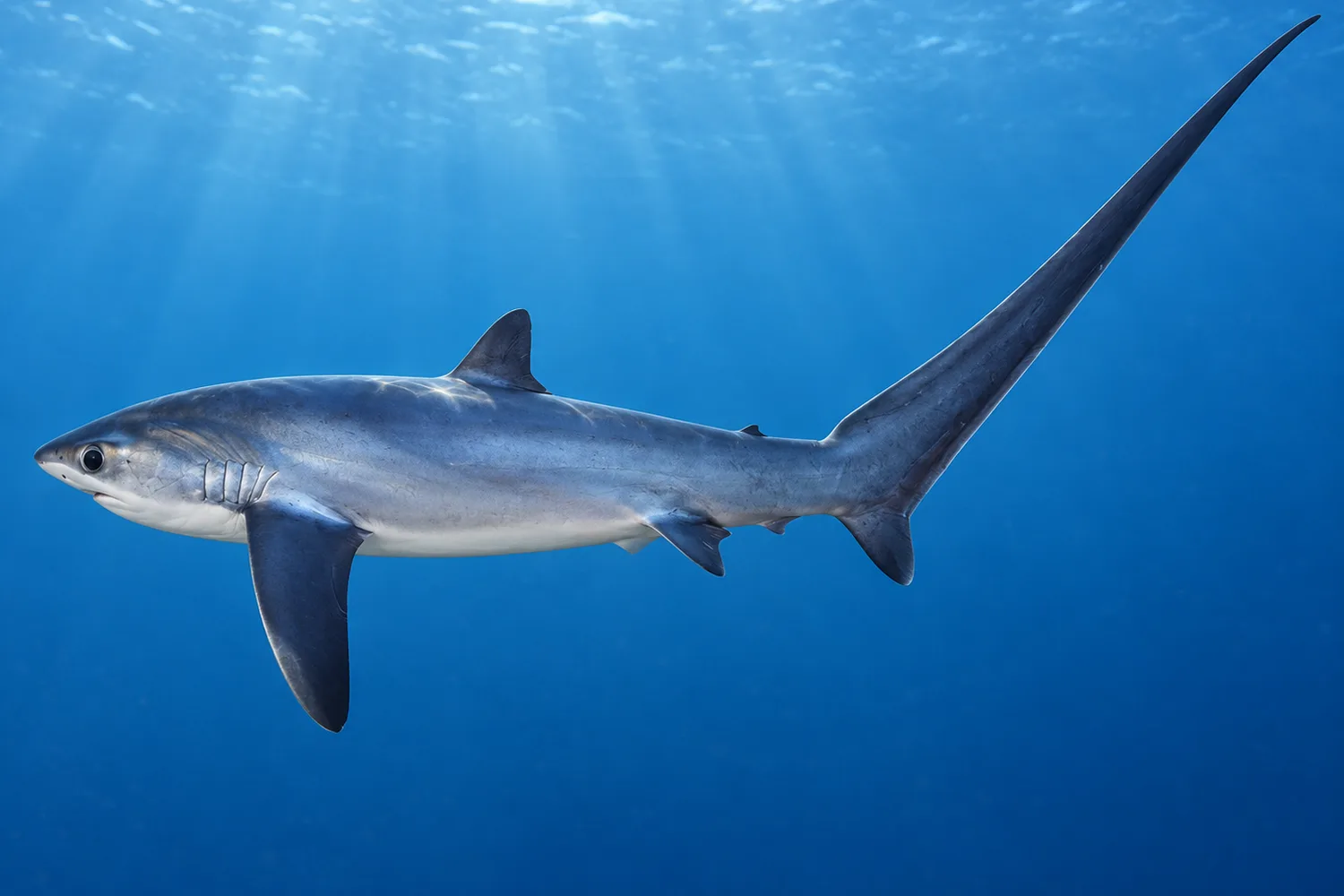
The smallest of the three thresher sharks, with an upper tail lobe almost as long as its body. It shows up only now and then off Los Cabos, and it is globally Endangered, which is why we release every one.
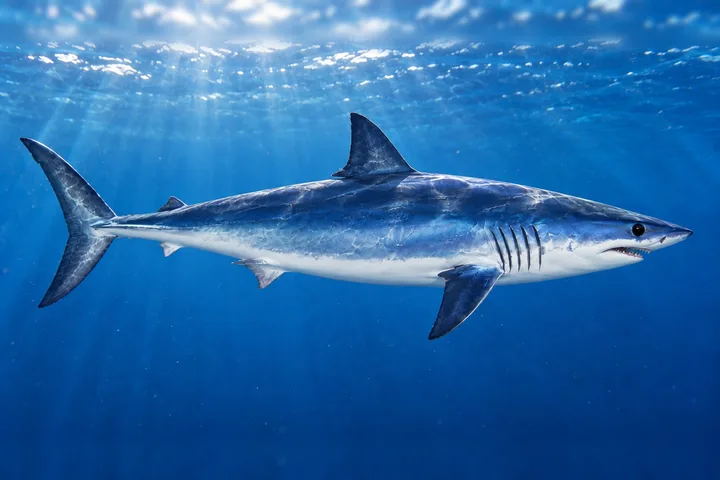
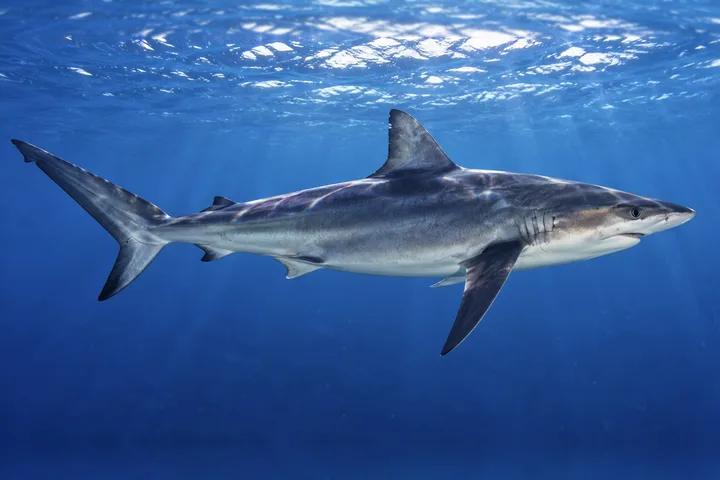
A slim shark with a short, pointed snout and an enormous, scythe-like upper tail lobe that ends in a very narrow tip. It is dark blue to gray-blue on the back and sides and white below, and the white does not extend up over the base of the pectoral fins. The pectoral fins are long, nearly straight and broad at the tips. The eyes are moderate in size, with no grooves on top of the head.
Pelagic threshers live in tropical oceans around the world, mostly in the open sea from the surface to 300 m, usually above 150 m. In the eastern Pacific they are found from the Gulf of California to the Galápagos; the first record from the Gulf of California was published in 1997. Genetic studies link the threshers of Mexico with those of Ecuador.
They feed on small schooling fish and squid. Each female carries just one embryo in each uterus, so a litter is two very large pups, born well over a meter long, and the embryos feed on unfertilized eggs while they grow. Females mature at roughly 9 to 13 years and the species may live 24 to 28 years. With only two pups at a time, a population can grow just a few percent a year, so it recovers very slowly from fishing.
Underwater video of pelagic threshers in the Philippines showed them hunting sardine schools with overhead tail-slaps that stun the fish, and a single strike let a shark eat more than one sardine.
Source ↗Pelagic threshers sampled in Ecuador carried one embryo in each uterus, a litter of two, among the smallest of any shark.
Source ↗The pelagic thresher was first reported from the Gulf of California only in 1997.
Source ↗In autumn 1998, pelagic threshers made up 25.6% of the artisanal shark and ray landings on the Gulf coast of Baja California. Almost 73% of the 143 examined were females, many of them pregnant.
Source ↗Catch-rate data from the Pacific and Indian oceans show declines of more than 70% over about 55 years (three generations), the basis for its Endangered listing.
Source ↗In March 2026 the Convention on Migratory Species moved all three thresher sharks to its Appendix I, which calls for strict protection across their range.
Source ↗Off Los Cabos, pelagic threshers are an occasional encounter in open water; the Cabo San Lucas Important Shark and Ray Area lists them among the sharks recorded there. Elsewhere in the Gulf they turn up in local catches by season: they were a large share of autumn landings on the Gulf coast of Baja California in 1998, and on the Gulf coast of Baja California Sur they were landed only in spring, in small numbers.
We release every thresher. Best practice: circle hooks that aren’t stainless steel, keep the shark in the water, unhook it quickly or cut the leader close to the hook, and hold it facing forward while the boat moves slowly so water runs over its gills. Keep clear of the long tail, and never lift a shark by the tail or gills.
| Daily limit (NOM-017-PESC-1994) | Sharks: 1 per angler per day, and it counts as 5 of the 10 fish |
|---|---|
| Closed season (Pacific) | All shark species, May 1 – July 31; no shark fishing during the closure |
| IUCN Red List | Endangered (assessed 2018, published 2019): more than 70% decline over three generations |
| CITES | Appendix II since October 4, 2017 (all thresher sharks): international trade needs permits |
| IGFA all-tackle record | No separate category; the thresher shark record (767 lb 3 oz, 348 kg, Bay of Islands, New Zealand, 1983) is a common thresher |
Top Anglers practices catch-and-release for all sharks.
The bigeye thresher has very large eyes and deep grooves along the top of the head, and its belly is a solid, pale cream. The common thresher has white on the belly that extends up above the pectoral fins and pectorals that are curved with pointed tips. The pelagic thresher has moderate eyes, no head grooves, no white patch over the pectoral bases, and straight, broad-tipped pectoral fins.
By law a sport angler may keep one shark per day outside the Pacific closed season (May 1 – July 31). The pelagic thresher is Endangered, and we release every one.
Look at the pectoral fins and belly. The common thresher has white that reaches up over the pectoral fin bases and curved, pointed pectorals; the pelagic thresher has no white there and its pectorals are straight with broad tips.
It uses it to hunt. Threshers swing the tail over their heads to slap and stun schooling fish, then pick up the stunned prey.

Top illustration: Top Anglers. Photos: iNaturalist contributors, credited on each photo.
Sportfishers with the range to reach the offshore banks. From $799 with license included.