The loudest animal on Earth
Sperm whale clicks recorded off Norway reached 236 dB re 1 µPa. The researchers called them by far the loudest sound measured from any living source.
Source ↗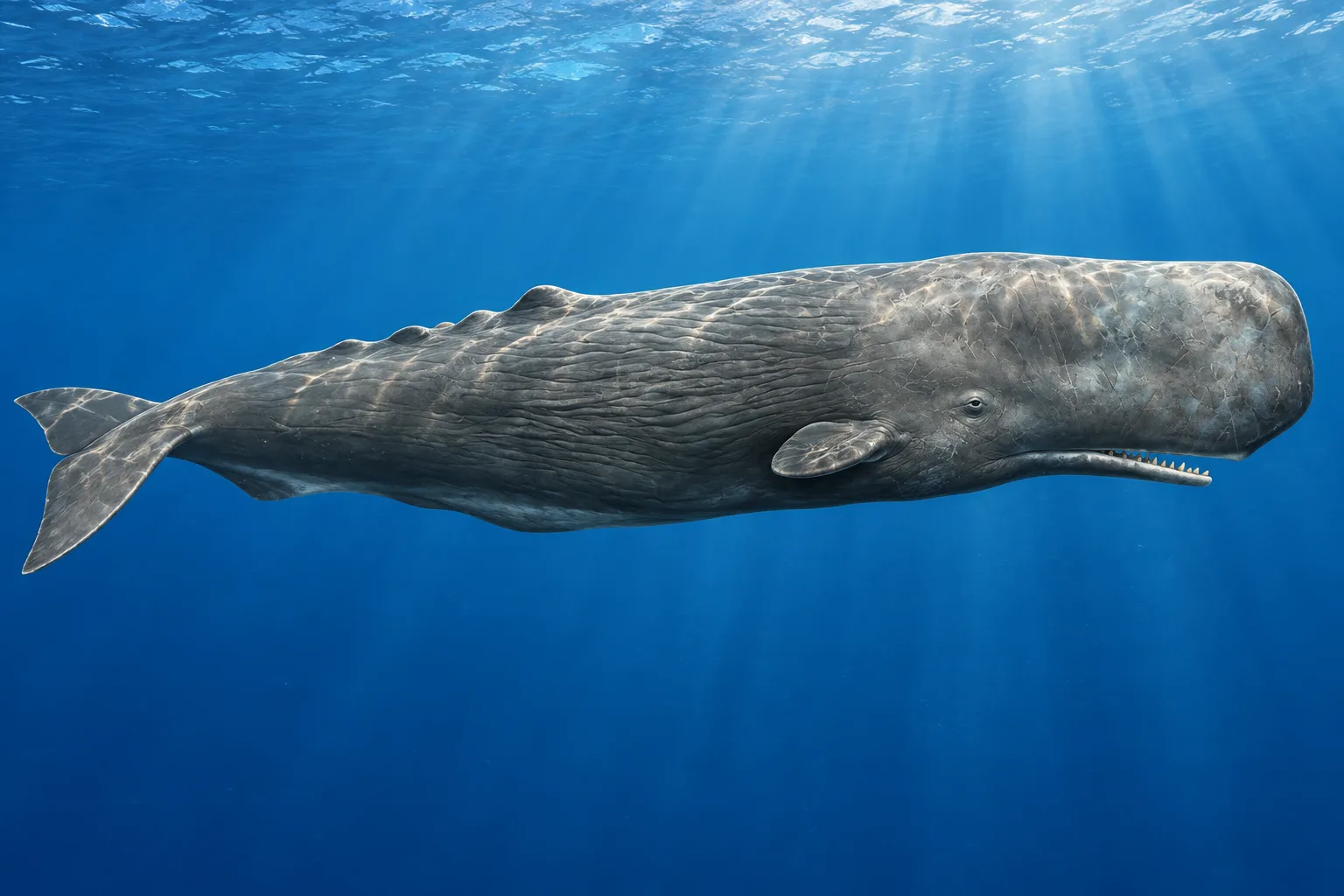
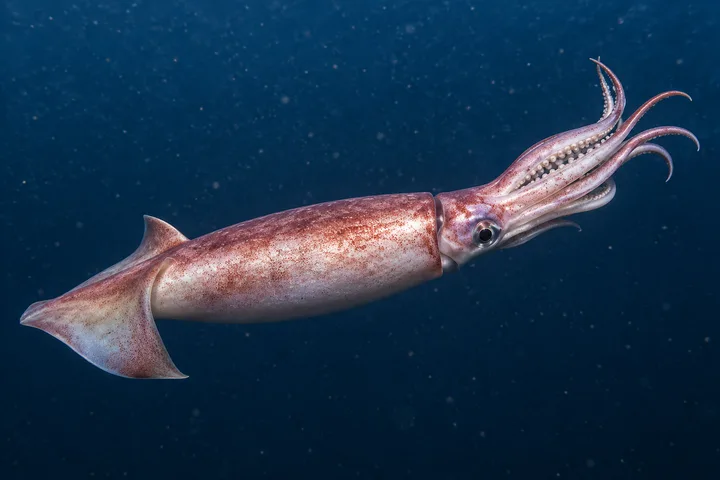
The largest toothed whale on the planet hunts jumbo squid in the deep basins of the Sea of Cortez. Near Cabo it’s an occasional, offshore sighting, and one worth stopping for.
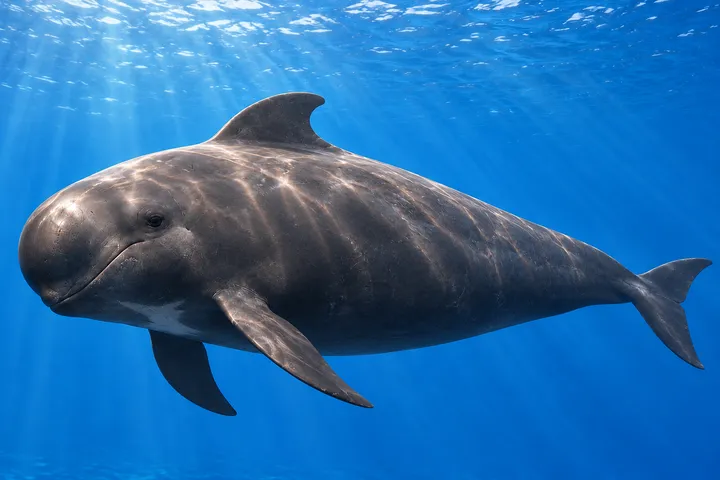
Dark brownish gray with wrinkled skin behind the huge, boxy head, which makes up a quarter to a third of the body. Its single blowhole sits at the front left of the head, so the bushy blow shoots forward and to the left at about 45°. Instead of a tall fin it has a low, rounded hump followed by a row of bumps, and it lifts a broad triangular tail before a deep dive.
Sperm whales live in deep water in every ocean, and the Gulf of California holds a semi-resident population made up mostly of females, juveniles and calves; adult males range much more widely. Records span from San Felipe in the north to Los Frailes in the south, and the whales have been seen most often between Loreto and Isla Cerralvo. Photo-ID and mark-recapture work estimated about 1,070 animals using the gulf between La Paz and San Pedro Mártir. Their main prey there is the jumbo (Humboldt) squid: in 1999, when squid were plentiful, they gathered in three “super-aggregations” about 55 × 75 km across that held for over a month.
Females and their young live in stable social units of about a dozen animals; young males leave to form bachelor groups, and the largest males often travel alone. A calf is born about 4 m long after a 14 to 16-month pregnancy, and sperm whales can live about 60 years. The head holds the spermaceti organ, with up to 1,900 liters of a waxy oil that helps focus the clicks they use to find prey in total darkness. Whales tagged near Santa Rosalía made most of their deep dives to 100–500 m, the same layer where the squid live, with a few dives to 1,250–1,500 m.
Sperm whale clicks recorded off Norway reached 236 dB re 1 µPa. The researchers called them by far the loudest sound measured from any living source.
Source ↗The sperm whale has the heaviest brain of any animal, about 9 kg, six times heavier than a human brain, yet only about 0.02% of its body weight.
Source ↗Photo-ID showed seven female sperm whales that moved from the Galápagos Islands into the Gulf of California, traveling up to 3,803 km, among the longest movements documented for females.
Source ↗In the Midriff Islands region, researchers logged 73 sightings totaling 648 sperm whales from 2009 to 2015. Squid landings fell from about 26,900 tons to under 200, and from 2016 to 2018 not a single sperm whale was seen there.
Source ↗In the Guaymas Basin, the depth of sperm whale dives tracked the depth of the sonar “scattering layer” where prey gathers, and whales surfaced 10 times with jumbo squid in their mouths.
Source ↗An analysis of 23,429 click patterns (codas) recorded across the Pacific from 1978 to 2017 identified at least seven clans, each with its own identity codas, used most distinctly where clans overlap.
Source ↗Near Los Cabos, sperm whales are an occasional, offshore sighting rather than a regular show like the winter humpbacks; local whale-watching operators list them among the species you might see. No monthly pattern has been documented off Cabo. In March 2016 a juvenile about 10 m long stranded near San José del Cabo and was guided back to deep water by PROFEPA and the Navy. The best-studied area is the central Gulf, around Santa Rosalía and the Guaymas Basin, although they have been scarce in the Midriff Islands since the jumbo squid collapse.
If you run into one offshore, slow down, stay at least 60–80 m away and never cut in front of a whale that is about to dive. Under Mexican rules you can’t fish, swim or dive while watching whales, and the sperm whale is the only toothed whale that legally counts as a “whale” for those rules.
| Closest approach (NOM-131) | 60 m for boats under 10 m, 80 m for boats 10 m and larger; 240 m waiting distance for all other boats. NOM-131 defines “whales” as all baleen whales plus the sperm whale |
|---|---|
| Boats per whale or group | 4 at most, for 30 minutes at most |
| Speed near whales | Under 5 knots, under 2 knots inside the watching zone |
| Not allowed | Fishing, swimming, diving, getting between mother and calf |
| Mexico (NOM-059) | Subject to special protection (Pr) |
| Ley General de Vida Silvestre, art. 60 Bis | No extractive use or possession of any marine mammal, except authorized research and conservation |
| IUCN Red List | Vulnerable (reassessed 2025) |
It’s often called the deepest-diving whale, but the record belongs to Cuvier’s beaked whale, tagged at 2,992 m off California.
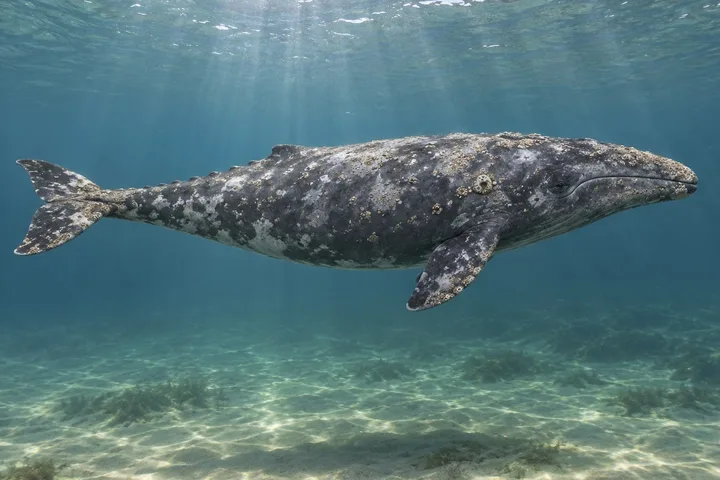
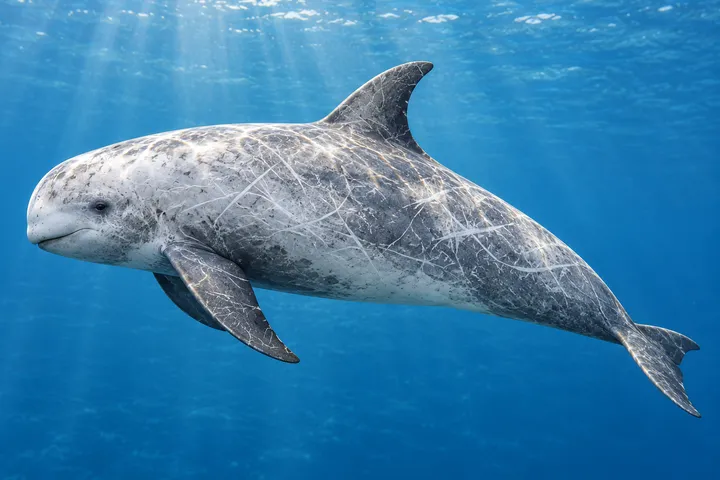
Dwarf and pygmy sperm whales share the name but are under 4 m and rarely seen at the surface. A gray whale also has a hump and knuckles instead of a fin, but it is mottled gray and white and blows straight up, not forward and to the left.
Occasionally, well offshore, but there is no reliable season off Cabo. They are much more regular in the deep basins of the central Gulf of California.
Yes. In the Gulf of California the jumbo (Humboldt) squid is their main prey, and when the squid fishery collapsed in the Midriff Islands region, the sperm whales disappeared from it.
No. Mexico’s whale-watching rule, NOM-131, covers the sperm whale and bans swimming and diving with whales; boats must stay at least 60 to 80 m away.

Top illustration: Top Anglers. Photos: iNaturalist contributors, credited on each photo.
Our charters leave the Cabo San Lucas marina every morning. From $799 with license included.