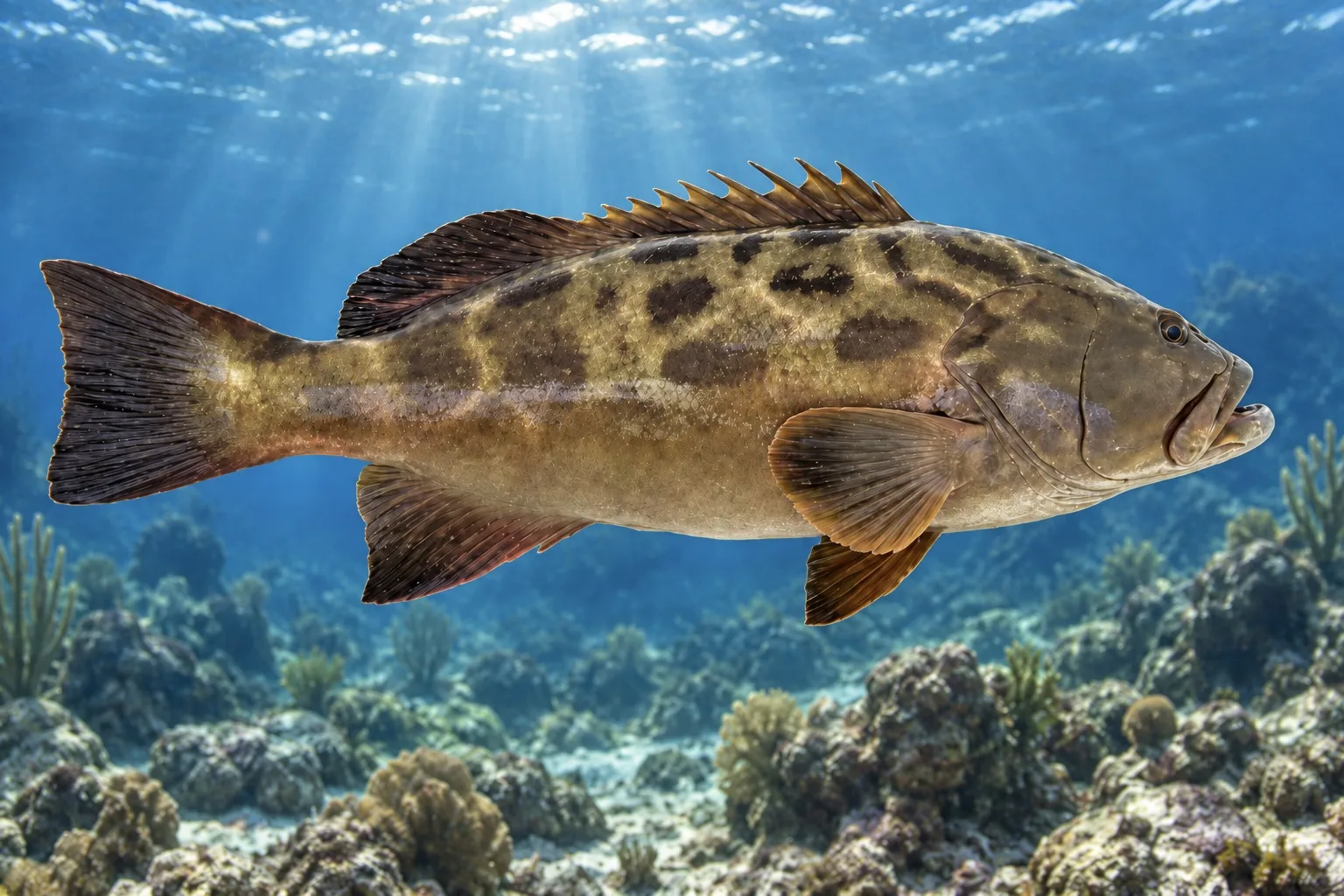
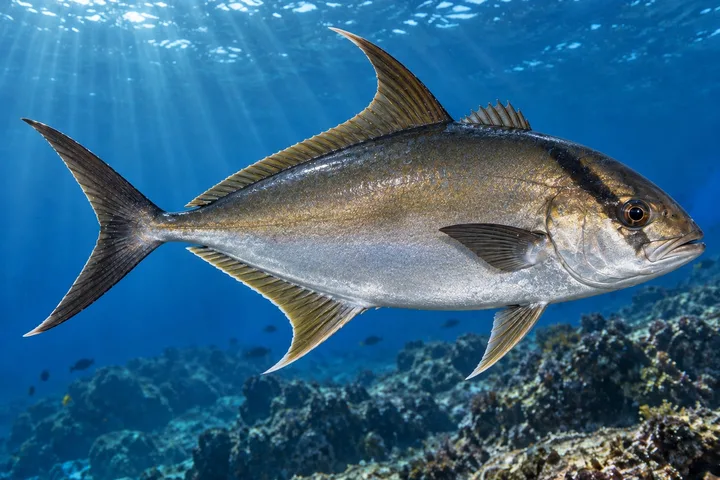
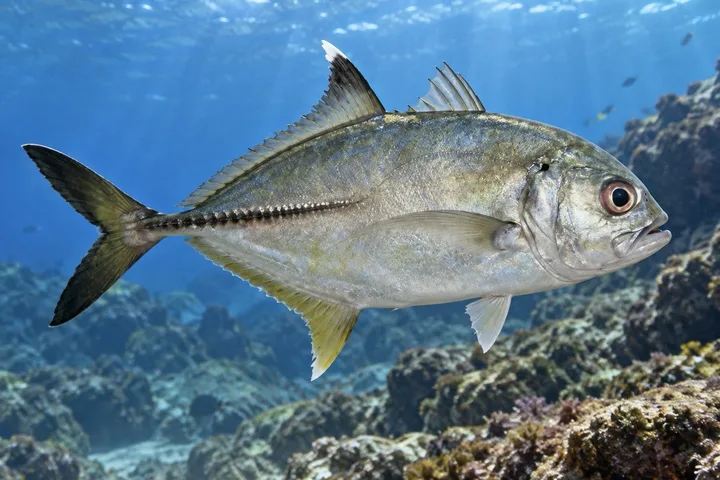
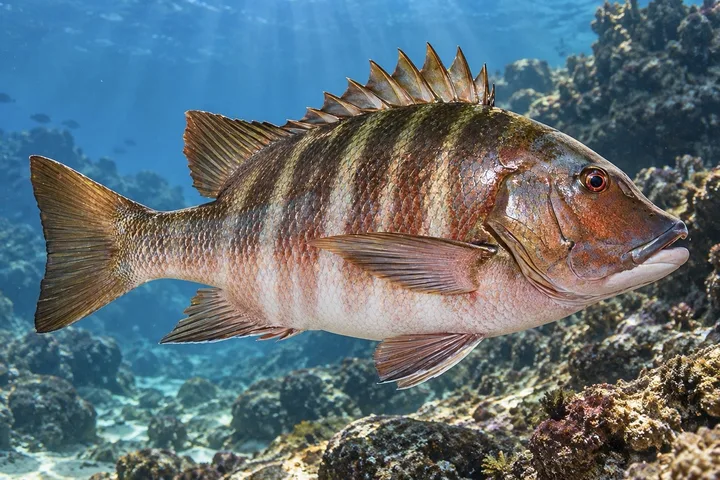
Gulf grouper (Mycteroperca jordani), illustration
Regulated · catch and release Mycteroperca jordani

Gulf grouper in Los Cabos

The giant grouper of the Sea of Cortez. It can pass 90 kg and live almost 50 years, and in 1960 it made up nearly half of the Gulf’s small-boat catch. Today it is endangered, and in Los Cabos it is a rare fish.

Up to ~2 mMax length
130 lb 1 ozIGFA world record
Up to 48 yearsLifespan
2 per dayLimit per angler

Season in Los Cabos

●● best months · ● regular · · occasional. Based on local fishing reports; conditions change year to year.

Tap a month to see everything biting in Cabo that month ›

How to recognize it

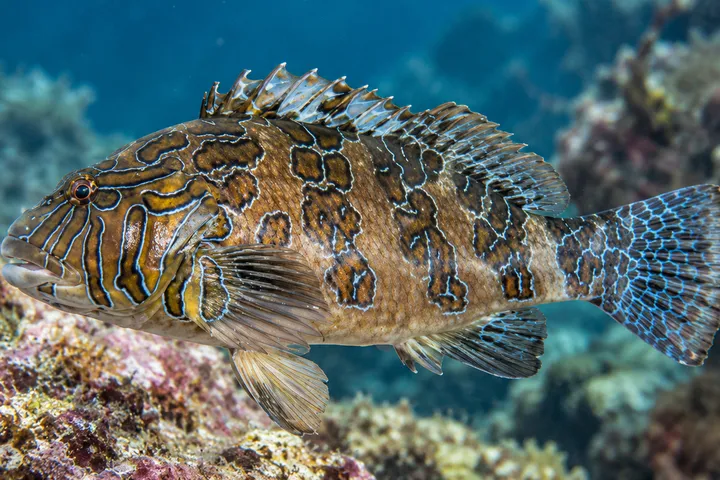
A big, heavy-bodied grouper. Adults are plain dark brown to grey; large adults have a white edge on the pectoral fins and a narrow white edge on the other fins. Juveniles have dark blotches on the upper body, and a stressed adult can flash that blotched pattern too.

Biology

The gulf grouper lives throughout the Gulf of California and south to Mazatlán. It is naturally rare north of Bahía Magdalena and rare on the Pacific side of southern Baja. Young fish grow up in mangroves, estuaries and bays; adults move to rocky reefs, seamounts and kelp beds from about 5 to 30 m deep, going deeper in summer.

Adults eat only fish, ambushing them with a sudden suck of their big mouth, mostly at dawn and dusk. Females mature at about 6 years, and the species is likely protogynous: some fish start as females and later become males. From April to June adults gather at reefs and seamounts to spawn, and they can live up to 48 years.

Things you probably didn't know

01

A best day 25 times bigger

In a survey of 108 Gulf of California fishers, the oldest had caught up to 25 times as many gulf grouper on their best day as young fishers had on theirs. Few young fishers believed big fish had ever been common near shore.

Source ↗
02

Statistics that hid a collapse

Official landings suggested gulf grouper catches were rising. Historical records and fishers’ memories showed the opposite: after a heyday before the 1970s, the species fell to probably a few percent of its former numbers.

Source ↗
03

From half the catch to almost none

In 1960 gulf grouper made up about 45% of the Gulf of California’s small-boat fishery. By the 1970s it was 10%; today it is less than 1%.

Source ↗
04

A spawning site in Cabo Pulmo

Divers found a spawning site inside Cabo Pulmo National Park. Big males hold territories over sand next to the reef, females visit them in the evening, and in May 2017 the fish spawned 12 evenings in a row before sunset.

Source ↗
05

A grouper that makes sounds

At the Cabo Pulmo site, males made sounds while patrolling their territories, courting and spawning. Underwater recorders picked up more sounds each day from March through June.

Source ↗
06

Hammerhead on the menu

Large adults feed on fish, and the gulf grouper has been reported to prey on juvenile hammerhead sharks.

Source ↗

Photos

tunicatedreamz · iNaturalist · CC BY 4.0
iNaturalist contributor · iNaturalist · CC0

How it's caught in Los Cabos

Around Los Cabos the gulf grouper is an occasional catch on rocky bottom and banks, usually by anglers fishing live bait or yo-yo jigs for other reef fish. Local reports from the San José del Cabo panga fleet include a 110 lb fish in March 2012 and a 150 lb fish on a live caballito near the Iman Bank in June 2012, but most weeks there are none.

Mexican law still allows two a day, but Top Anglers encourages releasing every gulf grouper. The species is endangered, takes about six years to mature and gathers to spawn in the same places every year, which made it easy to overfish. Fish pulled from deep water can suffer barotrauma: keep it in the water if you can, keep handling under 20 seconds, and send it back down with a descending device. Sport fishing is not allowed inside Cabo Pulmo National Park.

On the table

Mexican law allows two a day, but this is an endangered fish, so we encourage releasing it.

Rules, records & conservation

Daily limit (NOM-017-PESC-1994)Up to 2 per angler per day; each counts as 5 of the 10-fish total
IUCN Red ListEndangered (assessed 2016)
U.S. Endangered Species ActEndangered since 2016; importing it, or any part of it, into the U.S. is prohibited
NOM-059-SEMARNAT-2010Not on Mexico’s list of species at risk
IGFA all-tackle record130 lb 1 oz (59 kg), El Farallón de San Ignacio, Mexico, 2026
Cabo Pulmo National ParkSport fishing not allowed

Top Anglers encourages catch-and-release for every gulf grouper.

Don't confuse it with

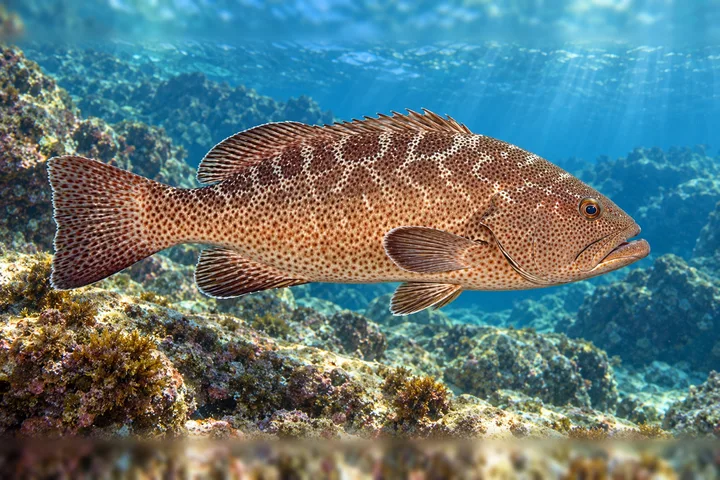
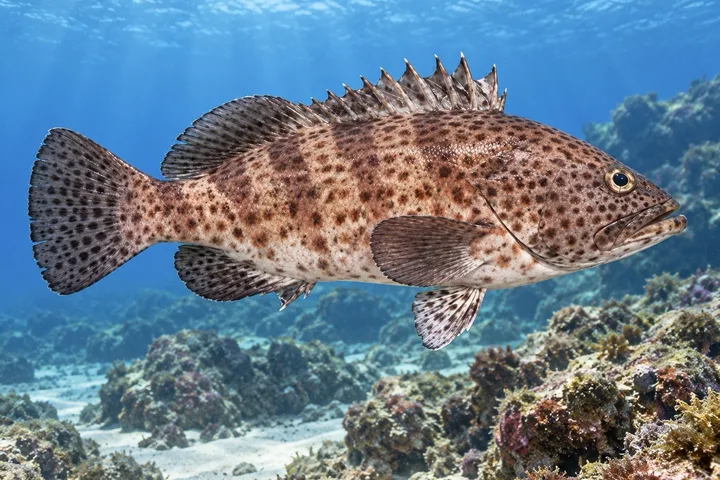
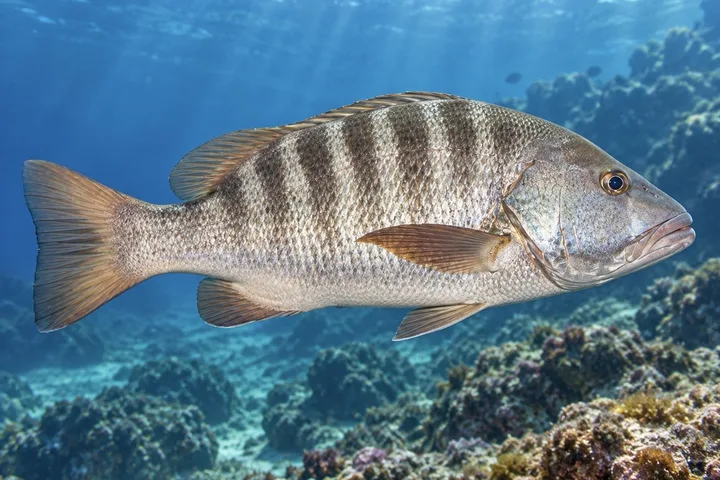
The leopard grouper or cabrilla sardinera (Mycteroperca rosacea) and the spotted cabrilla or cabrilla pinta (Epinephelus analogus) are covered in dark spots and much smaller, about 1 m at most. The broomtail grouper (Mycteroperca xenarcha) is often grey with dark blotches and a pale, maze-like network, and has a distinct lobe at the corner of the gill cover. The Pacific goliath grouper or mero (Epinephelus quinquefasciatus) has an extremely broad head and small black spots, and grows bigger still.

How to tell Cabo’s groupers and snappers apart ›

Questions

Can I keep a gulf grouper in Mexico?

Legally, yes: up to 2 per angler per day under NOM-017-PESC-1994. Because the species is endangered, Top Anglers encourages releasing it.

Can I take gulf grouper fillets home to the U.S.?

No. The gulf grouper has been listed as endangered under the U.S. Endangered Species Act since 2016, and importing it or any part of it into the U.S. is prohibited.

How big do gulf groupers get?

Up to about 198 cm and 91 kg. The IGFA all-tackle record is 130 lb 1 oz (59 kg), caught in Mexico in January 2026.

By Max VargasTop Anglers, Cabo San Lucas · international judge at big game fishing world championships · reviewed October 2026

Sources

Top illustration: Top Anglers. Photos: iNaturalist contributors, credited on each photo.

Boats for gulf grouper

Pangas and small boats that work the beaches, points and rocky reefs. From $453 with license included.
More species

Pacific sierra
Pacific sierra
Scomberomorus sierra
California yellowtail
Seriola dorsalis
Pacific crevalle jack
Caranx caninus
Skipjack tuna
Skipjack tuna
Katsuwonus pelamis
Shortfin mako
Shortfin mako
Isurus oxyrinchus
Leopard grouper
Leopard grouper
Mycteroperca rosacea
Colorado snapper
Colorado snapper
Lutjanus colorado
Striped bonito
Striped bonito
Sarda orientalis
Black skipjack
Black skipjack
Euthynnus lineatus
Finescale triggerfish
Balistes polylepis
Scalloped hammerhead
Sphyrna lewini
Humpback whale
Humpback whale
Megaptera novaeangliae
Gray whale
Gray whale
Eschrichtius robustus
California sea lion
California sea lion
Zalophus californianus
Whale shark
Whale shark
Rhincodon typus
Olive ridley sea turtle
Lepidochelys olivacea
Bottlenose dolphin
Bottlenose dolphin
Tursiops truncatus
Munk's devil ray (mobula)
Mobula munkiana
Swordfish
Swordfish
Xiphias gladius
Almaco jack
Almaco jack
Seriola rivoliana
Bigeye trevally
Bigeye trevally
Caranx sexfasciatus
Spotted cabrilla
Spotted cabrilla
Epinephelus analogus
Pacific dog snapper
Pacific dog snapper
Lutjanus novemfasciatus
Barred pargo
Barred pargo
Hoplopagrus guentherii
Blue whale
Blue whale
Balaenoptera musculus
Green sea turtle (black turtle)
Chelonia mydas
Leatherback sea turtle
Dermochelys coriacea
Rainbow runner
Rainbow runner
Elagatis bipinnulata
Yellow snapper
Yellow snapper
Lutjanus argentiventris
Pacific white snook
Pacific white snook
Centropomus viridis
Mexican barracuda
Mexican barracuda
Sphyraena ensis
Silky shark
Silky shark
Carcharhinus falciformis
Mexican needlefish
Mexican needlefish
Tylosurus fodiator
Humboldt squid
Humboldt squid
Dosidicus gigas
Giant manta ray
Giant manta ray
Mobula birostris
Fin whale
Fin whale
Balaenoptera physalus
Orca (killer whale)
Orca (killer whale)
Orcinus orca
Hawksbill sea turtle (carey)
Eretmochelys imbricata
Brown pelican
Brown pelican
Pelecanus occidentalis
Magnificent frigatebird
Fregata magnificens
Shortbill spearfish
Shortbill spearfish
Tetrapturus angustirostris
Loggerhead sea turtle (caguama)
Caretta caretta
Osprey
Osprey
Pandion haliaetus
Blue-footed booby
Blue-footed booby
Sula nebouxii
Common dolphin
Common dolphin
Delphinus delphis
Oarfish
Oarfish
Regalecus russelii
Heermann’s gull
Heermann’s gull
Larus heermanni
Yellow-footed gull
Yellow-footed gull
Larus livens
Ocean sunfish
Ocean sunfish
Mola mola
Sperm whale
Sperm whale
Physeter macrocephalus
Sally Lightfoot crab
Grapsus grapsus
Blue spiny lobster
Blue spiny lobster
Panulirus inflatus
Chocolate clam
Chocolate clam
Megapitaria squalida
Pelagic red crab
Pelagic red crab
Grimothea planipes
Hubbs’ octopus
Hubbs’ octopus
Octopus hubbsorum
Jewel moray
Jewel moray
Muraena lentiginosa
Panamic green moray
Panamic green moray
Gymnothorax castaneus
Spinner dolphin
Spinner dolphin
Stenella longirostris
Risso’s dolphin
Risso’s dolphin
Grampus griseus
Short-finned pilot whale
Globicephala macrorhynchus
Bigeye tuna
Bigeye tuna
Thunnus obesus
Pelagic thresher
Pelagic thresher
Alopias pelagicus
Blue shark
Blue shark
Prionace glauca
Giant hawkfish
Giant hawkfish
Cirrhitus rivulatus
Pacific bonito
Pacific bonito
Sarda lineolata
Cortez angelfish
Cortez angelfish
Pomacanthus zonipectus
Talk to the family

Questions? Message the family

The Vargas family answers personally. 7 days a week, 5 AM – 6 PM Cabo time.