Named for its belt
Zonipectus comes from the Latin zona (belt) and pectus (breast), for the dark band that girdles the breast behind the pectoral and pelvic fins.
Source ↗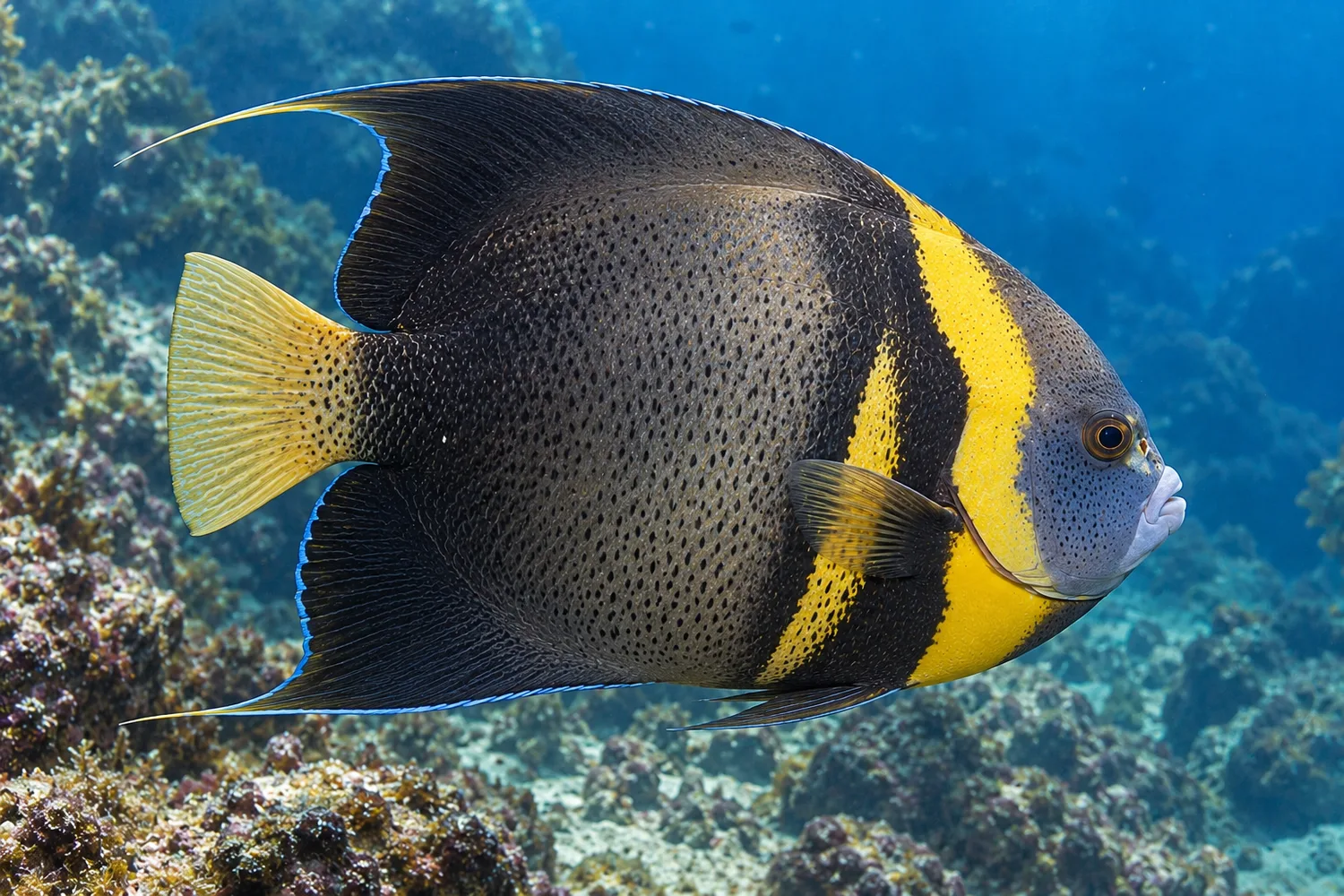
A big, gray angelfish with yellow bands, usually seen in pairs on rocky reefs. Its babies look like a different fish: black with bright yellow and blue curved bars. In Mexico it is a protected species.
Adults have a deep, flat, almost rectangular body. They are gray to gray-brown, darker toward the front, with small dark spots and faint pale arcs on the sides. Look for a broad yellow band from the nape down behind the cheek, and a narrower, black-edged yellow band just behind the pectoral fin. The rear of the body is charcoal, the tail is pale yellowish and the dorsal and anal fins have blue edges and usually end in filaments. Juveniles are black with six curved yellow bars on the head, body and tail, with narrow blue bars between them.
The Cortez angelfish lives only in the tropical eastern Pacific, from southern Baja and the Gulf of California to Peru, including the oceanic islands. It is a resident of rocky reefs from 1 to 50 m deep. Adults usually travel in pairs or small loose groups and range widely over the reef, while juveniles are solitary and defend a small territory.
Adults feed by day on the bottom, mainly on sponges, plus tunicates, algae, bryozoans, hydroids and fish eggs. Pairs appear to be monogamous. Breeding runs from midsummer to early fall, and juveniles are most common from August through November. Small juveniles work as cleaners, picking parasites off other fish.
Zonipectus comes from the Latin zona (belt) and pectus (breast), for the dark band that girdles the breast behind the pectoral and pelvic fins.
Source ↗Juvenile Cortez angelfish clean parasites from the skin of other fish, a job most people link to small wrasses and shrimp.
Source ↗Sponges are its main food. It adds tunicates, algae, bryozoans, hydroids and fish eggs.
Source ↗Adults are usually seen in pairs. FishBase describes them as monogamous, keeping a home range together rather than defending a strict territory.
Source ↗It is one of five Mexican ornamental reef fish listed under special protection (Pr). They may only be collected for aquariums in federally authorized areas under the wildlife law; in 2013 the average beach price was about 13.58 USD per fish.
Source ↗In a survey of 21 sites in western Mexico, it was found at every Gulf of California site but at only three sites on the mainland Pacific coast. Densities were highest in the northern Gulf, off Baja California.
Source ↗The Cortez angelfish is a fish for snorkelers and divers, not anglers. It lives on rocky reefs around Los Cabos, often in pairs, and the black-and-yellow juveniles hide in rocky shallows. It is not a sport fish.
It has a small mouth and eats sponges, so it is rarely hooked. If one ever comes up on a bait, unhook it gently and put it straight back: it is protected in Mexico. Sport fishing is not allowed inside Cabo Pulmo National Park.
| Mexico (NOM-059-SEMARNAT-2010) | Subject to special protection (Pr) |
|---|---|
| Aquarium collection | Only under federal wildlife authorization (Ley General de Vida Silvestre), in approved areas |
| IUCN Red List | Least Concern |
| CITES | Not listed |
| Cabo Pulmo National Park | Sport fishing not allowed |
Protected in Mexico. If one is ever hooked, release it right away.
The king angelfish (Holacanthus passer) is velvety blue-gray with a single narrow white bar on the side and a yellow tail; its juveniles are orange in front and brown behind, with thin blue bars, not the bold curved yellow bars of a young Cortez angelfish. The Cortez angelfish is bigger and gray, with yellow bands behind the head and behind the pectoral fin.
It is not a sport fish and is protected in Mexico (Pr). If one is hooked by accident, release it right away.
Juveniles are black with six curved yellow bars and thin blue bars between them. As they grow they turn gray with yellow bands. Small juveniles also clean parasites off other fish.
No. Sport fishing is not allowed in Cabo Pulmo National Park.

Top illustration: Top Anglers. Photos: iNaturalist contributors, credited on each photo.
Our charters leave the Cabo San Lucas marina every morning. From $453 with license included.