A heart that beats twice a minute
In 2019 a suction-cup tag on a blue whale in Monterey Bay recorded the first blue whale heart rate: 4 to 8 beats a minute at depth, with a low of 2, rising to 25–37 at the surface.
Source ↗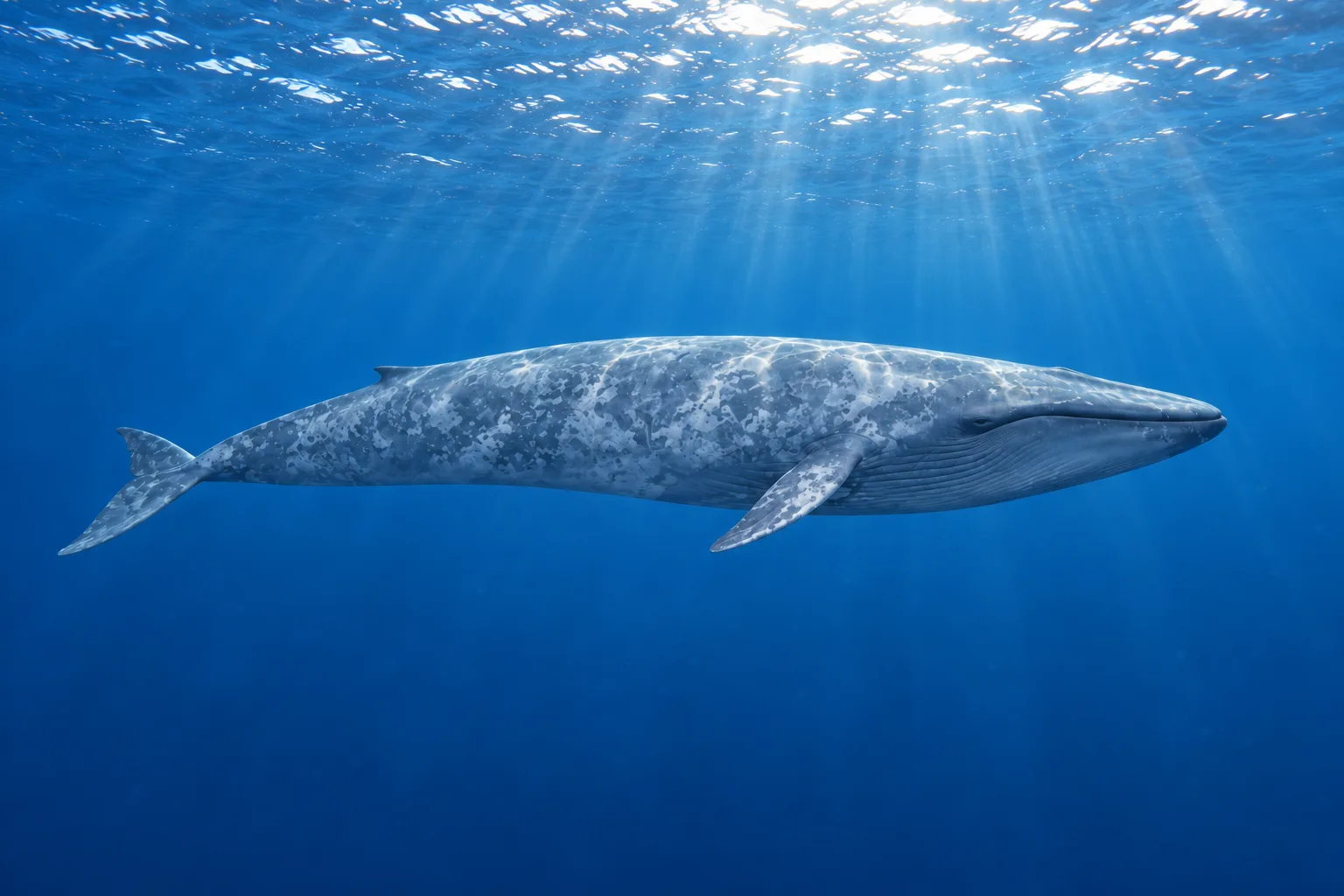
The largest animal that has ever lived spends part of every winter and spring in the waters of Baja California Sur. Off Cabo it’s an occasional, unforgettable sighting; up the Gulf, in Loreto, it’s a season.
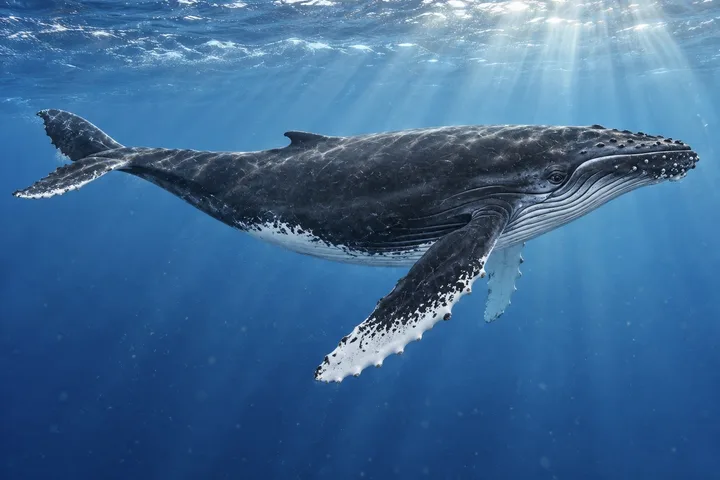
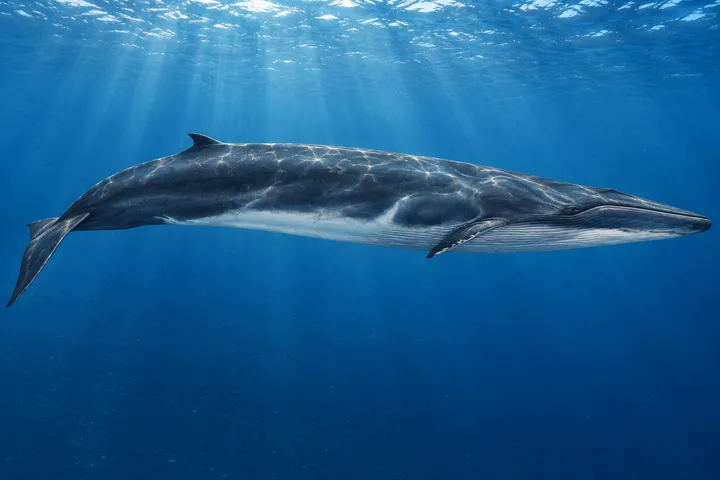
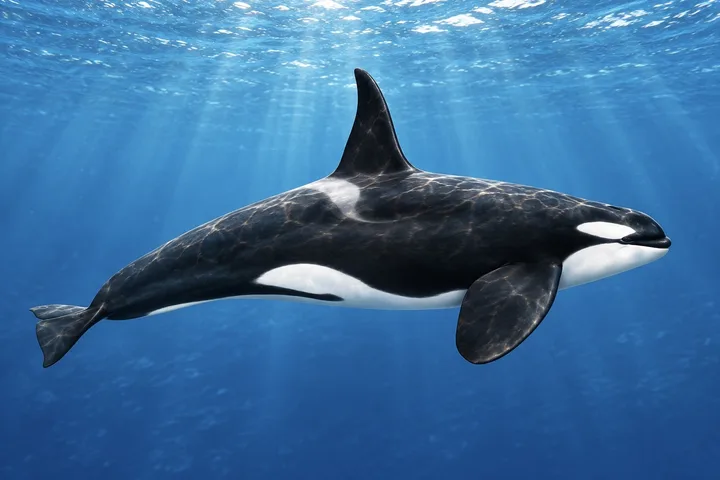
Enormous, long and slender, mottled blue-gray (light blue underwater). The head is broad and U-shaped seen from above, and the dorsal fin is tiny (about 30 cm) and set three-quarters of the way back, so it appears only at the end of a long roll of the back. The blow is a single thick column 6 to 12 m high. It usually doesn’t lift its tail, except sometimes on the last dive of a sequence.
Eastern North Pacific blue whales feed off the U.S. West Coast in summer and fall, and most migrate south for winter and spring to productive waters off Baja California, in the Gulf of California and on the Costa Rica Dome. Mexico’s whale-watching standard (NOM-131) describes an important nursery area between Bahía de La Paz and Loreto. The last mark-recapture estimate for this population was 1,647 whales (2008–2011).
It feeds almost only on krill: it swims into a swarm with its mouth open, inflates its pleated throat, then pushes the water out through its baleen, and the biggest individuals can eat up to 6 tons a day. Pregnancy lasts 10 to 12 months; the calf is born about 7 m long and weighing 2.5 to 4 tons, is weaned at 6 to 7 months, and females calve every 2 to 3 years. North Pacific blue whales reach about 27 m; the Antarctic ones are larger, and the biggest on record measured 33 m.
In 2019 a suction-cup tag on a blue whale in Monterey Bay recorded the first blue whale heart rate: 4 to 8 beats a minute at depth, with a low of 2, rising to 25–37 at the surface.
Source ↗Blue whale calls worldwide have been dropping in pitch since they were first recorded in the 1960s. Off Southern California, from 2006 to 2019, one call fell 0.32 Hz a year and the other 0.27 Hz. No current theory fully explains why.
Source ↗Photo-ID records from Loreto Bay going back to 1984 show the number of blue whales using the area fell from about 96 in 2012 to 13 in 2018 and 2019. The population as a whole is slowly growing, so the whales are probably using the Gulf less, and their numbers tracked water temperature compared with the Costa Rica Dome.
Source ↗Many blue whales from California spend the winter on the Costa Rica Dome, a patch of cold, upwelled water in the open Pacific where young calves have been seen. Of 211 blue whale sightings documented in the eastern tropical Pacific, 90% were off Baja California or around the Dome.
Source ↗Between 1993 and 2007, researchers put satellite tags on 159 blue whales off California. The whales traveled an average of 5,430 km, one track lasted 504 days, and they left their winter grounds in March–April but didn’t reach California until June.
Source ↗More than 300,000 blue whales were killed in the Southern Hemisphere alone, and another 20,000 in the North Atlantic and North Pacific. Antarctic blue whales are still below 1% of their pre-whaling numbers.
Source ↗Off Los Cabos, blue whales turn up only now and then, from about December to April: recent sighting records average roughly one encounter a year, and Gordo Banks fishing reports from 2010–2026 never mention one. Most are seen farther up the Gulf, in Loreto Bay National Park, where the season runs from about January–February to late March or early April. Off Cabo, a blue whale on an offshore trip is a lucky sighting, not something anyone can promise.
If we find one, we slow down, bring the lines in and watch from a distance: Mexican rules give blue and fin whales a bigger buffer than humpbacks or gray whales, and boats watching whales may not use sonar or a fishfinder to locate them or trail lines or hooks. A long roll of the back, then a tiny fin at the very end, is usually all you’ll see, and a thick blow that can rise over 6 m.
| Closest approach (NOM-131) | Blue and fin whales: 100 m for boats under 10 m, 120 m for larger boats; 240 m waiting distance for all other boats |
|---|---|
| Boats per whale or group | 4 at most, for 30 minutes at most |
| Speed near whales | Under 5 knots, under 2 knots inside the watching zone |
| Not allowed | Using sonar or a fishfinder to locate whales, trailing lines or hooks, fishing, swimming, feeding, chasing, getting between mother and calf |
| Mexico (NOM-059) | Subject to special protection (Pr) |
| Ley General de Vida Silvestre (art. 60 Bis) | No marine mammal may be captured or used, except for authorized conservation research |
| International status | IUCN: Endangered (2018); U.S.: listed as endangered since 1970 (under the Endangered Species Act since 1973) |
The fin whale is almost as long but slimmer and darker gray, its dorsal fin is taller and appears soon after the blow, and its lower jaw is white on the right side only. Blue whales have all-black baleen and a broad, U-shaped head.
Sometimes, between about December and April, but it’s rare and never guaranteed. Loreto Bay, farther up the Gulf, is the most reliable place in Mexico to see them.
100 m for boats under 10 m and 120 m for larger ones, more than for humpbacks or gray whales. Other boats wait 240 m away, and no more than 4 boats can watch one whale, for 30 minutes at most.
Yes. The IUCN lists them as Endangered, and the U.S. has listed them as endangered since 1970. In Mexico they’re subject to special protection. The eastern North Pacific population is slowly growing.

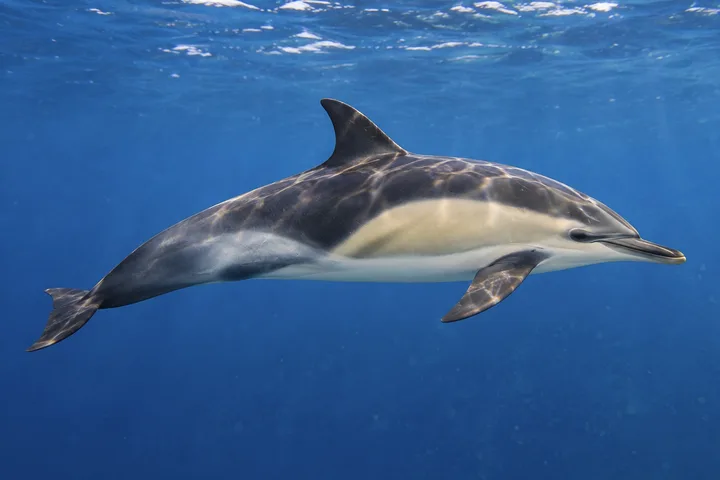
Top illustration: Top Anglers. Photos: iNaturalist contributors, credited on each photo.
Our charters leave the Cabo San Lucas marina every morning. From $799 with license included.