Cabo’s Groupers and Snappers: How to Tell Them Apart

Three groupers and three snappers make up much of the bottom catch on Cabo’s rocky reefs, and telling them apart matters: the gulf grouper, or baya, is endangered and has its own daily limit. Color shifts with size and mood, so this guide leans on the jaw, nostrils, teeth and fins that the Smithsonian and FAO guides use.

Quick key: check in this order

  1. With the mouth closed, is the rear end of the upper jawbone exposed on the cheek?Grouper. On a snapper it slides almost entirely under the bone below the eye. FAO adds that groupers have flat spines on the gill cover, and snappers have none.
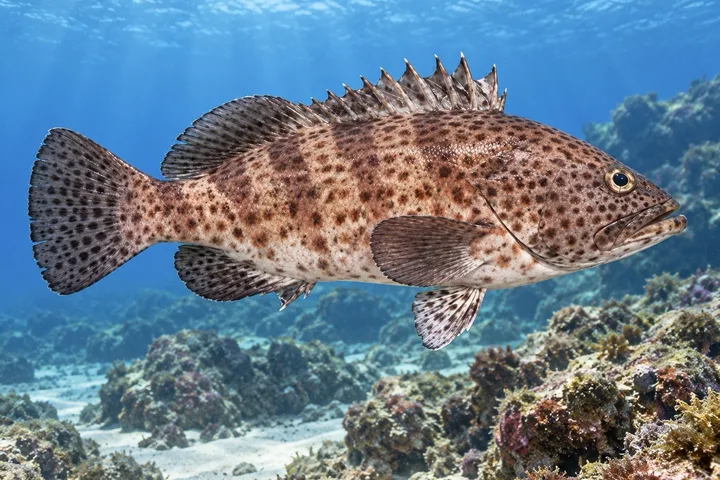
  2. Grouper with a rounded tail, red-brown spots and only 8 soft rays in the anal fin?Spotted cabrilla (cabrilla pinta). Leopard and gulf groupers have 10 or 11 anal rays and a straight to slightly concave tail.
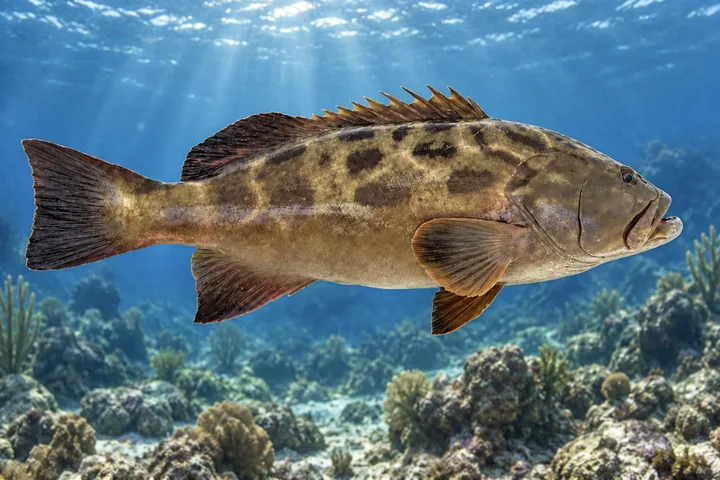
  3. Big grouper, plain dark brown or gray, with no spots?Gulf grouper (baya). Large adults have white edges on the pectoral and other fins. A disturbed fish can flash dark blotches, so a sudden pattern doesn’t rule it out.
  4. Grouper covered in small reddish-brown spots with white fin edges, or solid golden yellow?Leopard grouper (cabrilla sardinera). The golden phase is about 1% of the population.
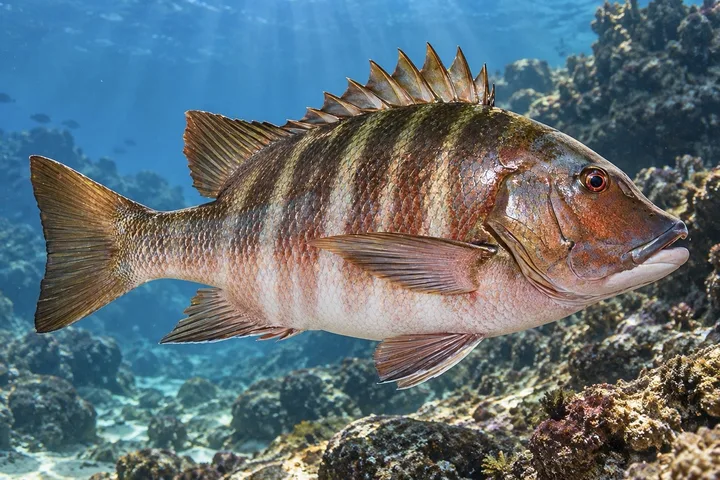
  5. Snapper with a tube-shaped front nostril, molar-like side teeth and paired bars?Barred pargo (pargo coconaco). Every Lutjanus snapper has simple, round nostrils.
  6. Rosy front and yellow-orange body, or dark copper with big canines and scale rows slanting up above the lateral line?The first is a yellow snapper (pargo amarillo), the second a Pacific dog snapper (pargo prieto). Deep red with scale rows parallel to the lateral line and pointed fins is a Colorado snapper.

Side by side

Leopard grouperSpotted cabrillaGulf grouperPacific dog snapperBarred pargoYellow snapper
FamilyGrouper (Mycteroperca)Grouper (Epinephelus)Grouper (Mycteroperca)Snapper (Lutjanus)Snapper (Hoplopagrus)Snapper (Lutjanus)
Upper jaw, mouth closedExposed on the cheekExposed on the cheekExposed on the cheekTucked under bone below eyeTucked under bone below eyeTucked under bone below eye
ColorGreenish to gray-brown, small reddish-brown spotsTan to gray, red-brown spotsAdults plain dark brown or grayOlive-brown to copper red, white belowGray to dark brown, dark-spotted headRosy front, yellow to orange body
Bars or blotchesIrregular dark saddles on upper backFour or five faint, broad barsAdults none; blotches when disturbed8–9 dusky bars, faint in big fishLong paired bars down the sidesNone
Anal fin10–11 soft rays, pointed8 soft rays10–11 soft rays, pointed in adults7–8 soft rays, white front edge9 soft rays8 soft rays
Nostrils and teethRear nostril 2–3× front in big adultsFront and rear nostrils about equalRear nostril under 2× frontSimple nostrils; four large caninesTube front nostril; molar-like side teethSimple nostrils; fang-like front teeth
Max size (Smithsonian)100 cm, 12.2 kg114 cm, 22.3 kg198 cm, 91 kg170 cm, 45 kgAbout 92 cmAbout 66 cm
Daily limit5, within 10-fish total5, within 10-fish total2; each counts as 55, within 10-fish total5, within 10-fish total5, within 10-fish total
IGFA all-tackle record28 lb 10 oz (12.98 kg)49 lb 3 oz (22.31 kg)130 lb 1 oz (59 kg)84 lb 5 oz (38.24 kg)29 lb 12 oz (13.49 kg)12 lb 0 oz (5.44 kg)

Swipe sideways on a phone to see all six.

Species by species

Leopard grouper

Leopard grouper

Mycteroperca rosacea
  • Greenish to gray-brown, densely covered in small reddish-brown spots, often with irregular dark saddles and pale streaks on the upper half
  • White margins on the fins, according to both FAO and FishBase
  • About 1% of the population is solid golden yellow, sometimes with a few dark patches
  • Anal fin with 10–11 soft rays and a pointed profile; tail edge straight in adults

Common mistake: The spotted cabrilla is spotted too, so count the anal rays: 8 on the cabrilla, 10–11 on the leopard, and the cabrilla’s tail is rounded. Small leopard groupers are pale tan with widely spaced spots, nothing like the dense adult pattern.

Spotted cabrilla

Spotted cabrilla

Epinephelus analogus
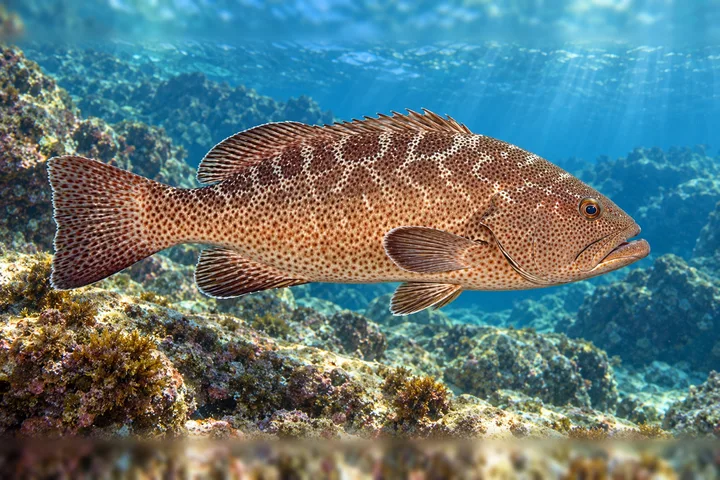
  • Tan to gray or reddish brown, covered in small red-brown spots about the size of the pupil, smaller on the head and fins
  • Four or five broad, faint dark bars on the upper half, reaching onto the dorsal fin; juveniles have bigger spots and stronger bars
  • Rounded tail and only 8 soft rays in the anal fin
  • Front and rear nostrils about the same size

Common mistake: “Cabrilla” is used for this fish and for the leopard grouper (cabrilla sardinera), so the Spanish name alone doesn’t settle it. The rounded tail and the 8 anal rays do.

Gulf grouper

Gulf grouper

Mycteroperca jordani
  • Large and heavy-bodied; adults plain dark brown or gray
  • Large adults have white-edged pectoral fins and narrow white edges on the other fins
  • Juveniles gray-brown with large, oblong dark blotches on the upper body and dark streaks radiating from the eye
  • Tail rounded in juveniles, straight to slightly concave in adults, with no projecting rays; 10–11 anal soft rays

Common mistake: FAO notes that adults switch quickly to the blotched juvenile pattern when excited or disturbed, so a blotchy fish at the boat can still be a baya. Check the nostrils: the rear one is less than twice the size of the front one, while in big leopard groupers it is two to three times larger.

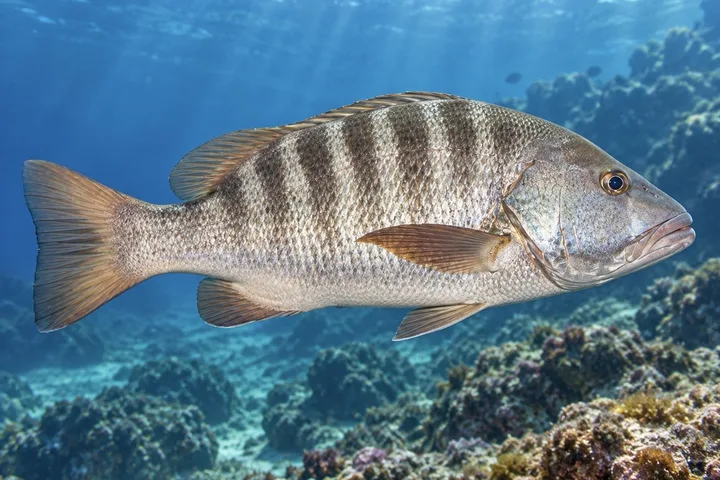
Pacific dog snapper

Pacific dog snapper

Lutjanus novemfasciatus
  • Dark olive-brown to copper red on the back and sides, silvery white below; large fish have dark fins
  • 8–9 dusky bars on the upper half that can be faint in large fish
  • Scale rows above the lateral line slant upward; in yellow and Colorado snappers and barred pargo they run parallel to it
  • Simple round nostrils and four large canines, two in each jaw

Common mistake: A Colorado snapper (pargo colorado) is also red and also has fangs. Look at the scale rows above the lateral line: slanted on the pargo prieto, parallel on the Colorado, which is mostly dark red, body and fins, with pointed soft dorsal and anal fins.

Barred pargo

Barred pargo

Hoplopagrus guentherii
  • Deep, moderately compressed body, gray to dark brown on the head and back
  • Long, paired brown bars on the sides (Smithsonian counts about 6 double bars, FAO about 8 bars) and many small dark spots on the snout and nape
  • Front nostril a long tube that points down; rear nostril in a deep groove in front of the eye
  • Molar-like teeth on the sides of the jaws and several large molars on the roof of the mouth

Common mistake: Bars alone don’t make it a barred pargo, because the pargo prieto has 8–9 of its own. Look at the snout: only the barred pargo has the tube nostril. Juveniles also show a blackish spot at the end of the dorsal fin base.

Yellow snapper

Yellow snapper

Lutjanus argentiventris
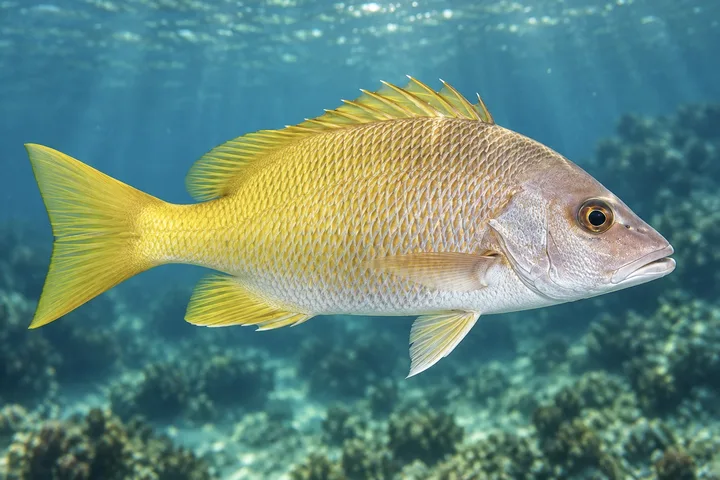
  • Rosy red at the front, turning bright yellow to orange over most of the body
  • A blue horizontal streak below the eye; the inside of the mouth is white
  • Steep forehead and somewhat pointed snout; scale rows above the lateral line run parallel to it
  • Simple nostrils, fang-like front teeth and a nearly straight tail edge

Common mistake: The blue streak isn’t unique: FAO says Colorado snappers sometimes have one, and IGFA says the same of the Pacific cubera snapper. FAO also describes yellow snappers with olive-green backs and bright red bellies, possibly spawning fish, so go by the yellow-orange rear half and the parallel scale rows.

Tips for identifying them

Start with the head, not the color. FAO notes that many groupers can change color quickly and some have a golden phase, and the gulf grouper switches to its blotched juvenile pattern when disturbed. Snappers change with size too: the pargo prieto’s bars fade in big fish, and young Colorado snappers can show bars. The jawbone, nostrils, teeth and the anal-fin ray count don’t change with mood, so check those first.

Make the call before anything goes in the fish box. Mexico’s NOM-017-PESC-1994 allows 10 fish per angler per day, no more than 5 of one species, but the baya is capped at 2 and each one counts as 5. It is also listed as endangered under the U.S. Endangered Species Act, which makes importing any part of one into the United States illegal. NOAA says it fell from about 45% of the Gulf of California’s small-boat catch in 1960 to under 1% today. Top Anglers encourages releasing every gulf grouper.

For a record claim or a tournament, photograph whatever decides the ID: the head side-on with the mouth closed so the jawbone shows, a close-up of the nostrils, and the anal fin spread wide enough to count the rays. On a snapper, add a shot of the scale rows above the lateral line. With those in the file, a judge can confirm the species long after the fish is gone.

Questions

Are cabrillas groupers?

Yes. The cabrilla sardinera (leopard grouper) and the cabrilla pinta (spotted cabrilla) are both groupers in the family Serranidae, in different genera: Mycteroperca and Epinephelus.

How many gulf groupers can I keep in Mexico?

Mexican law allows 2 per angler per day, and each counts as 5 of the 10-fish daily total. The species is endangered and can’t be imported into the U.S., so Top Anglers encourages releasing it.

Is the pargo prieto the same as the Pacific cubera snapper?

Yes. IGFA lists Lutjanus novemfasciatus as the Pacific cubera snapper, the Smithsonian guide calls it the Pacific dog snapper, and FAO’s Spanish name is pargo negro. The all-tackle record, 84 lb 5 oz, was caught off Puerto Vallarta in January 2026.

Is it true that snappers have canines and groupers don’t?

No. Snappers do have distinct canines, but the Smithsonian guide also lists canines at the front of the jaws of leopard and gulf groupers. Use the upper jawbone instead: exposed on a grouper’s cheek when the mouth is closed, tucked under the bone below the eye on a snapper.

By Max VargasTop Anglers, Cabo San Lucas · international judge at big game fishing world championships · reviewed October 2026

Sources

Fish for them with us →

Talk to the family

Questions? Message the family

The Vargas family answers personally. 7 days a week, 5 AM – 6 PM Cabo time.